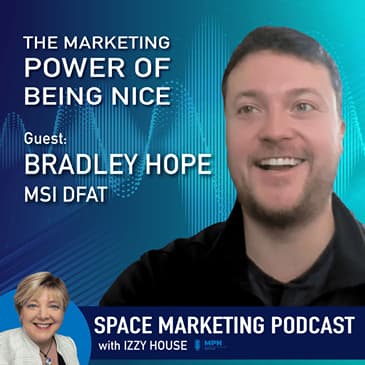
On this episode of the Space Marketing Podcast, we dive into one of the most simple yet incredibly powerful marketing strategies that often gets overlooked—being nice. Izzy chats with her guest - Bradley Hope, U.S. Area Sales Manager for MSI-DFAT.
Kindness might not sound like a groundbreaking strategy, but in the world of marketing, it can be a game-changer. Being nice isn’t just about good manners—it’s about building trust, creating connections, and leaving a lasting impression that money simply can’t buy.
Chapters:
01:29 Meet Bradley Hope
04:48 About MSI DFAT - Acoustic Testing
10:46 Power of being nice
13:01 Tactics of being nice
15:46 Golden Rule to make a connection
19:30 Challenges of being nice
20:56 Ways to be nice that cost nothing
23:29 Future of the space industry
28:13 Emotional Intelligence
32:58 Final Thoughts
Book references:
Disciplined Entrepreneurship: 24 Steps to a Successful Startup by Bill Aulet
Influence by Dr. Cialdini
MSI DFAT - Maryland Sound International - Direct Field Acoustic Testing
Orion images provided by MSI DFAT
ABOUT IZZY
Izzy's website - https://izzy.house
Author of Space Marketing: Competing in the new commercial space industry AND Space Marketing: Spaceports on Amazon and Audible - https://bit.ly/Space-Marketing
Podcast host for Space Marketing Podcast - https://spacemarketingpodcast.com
Organizer for Space for Kentucky Roundtable - https://spaceforkentucky.com
Hosted by Simplecast, an AdsWizz company. See pcm.adswizz.com for information about our collection and use of personal data for advertising.
[00:00:00] Brauchen wir wirklich noch einen Computer? Alle wahrscheinlich nicht. Aber wenn du Musik mit der Power eines Neuralprozessors neu erfindest oder unterwegs Migrationsmuster mit einem ganztägigen Akku analysierst oder deine Ideen mit dem KI-gesteuerten Co-Creator zum Leben erwächst, dann kann ein Co-Pilot Plus PC einen Unterschied machen. Nicht alle brauchen einen leistungsstärkeren KI-Computer. Aber wenn du versuchst, die Welt zu verändern, auch wenn es nur deine eigene ist, haben wir einen für dich entwickelt. Microsoft Co-Pilot Plus PC mit Snapdragon. Die bisher schnellsten und intelligentesten Windows-PCs. Die Akkulaufzeit variiert hier nach Nutzung und Einstellungen.
[00:00:30] Badewanne, Podcast und Herbst? Das wird nur getoppt von Alturs Reisen und Günstig. Denn auch wenn dein Schaumbad zum Träumen von sonnigen Breitengraden einlädt, echte Südsonne bleibt unschlagbar. Und Alturs hat einfach die besten Ziele für dich. Ägypten, Kanaren, Griechenland, Türkei, Karibik. Nicht träumen, Alturs buchen. Alles drin, alles gut, alles für dich. Alturs. Alles aber günstig. Jetzt im Reisebüro oder auf alturs.de.
[00:00:58] Welcome to the Space Marketing Podcast, where we look at marketing principles, strategies, and tactics through the lens of space.
[00:01:07] Today's episode is sponsored by the University of Alabama Huntsville's The Business of Space Conference in February 23rd through the 25th.
[00:01:18] Hi, I am your host, Izzy House. Today we're diving into the most simple yet incredibly powerful marketing strategies that often gets overlooked.
[00:01:30] Being nice.
[00:01:33] Bradley Hope, U.S. Area Sales Manager from MSDFAT and I will talk about this unique and overlooked strategy.
[00:01:42] So lift off in 3, 2, 1.
[00:01:57] Welcome to the Space Marketing Podcast.
[00:02:00] Information relating to our discussion today and links to the video version can be found in the episode show notes on spacemarketingpodcast.com.
[00:02:11] Please like and subscribe to the podcast.
[00:02:14] It will help more people reach beyond the atmosphere.
[00:02:18] Information in this episode is for entertainment and information only.
[00:02:24] Please consult a professional for your specific situation.
[00:02:28] Today we're diving into a topic that costs nothing but pays off in spades.
[00:02:35] The value of being nice in business.
[00:02:39] Kindness might not sound like a groundbreaking strategy, but in the world of marketing, it can be a game changer.
[00:02:46] Being nice isn't just about good manners.
[00:02:50] It's about building trust, creating connections, and leaving a lasting impression that money simply cannot buy.
[00:03:00] But how does this translate into real world results?
[00:03:04] And how can businesses, especially those on a tight budget, leverage kindness to grow and thrive?
[00:03:13] So let me introduce our guest today, Bradley Hope, U.S. Area Sales Manager from MSI DFAT.
[00:03:21] And we're going to dig a little deeper into these questions and more.
[00:03:26] So welcome to the podcast, Bradley.
[00:03:29] Thanks so much, Izzy.
[00:03:30] It's a real pleasure and thanks for having me on.
[00:03:33] Well, and I have been known for saying that marketing is like a diamond.
[00:03:38] You have all these different facets.
[00:03:41] You have education.
[00:03:42] You have branding.
[00:03:44] You have one of those facets is sales.
[00:03:47] This is the human touch that is marketing.
[00:03:52] This is where the relationships happen.
[00:03:55] So why don't you tell us a little bit about what you do?
[00:03:59] Yeah, absolutely.
[00:04:00] Great question.
[00:04:00] My name is Bradley, and I've been selling ever since I probably got my first job at a pizza place when I was still in high school.
[00:04:09] I work below minimum wage, and ever since then, I've been working my way up in the world.
[00:04:13] So, yeah, I got my first sales job when I was still in college, and I was selling all sorts of parts into aerospace companies.
[00:04:24] And being located in the Detroit area, for some reason, I never worked in the auto industry.
[00:04:30] I've always kind of been focused on the aerospace and defense industry.
[00:04:35] So after working business sales for several years, I paid my way through college.
[00:04:41] My employer paid through my master's degree, and I've been able to niche down over time, just continuing to develop relationships and work in now the space industry.
[00:04:52] I had a great opportunity right after I graduated working for a Fortune 100 company, giant company selling all sorts of software and hardware solutions across CAD and PLM and simulation and test solutions.
[00:05:06] And I got to get a really good look behind the scenes of a lot of these companies and start to develop a special focus on new space companies also.
[00:05:16] So I've been really blessed and fortunate to have an interesting career path so far.
[00:05:22] You know, this is one of the things.
[00:05:24] I think sales gets a bad rap because there's a few bad actors out there, and that's what people remember.
[00:05:30] But sales really, you're problem solvers for your clients.
[00:05:35] You know, this is the important thing about sales.
[00:05:37] We wouldn't be able to do anything without a sales team that understood their product and had a heart to help people solve their problems.
[00:05:46] You want to tell us a little bit about where you work and what it is that your company does?
[00:05:54] Absolutely.
[00:05:54] And I'll just back up real quick.
[00:05:56] I think you made a really interesting point.
[00:05:57] There's a great book called 24 Steps to Disciplined Entrepreneurship.
[00:06:03] It's by Bob Ouellette.
[00:06:04] He teaches out of MIT.
[00:06:06] And his formula, his secret formula is innovation, which is sort of a buzzword these days, is an equation.
[00:06:14] And the equation is it's an invention.
[00:06:17] So somebody invents something, some piece of technology or a way of doing something.
[00:06:21] And then you have to go commercialize it.
[00:06:22] And that's where the sales and marketing really comes in.
[00:06:25] So if either side of that equation doesn't work, the product is zero and you don't have a business.
[00:06:29] So all businesses, like you said, finding some way to help somebody and delivering value.
[00:06:37] And then you get the option of that value.
[00:06:39] Yeah.
[00:06:39] Yeah, that's where market fit is really important.
[00:06:42] And this is one of the little horns that I toot is that getting somebody that has marketing, that's a good marketer in on the product development is very important too.
[00:06:52] Because they understand the audience.
[00:06:55] They understand the problems.
[00:06:56] And so you really want that expertise when you're creating the product to begin with.
[00:07:02] Yes.
[00:07:02] Tell us about your company.
[00:07:04] Absolutely.
[00:07:04] So I do sales and marketing and business development at a company called MSI DFAT.
[00:07:09] So MSI is Maryland Sound International.
[00:07:12] And DFAT is an acronym.
[00:07:14] It stands for Direct Field Acoustic Test.
[00:07:16] So way back in the 70s, they started this company as a live sound production and execution company.
[00:07:24] So you can imagine a team of roadies, right?
[00:07:29] These audio engineers going all around the country and setting up and running live sound at concerts and events like they did Pink Floyd.
[00:07:37] Frankie Valli was a great client of Bob Goldstein, the founder and owner of the company.
[00:07:42] So they started to develop this core competency around all the complex logistics as well as the really high pressure environment of setting up and running the live sound event.
[00:07:54] And then in 1999, the company was approached by the space industry to recreate the sound of a rocket launch using their loudspeakers.
[00:08:04] So they started out with these concert loudspeakers, but blew up millions of dollars worth of that equipment until they realized they needed to kind of innovate and make their own form of noise generation systems to really recreate a precise sound field to simulate a rocket launch.
[00:08:21] And so the company goes around the country just like they did for the concerts, but for the space industry.
[00:08:27] And we'll go to wherever a spacecraft is located, typically at the site where it's manufactured.
[00:08:32] There's a process called assembly integration and test in any spacecraft manufacturing company or a company making a satellite.
[00:08:40] They'll send that satellite through its assembly process being integrated and then finally tested and qualified prior to being launched.
[00:08:47] So there's a bunch of different environments that they recreate to make sure that this thing will stand up against the launch environment as well as surviving in space throughout its entire mission.
[00:08:58] So there's one specific test called an acoustic test or a vibroacoustic test.
[00:09:03] And their traditional way of doing this was using big, fancy, state-of-the-art reverberant chambers.
[00:09:10] So if you go to NASA Goddard, for example, or Boeing Outwest or Lockheed Outwest, they've invested into these massive rooms and they're very echoey.
[00:09:20] And they can create this really crazy, intense sound field that recreates the launch.
[00:09:26] But the problem for the customer is they might be manufacturing on the other side of the country and then they have to ship this spacecraft to the other side of the country.
[00:09:35] And if you think about that, there's a lot of risk and there's a lot of expense in that.
[00:09:40] Not only is it risky to send the spacecraft across the country because it's a delicate object and you're only making one of them, but also there's a huge cost to insuring that test article.
[00:09:51] And there's a lot of downtime as well because it's gone for weeks or months at a time.
[00:09:56] The way that we created this portable test is we'll go on site and meet a customer right where they're located and we'll run that test in just one day of downtime typically.
[00:10:04] So it saves our customers just a ton of time and a ton of money and you get the exact same results.
[00:10:08] So that's what I do.
[00:10:10] I try to get the word out about MSI DFAT because, like you said, we're a small company.
[00:10:15] We're a very niche company and we just do kind of one thing on this side of the business.
[00:10:19] But it's really interesting to do.
[00:10:22] So I love what we do.
[00:10:24] And that's not the only industry, though.
[00:10:27] You do have other industries you work with, correct?
[00:10:30] Yeah, there are adjacent markets.
[00:10:32] So the primary market for us is spacecraft.
[00:10:35] And that's about 95% of our business.
[00:10:38] The other 5% tends to be applications that are very similar.
[00:10:42] So we'll do anything from small components to full assemblies of satellites, space telescopes, lunar landers, rovers, space stations.
[00:10:53] So this is a scalable test setup because of the speakers.
[00:10:55] So we could test anything from the size of a microwave to well over the size of a school bus just by stacking up more speakers or spreading out the diameter of the speaker's arrangement.
[00:11:04] We also tap into other markets as well.
[00:11:07] So defense has been something that's gaining interest as well as hypersonic aircraft and even high-speed rail.
[00:11:16] If you think about Maglev, I believe, is a project going on in Baltimore that's been kicked around for many years.
[00:11:23] You have passengers inside of a plane or a train, and they experience some really high, intense sound environments that have to get mitigated and attenuated.
[00:11:35] So, yeah, there's definitely other applications out there that we run across from time to time, and they're always interesting to poke around and work on.
[00:11:44] Well, when we were discussing what we were going to talk about today, you said something about being nice.
[00:11:51] And it seems so obvious, but it's really hard for a lot of people to do.
[00:11:58] And so let's discuss what it is that you mean when we talk about being nice and being in business.
[00:12:05] Yeah, I think there's sometimes some kind of a trade-off that people make maybe accidentally or unintentionally where you turn into being a jerk.
[00:12:14] Maybe it's stress.
[00:12:15] I'm not really sure, but I think there's a lot of power in simply being nice.
[00:12:20] And, I mean, you can still have boundaries in business and be assertive, but definitely you create a little bit of a flywheel just by being nice.
[00:12:27] So at MSI, one of my core challenges is how do I scale and get new business in an economical way?
[00:12:36] Because we're not a huge company with an unlimited marketing budget, right?
[00:12:40] So a lot of what I have to do is based on relationships.
[00:12:43] And I'd say if I wasn't nice or if other people weren't nice, I wouldn't have half of the success.
[00:12:51] So I don't think it takes a whole lot to maybe ruin your reputation or ruin a piece of business by being mean.
[00:12:59] You can lose that.
[00:13:00] Yeah, one bad day.
[00:13:01] Right.
[00:13:02] Yeah.
[00:13:02] I mean, you've got everything going wrong that day and you just kind of snap out at the wrong person.
[00:13:09] And that could be a million-dollar client.
[00:13:12] Yeah, absolutely.
[00:13:13] But I've never had a bad experience or a bad opportunity come by being nice.
[00:13:18] There's a lot of random coincidences that happen and people tend to open the right doors for you and introduce you to other people.
[00:13:26] And you create this flywheel over time where people, like you said, they start to trust you over time.
[00:13:31] And that's really one of the main goals that we try to do here at MSI DFAT is really be a trusted partner for our clients.
[00:13:40] Like you said, we're not trying to be a snake oil salesman or anything like that.
[00:13:45] And our customers, they come to us again and again on these mission-critical tests.
[00:13:49] So once one customer trusts us and we are kind of well-known, a lot of the marketing starts to be word of mouth and referral-based even.
[00:13:57] And they wouldn't do that unless they really liked you.
[00:14:00] Exactly.
[00:14:01] And so let's talk about some of the tactics on being nice because I think people struggle with this more than we might assume.
[00:14:09] So, for example, smiling.
[00:14:12] There's a real smile shortage out there.
[00:14:15] I was talking to my husband about it that people just go around and they just don't smile anymore.
[00:14:21] They're looking at their phones and it's just not an automatic.
[00:14:26] So there's different kinds of smiles.
[00:14:28] There's, you know, just turning up the corners of your mouth.
[00:14:32] But there's also smiling with your whole face and your eyes.
[00:14:36] And just being that warm, genuine smile can make a huge difference.
[00:14:43] Absolutely.
[00:14:44] And what are some other things that you find that is just being nice?
[00:14:50] I think just being a human day to day.
[00:14:53] I mean, at the end of the day, everybody in the entire industry, in the space industry, whether you're, you know, the janitor working at some factory floor or the CEO running, you know, the hottest, latest company.
[00:15:05] Everybody puts their pants on in the morning, right?
[00:15:08] Everybody drinks their morning coffee.
[00:15:10] Unless you don't drink coffee for some reason.
[00:15:12] Tea, you know.
[00:15:13] Yeah.
[00:15:13] Some people might like tea.
[00:15:15] But, yeah, so just being a human, right?
[00:15:19] You don't want to be a corporate shell of a person that is lacking emotion.
[00:15:24] I mean, everybody at the end of the day, we all have emotions and feelings and we're all looking for a human connection.
[00:15:30] Technology is a great enabler.
[00:15:31] But I think especially over the last five years, ever since the lockdowns happened, a lot of people have been feeling isolated or even uncertain with all the strange fluctuations happening and all the disruptions happening and how we work and how we go about doing our business and how we go about doing life.
[00:15:48] So I think people are really seeking for connection and community and being nice and friendly just goes a little bit of the extra way to show that, you know, you're a human and you're able to help other people.
[00:16:02] Hold on to your boosters.
[00:16:05] We will be right back with Bradley Hope from MSI DFAT after a brief message from our sponsors.
[00:16:13] Please like and subscribe to the Space Marketing Podcast so you don't miss a thing.
[00:16:19] Today's episode is sponsored by the University of Alabama Huntsville, the Business of Space Conference in February 23rd through the 25th.
[00:16:44] And there's a golden rule out there that's treat people like you want to be treated.
[00:16:49] And that goes pretty far.
[00:16:52] So if you find yourself, you know, getting down in the weeds and not really communicating, you know, think about maybe how that may come off.
[00:17:02] So, for example, this is a big one.
[00:17:05] Returning emails or returning calls or messages.
[00:17:08] Just letting that customer or client know that you're thinking about them.
[00:17:14] Can make a huge thing.
[00:17:17] Even if they don't, they're not waiting for you.
[00:17:19] If you just say, hey, you know, found this piece of news today and thought you might be interested.
[00:17:25] Just for no reason.
[00:17:27] You know, just making that connection and being nice.
[00:17:30] Giving them something of value that may not be anything that costs anything.
[00:17:35] Just might be something in the news that day.
[00:17:39] Absolutely.
[00:17:40] There's three kinds of people, right, in the world.
[00:17:43] There's givers, there's reciprocators, and there's takers.
[00:17:47] And so you don't want to be a taker.
[00:17:49] You probably don't want to be just a reciprocator.
[00:17:52] And you do want to be a giver.
[00:17:53] But there's not a lot of givers in the world.
[00:17:55] So anytime that you can go that extra step just to touch base with somebody and, you know, be present in their life or show them that you're not just trying to sell them something.
[00:18:08] You know, you're trying to help them in many other ways.
[00:18:10] I had customers where they were struggling with financing, and I don't even work for the company.
[00:18:15] I'm not part of their investor relations team or anything like that.
[00:18:18] I'm not fundraising for them.
[00:18:19] But I've connected them with investors or, you know, connected them with their customer or, you know, found some way to help them with their business besides just selling them something.
[00:18:31] I think a lot of salespeople get a bad rap because they're so transactional and all they're doing is trying to get money out of your pocket rather than truly trying to help another person.
[00:18:41] We don't remember the ones that are being helpful as much as we remember the ones that we have to put our guard against because that's just a survivor mechanism that we have in our body.
[00:18:51] When you have a salesperson that's coming off as disingenuous, then your shields go up and you become aware because all of a sudden it's kind of like a threat.
[00:19:03] But when you have a friend that's helping you, you don't think of that person as a salesperson.
[00:19:08] You think of that person as a partner in the problem-solving problem.
[00:19:15] Absolutely.
[00:19:16] Yeah, that makes perfect sense.
[00:19:18] So one of my favorite authors is Robert Cialdini and he has a book called Influence.
[00:19:26] And in there it talks about reciprocity and basically being nice and kind and how our civilization is built on that and how, you know, when we're kind to somebody that that person usually feels the need to reciprocate.
[00:19:43] So, you know, it just builds a very good relationship over time that is beneficial to both sides.
[00:19:51] Absolutely.
[00:19:51] Yeah, that's a phenomenal book.
[00:19:53] I recommend everybody reads it.
[00:19:55] He has a little bit of a case in point.
[00:19:57] There's an anecdote in the book where he talks about a waitress who gives little candies out to each of her customers when she's serving tables and it results in a bigger tip.
[00:20:09] So people go out of their way because you did something for them to do something in return.
[00:20:14] Even if it doesn't seem like that big of a deal.
[00:20:17] And, you know, just if you just are always just wanting to let people know that they matter, it will go pretty far.
[00:20:26] Absolutely.
[00:20:28] Now, there's some challenges in being nice.
[00:20:31] Believe it or not, there are some.
[00:20:34] And sometimes it may come off as flirty and which you don't want to do.
[00:20:41] You don't want to give those wrong messages out.
[00:20:44] Or it may come across as weak to somebody that thinks that business has to be mean and tough.
[00:20:51] And so are there any other challenges that you may have recommendations about how to circumvent or how to mitigate?
[00:21:02] Yeah, I think, you know, if you're overly nice in business and sales, right, if you have control over the price that you set, then you might be so nice that you give a huge discount.
[00:21:15] But then you're giving away a lot of your value.
[00:21:17] So you want to have you want to really know your customer and know the market, know the price points that you can support and then have a good strategy around your price point.
[00:21:28] But you want to be assertive enough that you're not giving away, you know, all of your value at the same time.
[00:21:36] So you don't want to get taken advantage of by being too nice.
[00:21:40] And yeah, definitely you don't want to come across the wrong way to to a customer or let them walk all over you.
[00:21:46] So it's a balancing act, right?
[00:21:48] That will take a little bit of learning over time.
[00:21:55] And let's go let's dig a little bit into, you know, being nice and showing it through price.
[00:22:01] That's not the only way you can be nice.
[00:22:02] And the danger with that is that when you when you take that money off of that product, then it also lessens the quality of that product in that customer's mind.
[00:22:15] So you hurt the product when you when you use that as your tactic for being nice.
[00:22:22] So there's there's other ways to be nice that may not cost money.
[00:22:26] So, you know, let's let's let's dive into a little bit of those is, you know, what would be some some examples of nice that cost nothing?
[00:22:37] With the marketing strategy here at MSI DFAT, we have a very limited marketing resource.
[00:22:44] Right.
[00:22:44] So we're not one of these giant companies with millions and millions of marketing budget that we can spend.
[00:22:49] So every dollar that I spend on the marketing side, I'm always very concerned about the returns on marketing investment.
[00:22:55] And how can I maximize my spend for what I where I'm trying to to get to?
[00:23:00] And so one of my favorite tactics this past year has been doing something I've never done before, which is a little bit of this podcast tour.
[00:23:08] So even the example of, you know, you coming and inviting me on the podcast, who knows where it will lead?
[00:23:15] Just a conversation that we're having here on mine.
[00:23:18] But it doesn't cost anything other than, you know, 45 minutes of our time or so.
[00:23:23] And, you know, the the downside is very limited.
[00:23:28] And the upside is, you know, potentially massive.
[00:23:30] What if there's, you know, one person listening to to this podcast who got interested in either you or me or something about the industry or one of our products or services?
[00:23:41] And then you have a new client coming again.
[00:23:44] So, yeah, you just never know where something will lead.
[00:23:46] So you have your time that you can give and your sweat equity rather than just giving, you know, you know, paying for things on the marketing side, too.
[00:23:55] And smiles are free.
[00:23:57] Yeah. Smiles are free.
[00:23:58] I remember one time when I went to buy a car while I was still in high school and the salesperson shipped some cookies to my house.
[00:24:07] Wow.
[00:24:08] And I mean, that costs a little bit of money, but it made me feel great after. Right.
[00:24:11] So like I'd send my friends and family to that person.
[00:24:14] Definitely.
[00:24:14] So, yeah, there's the little extra step that you take shows that, you know, you actually care about somebody and you value them.
[00:24:22] That they're more than just a transaction.
[00:24:25] Absolutely.
[00:24:27] So let's go back into space for a minute and let's talk about, you know, where do you see the industry in space for the next 10 to 20 years?
[00:24:37] I like to ask that question because everybody has a little bit of a different take.
[00:24:41] And here lately, that perception has really changed with the election that we just had.
[00:24:48] So I think that's going to be a positive towards the progression of space.
[00:24:55] Absolutely.
[00:24:56] My crystal ball is broken.
[00:24:58] But if I had to look into my crystal ball, I'd say I think ever since Elon Musk and SpaceX, there's this wave of new space companies that disrupted all the incumbent way of the industry.
[00:25:12] So all those competitive advantages have basically eroded.
[00:25:16] And if you need any case in point, I was at a trade show like two months ago and there was a young guy there who really he didn't even go to college and he was building a rocket.
[00:25:28] So I don't know what that tells you.
[00:25:31] But so I think there's no more barrier to entry into space anymore in terms of the overall trends.
[00:25:39] I think space tourism is probably something over the next 20 years that will continue to grow in popularity and hopefully accessibility so that more and more people can, you know, go hitch a ride up to the lower atmosphere.
[00:25:56] I think we're working on the Artemis program.
[00:26:00] Our company does acoustic testing on the crew service module and the crew module that the astronauts go to the moon in.
[00:26:09] And so I'm hoping that our government continues to fund and spend into Artemis and manned missions.
[00:26:15] That's very important.
[00:26:16] I think we learn a lot every time we go to the moon and hopefully beyond the moon, the moon to Mars.
[00:26:23] I'm cautiously optimistic that we'll be able to get to Mars.
[00:26:27] Mars.
[00:26:27] I'm not sure if that will happen in my lifetime, but I'm hoping that it will.
[00:26:34] Well, we have some people that are working on it.
[00:26:38] They're working on it.
[00:26:39] So for sure.
[00:26:41] Yeah.
[00:26:41] And then in terms of a return on investment, I think the most immediate and applicable business is really on these constellations of satellites.
[00:26:52] There's just so many of them.
[00:26:55] And even if you just take, you know, something like Kuiper or Starlink, for example, it's really providing a lot of utility for people all over the world.
[00:27:03] And increasing connectivity, increasing accessibility.
[00:27:09] These satellite constellations can provide Internet, you know, to the middle of nowhere where you couldn't get Internet access before.
[00:27:17] And I think that's an amazing thing because you might have some brilliant young kid like the guy I mentioned at the trade show who never went to college building a rocket, but nobody would ever hear about him.
[00:27:27] And maybe he would have no ability to go onto the Internet and go tap into learning resources.
[00:27:34] But now people can do that.
[00:27:37] So I'm hoping that connectivity and accessibility continues to increase over time.
[00:27:43] And then I think there's going to be a lot of continued disruption.
[00:27:46] Obviously, the Department of Government Efficiency is a new thing.
[00:27:50] You have a lot of strange things that I never thought would have come about, like targeting the F-35 program with Elon saying a lot of things about how it's kind of a jack of all trades, a master of none and very expensive.
[00:28:06] And there's better technologies like drones that can take place of conventional systems.
[00:28:12] So and that's more on the aerospace side.
[00:28:15] So I'm sure he sees all sorts of things to go after, you know, within space.
[00:28:19] I think the next four years are going to be pretty interesting.
[00:28:22] I think it's going to be a mixed bag.
[00:28:26] There's going to be some that's going to be really positive.
[00:28:29] There's going to be some that's not so good.
[00:28:32] And there's just going to be just a lot of change.
[00:28:35] And that's going to be hard for just regular people.
[00:28:39] So, you know, it's absolutely.
[00:28:41] I mean, imagine if you're at NASA and the funding gets cut and you're a super smart rocket scientist and you spent your life's work and now you're redirected to some other career opportunity.
[00:28:53] It's going to.
[00:28:53] And I think that's where the power of being nice comes into, because I think we have more change coming in the world than ever before at a faster rate than ever before.
[00:29:02] And so people have to be extremely adaptable and willing to work with each other to help out however we can going forward over the next few years.
[00:29:11] I'd like to go into that real quick.
[00:29:14] What you said is that being nice is is also important in your working day.
[00:29:21] So, you know, we choose to keep around those people that are nice.
[00:29:25] You may not be the smartest person in the room, but the smartest person in the room may be a jerk that nobody wants to be around.
[00:29:32] And we're willing to go for good and nice because we spend a good part of our day with the people that we work with.
[00:29:43] Nice goes a long way.
[00:29:44] And it may be the determining factor on whether or not somebody gets shipped off to a different department or gets to stay.
[00:29:52] Yeah.
[00:29:53] One company that I loved working for was Zeman's Digital Industry Software.
[00:29:58] And I was there for a little over five years.
[00:30:01] But they have this famous decentralized structure where you'll be working in a cross-functional team where the people don't directly report to you.
[00:30:10] And I had a role there as an orchestrator is what they called it internally.
[00:30:16] And I would have to get people who were technical experts in some subject to work with me on a customer's program or project.
[00:30:25] But they didn't directly report to me.
[00:30:28] So and they had other projects that they're working on that might even be more important projects and more valuable for their time.
[00:30:33] So, yeah, definitely like you have to find a way to get people to like you and work with you.
[00:30:41] And being nice is definitely a big part of that.
[00:30:43] And I know there's definitely I don't want to name names, but there's definitely people I've come across in my career who are super smart, super bright people at, you know, one thing.
[00:30:54] You know, there's T-shaped knowledge.
[00:30:56] Maybe they have not so much broad knowledge, but very deep knowledge on a particular subject.
[00:31:00] And so they kind of can get a heightened sense of self-esteem.
[00:31:04] And that makes them a little bit of a jerk on certain ways of working with them.
[00:31:10] A Sheldon.
[00:31:12] Yeah.
[00:31:12] Right.
[00:31:14] Yeah.
[00:31:15] So, I mean, definitely people will definitely come across you in your career.
[00:31:21] And it takes a lot of EQ, a lot of emotional intelligence.
[00:31:25] And it's not just IQ, it's EQ that matters in business.
[00:31:31] I know the biggest challenge that I had was slowing down enough to to really listen to my my office mates, you know, because I get very focused in work.
[00:31:43] And, you know, I love what I do.
[00:31:46] And I just get deep into it.
[00:31:48] And sometimes the world falls away.
[00:31:49] Well, sometimes it's a conscious choice to make sure that you come back to the world and engage.
[00:31:58] And that may be easier said than done.
[00:32:01] It's been one of the things that I have worked on all my whole life and I will continue to work on.
[00:32:07] Yeah, absolutely.
[00:32:37] Absolutely.
[00:32:38] So, we pulled into a McDonald's on this, like, back off country road in the middle of nowhere.
[00:32:45] And we were sheltering in there trying to figure out what to do.
[00:32:48] And a random couple of people came up to us and they're like, hey, you know, there's this crazy weather going on.
[00:32:56] But we have we operate this youth shelter about a half block down the road.
[00:33:02] So, they take in teenagers who struggle with, like, criminal problems or drug problems or maybe they have autism or some disability.
[00:33:14] And for some reason, they're not functioning at the best way in society.
[00:33:19] And so, they'll take them in and give them a place to stay and give them food and help them get a job and stuff like that.
[00:33:25] So, she opened up the facility to me and my wife to stay the night and gave us all this food and a place to stay.
[00:33:34] And they didn't have to do that.
[00:33:36] It was an awesome experience.
[00:33:37] So, when we told our families about that, they ended up giving a pretty big donation over to that shelter.
[00:33:43] So, you know, there's definitely power in being nice, not just in, you know, what you're doing for your job.
[00:33:51] But it could be a random event like you're driving through a blizzard and you don't expect that to happen.
[00:33:57] Absolutely.
[00:33:58] Absolutely.
[00:33:59] Okay.
[00:33:59] So, the last question of the day is what thoughts do you want to leave your audience with today?
[00:34:07] What do you want them to mull around and a challenge or two to take with them as they go forward?
[00:34:16] Don't wait to get into something.
[00:34:18] Just start doing it.
[00:34:19] I think a lot of the times people are waiting to have the best skill in order to go do something or the best product to go take to market.
[00:34:27] I think if you have a minimum viable product or a minimum viable skill set, just go start doing what it is that you want to do and go get after it.
[00:34:36] And you'll incrementally improve along the way as you go.
[00:34:40] And you'll figure out what you like and what you don't like to do.
[00:34:42] So, just go get started.
[00:34:44] Yeah, I think it's just good to not be a jerk.
[00:34:50] I think if I leave anybody with one last piece of advice, I'm not the smartest guy in the room.
[00:34:56] I'm terrible at doing mental math.
[00:34:59] So, I hope I never get into a situation where I have to do math out loud.
[00:35:04] But just by, you know, being friendly, being nice, working with people and having a better sense of emotional intelligence that goes a long way in your career.
[00:35:16] So, always be nice.
[00:35:18] Don't be a jerk.
[00:35:19] And you'll do well in life.
[00:35:22] Well said.
[00:35:23] Well said.
[00:35:24] A special thanks to Bradley Hope from MSIDFAT for sharing his journey to space.
[00:35:30] Be sure to check out his links listed in today's show notes.
[00:35:35] Please like and subscribe to the Space Marketing Podcast to help us get the word out about this incredible industry of space.
[00:35:45] Today's episode is sponsored by the University of Alabama Huntsville's The Business of Space Conference in February 23rd through the 25th.
[00:35:57] I hope that you have found this podcast useful for your journey as you reach for the stars.
[00:36:27] You may know you're listening to this show along the Marketing Podcast Network, but did you know there are other great shows on MPN to help your business?
[00:36:33] Hennika Watka-Sporter hosts the Entrepreneurial You, empowering entrepreneurs with insights on leadership, business, and success.
[00:36:40] Hennika, tell listeners what to expect from your show.
[00:36:42] So we provide innovative business strategies and practical solutions to common entrepreneurial challenges.
[00:36:49] And where can people subscribe?
[00:36:50] Find us at HennikaWatkaSporter.com, as well as the Marketing Podcast Network at MarketingPodcast.net, or search for it wherever you get your podcasts.
[00:37:01] You heard her.
[00:37:02] Go subscribe.
[00:37:03] This podcast is heard along the Marketing Podcast Network.
[00:37:06] For more great marketing podcasts, visit MarketingPodcasts.net.