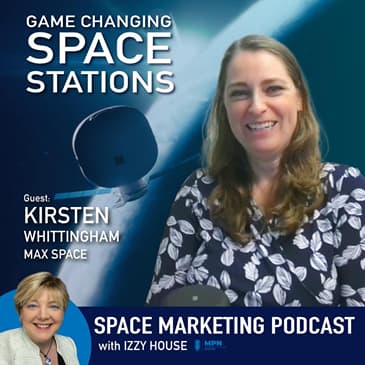
Space is on the verge of major changes within the next four years. Join Izzy as she chats with Kirsten Whittingham, the new President of Max Space about the disruption her company is leading in new space station inflatable modules providing affordable scalable modules for in-space habitation, manufacturing, research labs, space farms, tourism, sports, and entertainment.
https://getmaxspace.com/
CHAPTERS
01:13 Introduction of Kirsten Whittingham, President of Max Space
02:32 Building a cake and contracts
Kirstn’s journey to space via space camp
09:20 Max Space
13:21 Max Space Founders - Aaron Kemmer and Maxim de Jong
20:03 Manufacturing in space - What is the difference between manufacturing in space and manufacturing on Earth
21:15 Biomanufacturing of human organs and retinas
24:53 Cosmic Girls Foundation
30:44 Diversity in culture and background experience to bring different perspectives and different solutions
32:42 Space needs you - space needs all kinds of professions
Outreach of space
33:48 Marketing through thought leadership with conferences by speaking on panels and sponsoring, then building trust further with news releases, websites, and social media.
37:09 Importance of outreach
40:06 Marketing and outreach challenges
44:35 Websites and social media
45:08 Having a professional marketing from the beginning
47:53 Future outlook for space
50:11 Final thoughts of the day
Cosmic Girls Foundation - https://www.cosmicgirls.org/
Space Camp - https://www.rocketcenter.com/SpaceCamp
Embry-Riddle University - https://erau.edu/
Genesis 1 and 2
Bigelow Expandable Activity Module (BEAM) on the International Space Station
Made in Space
Small Sat 2024 - https://smallsat.org
ABOUT IZZY
Izzy's website - https://izzy.house
Author of Space Marketing: Competing in the new commercial space industry AND Space Marketing: Spaceports on Amazon and Audible - https://bit.ly/Space-Marketing
Podcast host for Space Marketing Podcast - https://spacemarketingpodcast.com
Organizer for Space for Kentucky Roundtable - https://spaceforkentucky.com
Hosted by Simplecast, an AdsWizz company. See pcm.adswizz.com for information about our collection and use of personal data for advertising.
[00:00:00] My dad works in B2B marketing, but I never really knew what that meant.
[00:00:04] Then one day my dad came by my school for career day and told everyone in my class he was a big ROAS man.
[00:00:11] Then he just kept saying things like,
[00:00:13] The bigger the ROAS the better. Over and over.
[00:00:16] My friends still laugh at me to this day.
[00:00:19] I think it means calculating a return on ad spend.
[00:00:23] One thing's for sure, I'll be known as the ROAS man's kid for the rest of my days.
[00:00:28] Why couldn't you just be a fireman or a lawyer?
[00:00:31] Why?
[00:00:32] You ruined my life dad.
[00:00:34] Not everyone gets B2B, but LinkedIn has the people who do.
[00:00:38] And with ads on LinkedIn, you'll be able to reach people based on job title, industry, likelihood to buy and more.
[00:00:44] Start converting your B2B audience into high quality leads today.
[00:00:48] We'll even give you $100 credit on your next ad campaign.
[00:00:51] Go to linkedin.com slash mpn to claim your credit.
[00:00:54] That's linkedin.com slash mpn.
[00:00:56] Terms and conditions apply.
[00:00:57] LinkedIn, the place to be.
[00:00:59] To be.
[00:01:00] Hi, I'm Jason Falls, the executive producer of the Marketing Podcast Network.
[00:01:04] As you probably know, Asheville and Western North Carolina were nearly destroyed by Hurricane Helene in late September.
[00:01:10] The Red Cross has deemed this a Category 7 disaster, which is the largest category they give.
[00:01:15] One of our member podcasters, Patrick Casale, is on the front lines there.
[00:01:19] He's an Asheville native who is living through and witnessing the trauma, destruction, and recovery his family, friends, and fellow community members are going through.
[00:01:26] Patrick started a GoFundMe campaign to raise money for relief efforts.
[00:01:30] All donations through Patrick's fundraiser go to local nonprofits who are helping with supply runs.
[00:01:36] Donations there directly impact people in need.
[00:01:38] I've given to the fund personally.
[00:01:40] Patrick has given as well, despite the fact he's having to recover too.
[00:01:43] The Marketing Podcast Network wants to help, and we know you do too.
[00:01:46] Visit Patrick's campaign at bit.ly slash WNCHelp.
[00:01:51] The abbreviation is for Western North Carolina WNC.
[00:01:55] Bit.ly, B-I-T dot L-Y slash WNCHelp.
[00:02:00] Any amount goes a long way.
[00:02:01] Even just $5 can provide a few gallons of clean drinking water to a family in need.
[00:02:06] Please join us in helping the relief and recovery efforts in Asheville and Western North Carolina.
[00:02:10] Go to bit.ly slash WNCHelp today and contribute.
[00:02:15] That's bit.ly slash WNCHelp.
[00:02:18] The full URL, B-I-T dot L-Y slash WNCHelp.
[00:02:24] Donate what you can.
[00:02:25] Every dollar helps.
[00:02:26] Welcome to the Space Marketing Podcast, where we look at marketing principles, strategies, and tactics through the lens of space.
[00:02:33] Hi, I am your host, Izzy House.
[00:02:37] Space is on the verge of some major changes within the next four years.
[00:02:42] Today, we chat with Kirsten Whittingham, president of MaxSpace, about the disruption her company is leading in the new space station inflatable modules.
[00:02:53] So, lift off in three, two, one.
[00:03:07] Welcome to the Space Marketing Podcast.
[00:03:10] Information relating to our discussion today and links to the video version can be found in the episode show notes on spacemarketingpodcast.com.
[00:03:21] Please like and subscribe to the podcast.
[00:03:24] It will help more people reach beyond the atmosphere.
[00:03:29] Information in this episode is for entertainment and information only.
[00:03:34] Please consult a professional for your specific situation.
[00:03:38] One of the reasons that I love doing this podcast is that I get to introduce you to some very interesting people who are doing interesting things.
[00:03:47] Today's guest is one of those people.
[00:03:50] Kirsten Whittingham, the new president of MaxSpace, has worked with companies like Pratt & Whitney Military Engines and Axiom Space in areas of operations management and strategic planning
[00:04:03] with experience delivering results in spaceflight, aerospace and defense industries.
[00:04:12] So, welcome to the podcast.
[00:04:15] How are you doing today?
[00:04:17] I'm well.
[00:04:18] Thank you so much for having me, Izzy.
[00:04:20] I really appreciate it.
[00:04:21] Oh, thank you for being here.
[00:04:23] I love to highlight people that are doing some...
[00:04:28] You've worked in aerospace.
[00:04:29] You've worked in defense.
[00:04:31] You've got a very interesting background, I have to say.
[00:04:37] Thank you.
[00:04:39] To me, it's just normal.
[00:04:41] But yes, I've got a really interesting breadth of experience across a lot of different things.
[00:04:47] When you think about aerospace and defense as just being one industry, I have really seen all of the pieces of that,
[00:04:53] whether that's aviation or defense or spaceflight, I've done a little bit of everything.
[00:04:58] So, when I was looking at your description in LinkedIn, you begin with a statement that was very interesting.
[00:05:05] You state, I help governments, companies and private individuals achieve their goals in space.
[00:05:11] And then I obsess about what kind of cake represents them.
[00:05:16] So, please let us know, what do you mean by cake?
[00:05:22] I love that you read that.
[00:05:24] So, this actually goes back to the Axiom space days.
[00:05:27] And it's a bit of a story.
[00:05:29] So, here we go.
[00:05:30] I was working with one of our international government customers to get them on one of the missions.
[00:05:37] And the way that they needed to contract that mission was going to be done in three separate contracts.
[00:05:43] But we really needed them to just be kind of one.
[00:05:45] It's one mission.
[00:05:46] So, I was struggling over how do we do this?
[00:05:51] So, I called my counterpart and he said in his very accent in English, he's like,
[00:05:58] Kirsten, it's very simple.
[00:05:59] On this PO, this contract, you give me flour, sugar and eggs.
[00:06:04] And on this one, I give you a cake.
[00:06:06] And for whatever reason, that clicked with me.
[00:06:08] I was able to understand how we needed to do this arrangement.
[00:06:12] It still wasn't perfect, but I got it.
[00:06:14] And as we kept going through the negotiations, I would tell people on my stuff, I'm like, this is the worst cake ever.
[00:06:20] I don't ever want to see this cake.
[00:06:22] Like, what kind of cake is this?
[00:06:23] It's terrible.
[00:06:25] But when we signed that contract, you know, we got over the frustration of it all.
[00:06:29] And I bought a three-tiered cake, one for each of the contracts.
[00:06:33] And I put their national flag on the outside of the cake.
[00:06:38] And from then on, we decided that when we signed a contract, we were going to buy a cake that represented this customer.
[00:06:46] So, the very perfect customer, if we ever achieved that, you know, an easy negotiation and they're just great to work with.
[00:06:52] And we're all so happy it's going to be this perfect chocolate cake.
[00:06:54] And so, I literally had a picture of a perfect chocolate cake hanging in my office.
[00:07:00] But, you know, all cake is good cake.
[00:07:02] There's no such thing as a bad cake.
[00:07:04] So, we had fun picking out what kind of cakes.
[00:07:06] We had different cheesecakes.
[00:07:08] We had cupcakes.
[00:07:09] We had cake pops, I think, at one point.
[00:07:12] So, it was fun.
[00:07:14] We ate a lot of cake and put on a lot of weight.
[00:07:18] Well, and cake is a good thing if it means contract.
[00:07:21] That's right.
[00:07:22] Right.
[00:07:22] So, the more cake, the better.
[00:07:26] That's right.
[00:07:27] So, when I talk with somebody, we like to get to know you a little bit better.
[00:07:32] And I would like to know, how did you become interested in space?
[00:07:37] Your journey was a little bit aerospace there for a bit.
[00:07:40] And then it switched over into space.
[00:07:42] And so, tell us about your journey.
[00:07:44] Sure.
[00:07:45] It actually starts way back when I was three years old.
[00:07:50] I'm one of those kids who grew up wanting to be an astronaut.
[00:07:54] And I apparently told a family member at the time that, you know, I wanted to be an astronaut.
[00:07:58] And a lot of kids at three years old say things like that.
[00:08:01] It's astronauts.
[00:08:02] It's superheroes and firemen.
[00:08:04] But I never change.
[00:08:06] So, I'm in school.
[00:08:08] I'm eight years old or nine years old.
[00:08:09] And I still want to be an astronaut.
[00:08:12] So, I was lucky enough to be able to go to space camp when I was in sixth grade.
[00:08:17] And at the time, this is still back in the shuttle days.
[00:08:20] So, we did a space shuttle simulation at space camp.
[00:08:24] And half of our group had to be flight controllers.
[00:08:26] And half of our group got to be astronauts.
[00:08:29] And I was like, I want to be an astronaut.
[00:08:31] I will do anything.
[00:08:32] I will be the janitor.
[00:08:33] I will do anything to be on that shuttle sim.
[00:08:37] But I got picked to be a flight controller.
[00:08:39] And looking back on it, I know why.
[00:08:42] Because a lot of the other kids were there just for the fun of it.
[00:08:45] And I clearly knew about space.
[00:08:48] And the flight controllers, even in the simulation in sixth grade, had to solve problems.
[00:08:53] Which is what real flight controllers do.
[00:08:55] So, I was actually chosen to be one of the lead flight controllers because of the background that I had.
[00:09:01] And as I'm sitting on console and the sim, I think, this is what I want to do.
[00:09:06] I don't really care.
[00:09:07] It's not about being an astronaut or going to space.
[00:09:10] I just love space.
[00:09:12] I love that we go to space.
[00:09:13] And I'm very happy to support the astronauts because this is fun.
[00:09:19] Solving the problems and my sixth grade self would say telling them what to do.
[00:09:24] That's what I want to do.
[00:09:25] So, I got an aerospace engineering degree from Amber Riddle Aeronautical University.
[00:09:31] It's a great university.
[00:09:33] And I graduated at the time when it was just after Columbia's accident had happened.
[00:09:39] And so, there was a lot of uncertainty about the shuttle program.
[00:09:43] And NASA and their contractors were not hiring a lot of flight controllers because they didn't really know what they were going to need.
[00:09:51] So, I took a job.
[00:09:53] My first job out of school was going to an Air Force base where I did defense testing.
[00:09:59] I lit things on fire to see how it survived reentry.
[00:10:02] I did some rocket tests.
[00:10:03] It was cool stuff.
[00:10:04] And I did that for two years.
[00:10:06] That is what introduced me to project management and managing customers and contracts and things like that.
[00:10:11] And I got to do that fresh out of school.
[00:10:13] And I wouldn't have had that opportunity if there hadn't sort of been this little bump in hiring for the flight controllers.
[00:10:21] But I did that for two years.
[00:10:22] And then I was able to get a job as a flight controller.
[00:10:26] I started off on the shuttle world.
[00:10:28] And then I got to go into the International Space Station program before I left.
[00:10:33] So, I got to experience both of those programs.
[00:10:35] And that was just wonderful.
[00:10:38] Being a flight controller, though, it's stressful.
[00:10:42] And you work rotating shifts.
[00:10:44] You have to be on call.
[00:10:46] So, it's not something that a lot of people do for their entire career, which is not something I knew as that sixth grader at space camp solving problems.
[00:10:53] So, I used that background that I had achieved right out of school.
[00:10:57] And I transitioned into more of that program management and working back with the customers, which then brings me full circle to Axiom, where I'm able to use the space flight experience that I have, the contracting, international government relationship management, all of that, and put that together in one position.
[00:11:14] And I'd like to make a quick point that this job that you're in right now did not exist when you came out of school.
[00:11:22] That's right.
[00:11:23] You couldn't have said, oh, I want to make inflatable habitats for space stations.
[00:11:29] That just, it didn't exist.
[00:11:31] So, one of the advice I give to some youth that I work with is that, you know, just get the ingredients.
[00:11:41] Get the ingredients to the cake.
[00:11:43] Just focus on that.
[00:11:44] Exactly.
[00:11:45] Because your job won't exist yet.
[00:11:47] But you need to be ready for it.
[00:11:49] And it sounds like you had all the ingredients that were perfect for Max Space.
[00:11:54] That's right.
[00:11:55] When SpaceX began building affordable rockets that provided affordable payload services, it was a total game changer.
[00:12:04] Max Space is doing the same, in my opinion, that SpaceX did for rockets you're doing for space stations.
[00:12:12] And I'm very excited about that because I think it's long overdue that we get some more people up there.
[00:12:19] And so, can you tell us a little bit about Max Space?
[00:12:23] I would love to.
[00:12:24] And I think you gave a perfect introduction to that.
[00:12:26] I view Max Space as a total game changer.
[00:12:29] Right now, the modules that are produced to go to be part of those space stations that you were talking about or for other applications of purposes are traditionally metal modules.
[00:12:41] They take a long time to produce.
[00:12:43] They're very heavy.
[00:12:45] They're not very cheap to manufacture.
[00:12:47] They're expensive to launch because they're very heavy.
[00:12:50] But what we offer is an inflatable structure that is actually very inexpensive to produce because of the weight savings.
[00:12:58] It is less expensive to launch.
[00:13:00] It's actually even safer than the metallic modules because it offers more protection from micrometeorite hits, which can cause leaks and things like that.
[00:13:10] We believe it's going to provide more radiation protection.
[00:13:13] So, if you have crew or equipment on there, there will be even more protection from that.
[00:13:17] So, the fact that it's quicker to manufacture, it's less expensive, these are things that are going to help space businesses get into the black quicker.
[00:13:27] Those investors will get a return on their investment more quickly.
[00:13:30] And we really believe that what we have, like I said, is a game changer.
[00:13:34] Well, and it could be bigger.
[00:13:36] When you're sending out rockets and you're using the hulls of the rockets for, like, the space station, that's as big as it's going to get.
[00:13:43] But the inflatables, you can get bigger.
[00:13:46] And you can do space sports.
[00:13:48] And you can do agriculture.
[00:13:51] And you can do all these really cool things that we need up there that will change.
[00:13:57] They'll change Ellie up.
[00:13:59] They will change what we do down here, too.
[00:14:02] Because I'm a proponent that what happens up there comes back down here.
[00:14:07] Your technology can also come into here for harsh environments or temporary placements of habitats.
[00:14:18] Or, you know, tell us a little bit about that direction a little bit.
[00:14:21] So one of the things, I'll just go back just a little bit on what you said.
[00:14:25] Absolutely.
[00:14:25] We have a graphic that I love that shows that it took around 60 launches to launch the International Space Station and all that volume.
[00:14:33] You can launch the same volume that we have in one launch.
[00:14:37] So just imagine the savings on programs like that.
[00:14:41] Yeah.
[00:14:42] When I joined Max Space, we were talking about are there terrestrial applications?
[00:14:46] I do think it's important to at least talk about those things.
[00:14:49] The space market is still nascent.
[00:14:52] It's growing.
[00:14:52] And you've got to try to understand are there other aspects that you can use your technology in.
[00:14:58] There are things like forward operating bases, I believe is what it's called, for the military, where they need to pop something up very quickly.
[00:15:05] And so there's opportunities here.
[00:15:07] And like you said, in harsh environments as well, where it's just very easy to stand up a structure.
[00:15:13] And I think there's other applications as well.
[00:15:15] But I think we're still trying to figure out what some of those could be and whether or not there's a market for that.
[00:15:21] Yeah, because sometimes space technology takes a completely different turn than you expected.
[00:15:25] For example, memory foam.
[00:15:27] Memory foam is used to protect the satellites and the astronauts during launch.
[00:15:34] Well, now we sleep on them.
[00:15:35] We have them in our shoes.
[00:15:36] We have them everywhere, cushions.
[00:15:39] And it's just become a part of our life.
[00:15:42] Sometimes you just don't know where that technology is going to take us.
[00:15:45] And it's very cool.
[00:15:47] Now, you have two founders, and they have quite the pedigree as well.
[00:15:52] And do you want to talk a little bit about your founders?
[00:15:55] Yes.
[00:15:56] So first I want to talk about Maxim because Maxim is the reason that we can even exist.
[00:16:01] So when we talk about space inflatable architecture, I think there's probably a lot of people,
[00:16:07] especially on the outside of the space industry, that would think, well, why would you do that?
[00:16:12] And that doesn't sound very smart.
[00:16:14] But like I said, it is safer.
[00:16:16] There's a lot of value for that.
[00:16:19] But also, it's been done.
[00:16:20] And Maxim has been the one that has done that before.
[00:16:23] So Genesis 1 and 2 are inflatable modules that are still orbiting the Earth today.
[00:16:27] They were launched several years back.
[00:16:30] Now, a lot of people know about those, but they exist because of Maxim and his work within Redline,
[00:16:36] which is his other company.
[00:16:37] He also consulted on BEAM, which is the inflatable structure that's attached to the International Space Station.
[00:16:44] So some people don't know that the ISS itself has an inflatable structure, and he consulted on that.
[00:16:50] So we have quite the heritage there.
[00:16:52] And Maxim is somebody that will also just throw in.
[00:16:55] It's in the running for the most interesting man in the world.
[00:16:59] He has done a lot of extreme environment type things.
[00:17:03] He does rock climbing.
[00:17:05] He goes mountain climbing.
[00:17:07] He does paragliding.
[00:17:08] And a lot of this is to test out equipment that, again, he produces for Thin Redline, which is his other company.
[00:17:14] So he's an interesting individual.
[00:17:16] If you don't know about Maxim, I recommend people go and look him up.
[00:17:19] There's some articles about him out on the Internet that you can find.
[00:17:22] And then our CEO is Aaron.
[00:17:25] Aaron is one of the co-founders of Made in Space, which a lot of people do recognize that name.
[00:17:30] They were the first people to do commercial manufacturing on the International Space Station.
[00:17:36] So that's a very interesting pedigree.
[00:17:39] He is a serial entrepreneur, as one might say.
[00:17:42] He has founded several companies.
[00:17:44] A couple of the other ones are not space companies, but now he's got Max Space to sort of round out his portfolio
[00:17:50] and having to now a couple of space companies.
[00:17:53] So, yeah, Aaron brings his entrepreneurial background and vision and drive to the company.
[00:17:59] And it's interesting to see the two of them as partners because they're very different people.
[00:18:04] Maxim is more of the, you know, true engineer, the true product visionary.
[00:18:09] And Aaron is a little bit more of the company visionary.
[00:18:12] But they complement each other very well.
[00:18:14] And I think that's one of the reasons that I was excited to join Max Space.
[00:18:21] Videos or sizzle reels are a great way to tell your company's story.
[00:18:26] Here is a video from Max Space if you are watching this on YouTube.
[00:18:45] The International Space Station took 60 launches and $100 billion to make.
[00:18:51] Unless we make usable space in space a lot less expensive and much, much larger,
[00:18:56] humanity's future in space will remain limited.
[00:18:59] My first company, Made in Space, pioneered the first in space manufacturing.
[00:19:08] But I quickly realized if we were ever going to bring real commercialization to space,
[00:19:12] we needed a lot more volume.
[00:19:15] Expandables are the only comprehensive solution that allowed this to be possible.
[00:19:19] And no one in the world knows space expandables better than Maxim.
[00:19:22] I built the first two inflatable, deployable spacecraft, Genesis 1 and 2.
[00:19:29] And they're still circling the globe to this day.
[00:19:32] Despite the success, we needed still a much bigger size.
[00:19:36] We developed a proprietary expandable architecture.
[00:19:40] It decomposes the pressure shell into discrete, uncoupled structural elements.
[00:19:45] It means that we can double, triple, quadruple the size of our architecture with full predictability.
[00:19:52] Our expandables at Max Space are safer and stronger than standard metallic architecture.
[00:19:58] We've tested our modules to the limit.
[00:20:00] We exploded them, launched projectiles at them,
[00:20:03] vibe tested, vacuum tested, exposed them to space's harshest conditions.
[00:20:08] Our Max Space modules are bigger, easier to manufacture, and more scalable than other systems.
[00:20:14] We just finished our full fidelity ground unit and are now building our flight unit,
[00:20:18] which will be the largest expandable habitat to ever go to space.
[00:20:22] The cost of launching to space is dropping dramatically.
[00:20:25] But without access to more volume, the potential of space remains out of our grasp.
[00:20:31] Our mission is to unlock a new frontier for humanity.
[00:20:34] This will enable new drugs to be created in space.
[00:20:36] This will enable new drugs to be created in space, revolutionary space farming technologies,
[00:20:39] removing heavy industries' limitations on Earth, and a new type of entertainment.
[00:20:49] Everything we do stems from one goal, more volume, less cost.
[00:20:54] We get orders of magnitude more volume per rocket.
[00:20:58] That means one ISS at less than 1% of the cost.
[00:21:04] Max Space was created to maximize space in space in a way that's never been possible before.
[00:21:24] Hold on to your boosters.
[00:21:27] We will be right back with guest Kirsten Whittingham, president of Max Space,
[00:21:33] after the briefest message from our sponsors.
[00:21:36] Please like and subscribe to the Space Marketing Podcast so you don't miss a thing.
[00:21:41] Hi, I'm Jason Falls, the executive producer of the Marketing Podcast Network.
[00:22:04] As you probably know, Asheville and Western North Carolina were nearly destroyed by Hurricane
[00:22:08] Helene in late September.
[00:22:10] The Red Cross has deemed this a Category 7 disaster, which is the largest category they give.
[00:22:15] One of our member podcasters, Patrick Casale, is on the front lines there.
[00:22:19] He's an Asheville native who is living through and witnessing the trauma, destruction, and recovery
[00:22:24] his family, friends, and fellow community members are going through.
[00:22:27] Patrick started a GoFundMe campaign to raise money for relief efforts.
[00:22:30] All donations through Patrick's fundraiser go to local nonprofits who are helping with supply runs.
[00:22:36] Donations there directly impact people in need.
[00:22:38] I've given to the fund personally.
[00:22:40] Patrick has given as well, despite the fact he's having to recover too.
[00:22:43] The Marketing Podcast Network wants to help, and we know you do too.
[00:22:46] Visit Patrick's campaign at bit.ly slash WNCHelp.
[00:22:51] The abbreviation is for Western North Carolina WNC.
[00:22:55] bit.ly, B-I-T dot L-Y slash WNCHelp.
[00:23:00] Any amount goes a long way.
[00:23:01] Even just $5 can provide a few gallons of clean drinking water to a family in need.
[00:23:06] Please join us in helping the relief and recovery efforts in Asheville and Western North Carolina.
[00:23:10] Go to bit.ly slash WNCHelp today and contribute.
[00:23:15] That's bit.ly slash WNCHelp.
[00:23:18] The full URL, B-I-T dot L-Y slash WNCHelp.
[00:23:24] Donate what you can.
[00:23:25] Every dollar helps.
[00:23:26] Well, one of the reasons why we've heard of Made in Space is because it was marketed and branded very well.
[00:23:34] The information was out about what they were doing.
[00:23:37] You know, the name itself said a lot about what they were doing.
[00:23:42] And so there's a power in the name when you pick it for your brand.
[00:23:46] And so I've been a fan of his work for a while.
[00:23:51] One of the questions people ask is, well, why don't we just, you know, do that stuff down here?
[00:23:58] What's the difference between manufacturing down here and manufacturing up there?
[00:24:02] And it is a completely different thing.
[00:24:07] Like Zeblan was one of the examples that I use a lot, which he Made in Space was actually the maker of.
[00:24:16] And when you take a piece of Zeblan that was made in space and you take some Zeblan made down here, it's cloudy down here.
[00:24:25] The crystals aren't as clear.
[00:24:26] The structure is not as clear.
[00:24:29] So the crystals grow bigger.
[00:24:30] And it just everything mixes differently, which is why I think the space stations are going to be a game changer,
[00:24:38] because pharmaceuticals are one of those things that really drastically are different up in space.
[00:24:46] And so once the manufacturers of pharmaceuticals actually say, we need some manufacturing space,
[00:24:52] and the cost comes down to bring it back down to Earth,
[00:24:56] then I think that they're going to be looking at what you do as the factories.
[00:25:04] That's right.
[00:25:05] That's right.
[00:25:06] And I would just add on to that, one of the things that I find so fascinating,
[00:25:09] and I think you would agree, we wish more people knew about the benefits of space,
[00:25:14] but manufacturing the prosthetic organs, like you cannot manufacture them the same way on Earth.
[00:25:19] They collapse upon themselves.
[00:25:20] You need microgravity to do those.
[00:25:23] So there are certain things that you just can't even do on Earth,
[00:25:28] even if we had different manufacturing techniques.
[00:25:31] I don't know that it would work the same.
[00:25:32] So, yeah, there's definite benefits to space,
[00:25:35] and I think that there are going to be even more that we uncover as it becomes cheaper
[00:25:40] for people to be able to send things up and bring it back down, just like you were saying.
[00:25:45] More people will go, hey, you know, I got an idea,
[00:25:47] and then we'll have these discoveries that you and I can't even predict today.
[00:25:50] We can't even tell.
[00:25:52] I mean, look at the smartphone and how it changed everything in 2007.
[00:25:57] I had one of the students that I'm mentoring,
[00:26:00] they were two years old when that happened.
[00:26:03] Oh, blows my mind.
[00:26:05] Anyway, I digress.
[00:26:07] But, you know, that was a pivotal point in our world and how business was done, social media, all that.
[00:26:16] And so there's going to be pivot points like that that are going to happen in the near future.
[00:26:21] I think a lot of things are on the tipping point right now.
[00:26:24] And once they tip, you know, we're just going to look back and go, oh, we never even saw that coming.
[00:26:33] And organ manufacturing in that type of thing, where I am,
[00:26:39] TechShot was the one that was doing the 3D printing of human hearts.
[00:26:43] And just for the audience out there, they were able to use skin cells and print a 3D heart up in space that beat.
[00:26:55] It actually worked.
[00:26:56] And the reason why you can't do that down here is it's like I describe it like you're 3D printing with water.
[00:27:03] So it takes time for the structures to actually build.
[00:27:07] And they can do that in space.
[00:27:10] And space is more natural for a cell environment.
[00:27:14] When you think of your blood and you think of the cells in your body, they're really in a zero-G atmosphere.
[00:27:21] So space really is complementary to that.
[00:27:25] One of the companies that's near me is Space Tango.
[00:27:29] And they're doing artificial retinas in space.
[00:27:34] And this will give people with macular degeneration eyesight.
[00:27:40] And it's just a matter of bringing it back down.
[00:27:44] And I believe Sierra Space is getting ready to tip that point and make it to where it's affordable and safe to bring down that type of manufacturing.
[00:27:53] So I think we're going to see a lot of change in the next few years with that once they get that rolling.
[00:28:01] 100% agree.
[00:28:02] And I was just talking to Aaron.
[00:28:04] I think it was yesterday or the day before.
[00:28:06] Anyway, it was this week.
[00:28:07] And he's like, it's just about being ready.
[00:28:10] About being ready for that change and being there and being able to take advantage of that.
[00:28:14] So, yeah, hopefully between our offering and the game changing and then the cost savings that that will introduce into the market and some of the other cost savings returns, whether that's Sierra Space or places like Outposts are also working on that.
[00:28:29] I do think things are just right around the corner.
[00:28:33] Whether, again, like we can't predict those things, but it's right around the corner.
[00:28:37] Something big is going to happen.
[00:28:39] And we just have to make sure our oven is preheated.
[00:28:43] That's right.
[00:28:45] So, all right.
[00:28:46] So you are also Chief Revenue Officer for the Cosmic Girls Foundation.
[00:28:51] Do you want to tell us a little bit about what that is and what you do there?
[00:28:56] Sure.
[00:28:57] I joined that organization because, you know, as a woman in the space industry, there's a lot of times that I sit in rooms and I'm the only woman there.
[00:29:06] I don't know that I even recognize it most times anymore.
[00:29:10] You know, sometimes I'll take a step back and go, oh, hey, you know, I'm the only woman here.
[00:29:13] But for the most part, it's just been my world.
[00:29:16] It's been the industry and it's been just normal for me.
[00:29:19] Even back to when I was in college, there were a lot of classes where it might be myself and one other girl and 30 men in that class.
[00:29:30] So the goal of Cosmic Girls and other foundations like it is really to turn that tide.
[00:29:37] In order to get women to be in those rooms, you have to start way, way, way, way back.
[00:29:43] You can't just say, hey, organizations, you need to hire more women.
[00:29:47] If the women aren't graduating in the STEM degree programs in the first place, then they can't really do that.
[00:29:53] So it's interesting to me that women have a higher percentage of graduation rates than men.
[00:29:59] So it's like over 50 percent of the graduates will be women and less than 50 percent will be men.
[00:30:04] Fine. But then you look at the STEM fields and depending on what field it is, it's like 20 to 30 percent women.
[00:30:10] So they're not entering into those programs at the same rates that they're entering into other things like education or nursing is one of the STEM fields where they do tend to go in.
[00:30:20] But we want to get them interested in the space STEM fields, right, whether that's computer science or aerospace engineering, those types of things.
[00:30:30] And so the idea, it's a very ambitious goal, but I love it.
[00:30:34] The idea is to get girls, teen girls, more interested in the space world by offering them a forum where they can interact with others, they can learn.
[00:30:46] But then also offering this option for one girl from each continent to get astronaut training and then to go on a suborbital flight.
[00:30:56] Probably just one will be selected for that opportunity.
[00:30:59] But just using that as this entry point of getting girls excited and engaged and asking, well, what is space and and trying to understand more about how they can contribute to that industry and then get them interested in into that pipeline so that we can start to see a little bit more of a balance.
[00:31:16] And these tech fields.
[00:31:17] So are you talking like space perspectives kind of flight, like the balloon up into the stratosphere and that sort of flight, Virgin Galactic, that kind?
[00:31:26] It's possible it could be the balloon or it could be like a Virgin Galactic.
[00:31:30] We're still working out the details.
[00:31:32] And obviously there's age issues and things like that, that we're going to have to make sure that we consider appropriately for whoever we're using.
[00:31:41] But yeah, that the space perspectives and worldview would be a neat option because I think maybe all six girls could go on something like that.
[00:31:50] But yeah, you know, we're still looking.
[00:31:52] Here's what I will say.
[00:31:53] I'll put the plug in.
[00:31:54] We need donations.
[00:31:55] So if you like this idea and you if you want to support this, please hop on to the Cosmic Girls website and click donate and and help support this initiative.
[00:32:05] And folks can also go to Silent Donor, which does more of a pooling of resources for STEM fields and things like that.
[00:32:13] At the very minimum, share the posts, share the information.
[00:32:18] Yes.
[00:32:18] Tell that young lady that there is this option and just slide it her way because I'm one of those girls.
[00:32:28] You know, I look back through my life and if I had thought that I could be a space engineer and somebody had told me when I was 16 years old, you know what?
[00:32:39] You can do that.
[00:32:41] But I that's totally what I have would have done.
[00:32:45] And I visited my grandparents and they turned me on to science fiction and they took me to Kennedy Space Center.
[00:32:51] And I came back to ninth grade totally ready for space.
[00:32:55] I my mindset was that I was going to pick a career where I could be chosen to be a colonist.
[00:33:03] That was my my thinking coming into ninth grade and through peer pressure and through parent pressure, because my parents were like, oh, no, no, no, no.
[00:33:13] That's not reasonable.
[00:33:15] I chose to do something different.
[00:33:18] And I think that if we make it safe to think those thoughts, we make it safe and encouraging those thoughts, then maybe we might have more people enter into it because we we really need the pipeline for engineers, you know, for for for women.
[00:33:36] But for men, but for men, too, you know, for just people in general, we need the pipeline.
[00:33:41] But we also, you know, one of the things I love about space is that it's more diverse as just, you know, it's not about what country.
[00:33:52] Well, it is if you're in NASA, but it's there.
[00:33:55] You have other countries and other cultures that are all coming together to make an international space station.
[00:34:02] You know, where else does that happen?
[00:34:04] Right.
[00:34:05] So that's one of the things I love about space is diversity should be celebrated.
[00:34:10] Culture should be celebrated.
[00:34:12] And I think space does that more than a lot of other industries do.
[00:34:16] A hundred percent.
[00:34:17] I a hundred percent agree with that.
[00:34:18] I think that's one of the things, again, as I could have predicted this in sixth grade about what I would love about the space industry.
[00:34:25] It was just something I was following.
[00:34:26] But now that I'm really involved in it, I love the international aspect.
[00:34:30] I love this sort of coming together to collaborate on different research projects or different missions, whether that's human rated missions or even their satellite projects and Earth observation that are being done with collaborations.
[00:34:46] And I love that.
[00:34:46] I love that we can do that.
[00:34:48] And it's the world coming together and holding hands.
[00:34:50] But even going back to that, the diversity element, I think what you say is true.
[00:34:54] When I talk about diversity in the space field, what I would love to see is diversity of all kinds.
[00:35:02] Yes, men and women.
[00:35:04] Cool.
[00:35:04] Like more of a split.
[00:35:05] Races, of course.
[00:35:06] But it's also just backgrounds, bringing in diverse backgrounds and perspectives, not just the NASA folks, not just the former SpaceX folks.
[00:35:15] There's room for other people who have different perspectives to come into the field and say, hey, you know, I've got some ideas.
[00:35:22] And that can be done in a variety of different ways.
[00:35:25] No, you're not going to come in easy tomorrow and design a rocket for somebody.
[00:35:29] That's not your background.
[00:35:31] Cool.
[00:35:32] But somebody who's been a marketer in a different field could come into the space industry and say, hey, I've got a different background and I've got some perspectives and I have experience to add to this.
[00:35:42] And so I would really like to see the space industry embrace that and bring in more people, more thoughts, because I think it will just help us grow faster and be more successful more quickly.
[00:35:53] Well, and it solves problems.
[00:35:55] You know, if you take somebody that is an HVAC person, that's all he's ever done is work on air conditionings and you bring him into the environment.
[00:36:06] There may be some some workarounds that he has discovered working on our earthly habitats that could work in the space habitats that maybe somebody that has been in space would not have thought of.
[00:36:22] And so, yes, that I mean, it's we need all those people and they don't think that they can come to space.
[00:36:30] And but we totally need you if you're a welder, if you're a HVAC, if you're a marketer.
[00:36:38] We write accountants.
[00:36:40] There's so many degree degree bills that could get involved if you've just about anything.
[00:36:45] I mean, there's legal, there's accounting and finance, there's HR, there's marketing, there's comms.
[00:36:52] I mean, so you think about just about any degree field.
[00:36:55] I won't say all of them, but just about any degree field can probably find some sort of application in the space industry.
[00:37:01] Absolutely.
[00:37:02] Absolutely.
[00:37:03] Spaces for everyone is what a lot of us are saying, because there's a business part of it, which you're a very much of as operations.
[00:37:11] You're a part of, you know, that is your strength is your business with a lot of space experience.
[00:37:18] The business aspect still remains.
[00:37:20] If you take space out of it, you still have businesses that need to function.
[00:37:24] They need to work.
[00:37:26] Payrolls need to be made.
[00:37:28] So you have all those same positions in the space business as you would just a regular business.
[00:37:35] That's right.
[00:37:36] That's right.
[00:37:37] OK, so this is marketing.
[00:37:38] And when I say marketing, I don't mean sales.
[00:37:41] I mean getting the word out, getting the outreach, the tooting that horn for whatever it is that you're doing.
[00:37:49] As the leader of your industry, what's your favorite outreach or marketing strategy and why?
[00:37:57] You know, I think that the space industry is a hard nut to crack, I think, in this regard.
[00:38:04] And maybe maybe I just don't look at it the right way, so feel free to enlighten me.
[00:38:09] But the people who are going to buy your service or your product, it's just it's a handful like worldwide.
[00:38:16] There's not a lot of people that are the decision makers for these, whether it's a big space flight or a launcher or a satellite.
[00:38:24] It's a very niche market.
[00:38:26] And so one of my favorite strategies is it's a combo of strategies like it's really getting the news out to those people.
[00:38:35] And so doing that at conferences is whether that's being a thought leader on the panels, sponsoring at the conferences, because, you know, they're going to be there.
[00:38:43] But you don't know that they're going to see your social media, for example.
[00:38:47] Now, I do think it's a combo, right?
[00:38:49] Because I think if you're going to be at that conference and be on that panel, you still want to have a really good website behind that.
[00:38:57] You still want to have a really strong social media presence behind that.
[00:39:00] They kind of all go together because you and I know that once you meet somebody, what do you do?
[00:39:05] Go check out their website.
[00:39:06] Absolutely.
[00:39:06] Go check out their social media.
[00:39:08] And if you go, oh, that doesn't drive with what I heard or saw.
[00:39:13] Now you've got this incongruence and maybe you don't have that trust.
[00:39:18] And trust is a huge piece of building the brand.
[00:39:20] So all of these things come together.
[00:39:22] But I think my favorite strategy is really getting to the conferences and getting to the people, combining that with some thought leadership, hopefully with some press.
[00:39:32] And then right behind that, you have your website, your social media, and you're just sort of telling that story cohesively in all of your channels.
[00:39:41] Well, the last few episodes of space marketing has been this conference theme, by the way.
[00:39:48] And I'm a big proponent of conferences.
[00:39:51] And I believe that they're going to be more important as AI continues to go forward because there's a lot on the Internet now that you don't know if they're real people.
[00:40:03] They look real.
[00:40:05] They sound real.
[00:40:06] But they're not real.
[00:40:07] And so when you're at a conference and you're meeting with somebody, they're flesh and blood.
[00:40:13] They're right there.
[00:40:14] You know, okay, this person exists.
[00:40:16] They're for real.
[00:40:17] They have a booth here.
[00:40:18] Some trust is established.
[00:40:20] Right off the gate.
[00:40:22] Then you have a relationship with them.
[00:40:24] And there's something about meeting in person that there's an energy, a connection that just cannot be simulated online.
[00:40:32] As much as I love Zoom and I'm able to talk to anybody all over the world.
[00:40:36] And I love that part.
[00:40:38] Something about shaking that hand.
[00:40:40] There's that electric connection that you cannot simulate.
[00:40:44] For starters, that is thing.
[00:40:47] Right.
[00:40:47] And I'm a big proponent.
[00:40:49] I'm actually going to be speaking.
[00:40:51] And I love speaking.
[00:40:52] The last episode that I did, we talked about speaking, how important that was.
[00:40:57] I'm going to be speaking at SmallSat.
[00:41:00] I'm going to be talking about how we need to get the word out about space.
[00:41:04] Because it's not just about getting the pipeline is important and everything.
[00:41:09] But when you look at the Apollo program, it was marketing and public affairs that were able to change the public's mind and garner that 4% of the national budget that was needed to launch a rocket.
[00:41:24] And if you look at NASA right now, they're cutting severely everywhere.
[00:41:29] I mean, they just cut a moon lander.
[00:41:32] So that's not cool.
[00:41:35] That's not cool at all.
[00:41:36] And they just had to cut something in their outreach budget, I believe, as well, which kind of goes back to your point of that is an important function of what NASA is doing.
[00:41:45] We were just having the conversation about not many people knowing about manufacturing organs in space and that type of thing.
[00:41:52] So NASA is trying to get that word out.
[00:41:55] I think it's being drowned out by all the other.
[00:41:57] There's so much to pay attention to right now.
[00:41:59] But if we were all in the space industry sort of cohesively telling these messages, can you imagine how that would shift public perspectives and funding and those types of things?
[00:42:09] So I agree with you.
[00:42:09] I think it's more important for us collectively to just talk even about the benefits of space.
[00:42:15] MaxSpace even could be out there talking about these types of things.
[00:42:18] You can use our modules to do these things and letting the public know it's not about billionaires going to orbit.
[00:42:24] That can be a thing.
[00:42:25] But there are really important uses of low Earth orbit.
[00:42:30] There's vessels and there's really important uses of lunar habitats.
[00:42:35] What are those?
[00:42:36] Let's talk about those things.
[00:42:37] Let's convince people that this is really important to you or to your family and help them to understand that it does impact them, even if they're not a buyer of that service.
[00:42:47] They're not going to the grocery store to buy the habitat.
[00:42:49] But you're still part of funding it because you're a taxpayer or you're still part of supporting it because of just the notion of supporting spaceflight.
[00:42:58] And you're still a recipient of the tech that comes from it.
[00:43:00] So, like, for the example, the International Space Station, that's why I do what I do is because I think that us as a space company collective need to understand marketing a little bit better so that we can collectively push it up and make it to where it's in the awareness of everybody.
[00:43:21] Because you have people walking around that think that they have no connection to space when they're on their phone, checking their traffic, checking the weather.
[00:43:29] And that's all from space.
[00:43:31] You know, we wouldn't be able to do that without it.
[00:43:34] And so there's a big disconnect between people and space.
[00:43:40] And we need to make them aware that if space goes out tomorrow, if our adversaries take out our satellites, you'll notice.
[00:43:53] It's a problem.
[00:43:53] You'll notice.
[00:43:55] So we're talking about some outreach marketing challenges, and that is that you have NASA, the budget's cut.
[00:44:04] But what are other outreach challenges that you face in getting the word out about space?
[00:44:10] I think it's just like I said before, it's about being drowned out by so many other messages.
[00:44:16] The forums that you're using for contacting, you know, your customers and the people that need to advocate or conferences, that isn't getting out the word to the public about space.
[00:44:27] So if you're using your social media channels, you know as well as I do, that there's so many things to look at.
[00:44:34] And how are you more entertaining than that content creator that's doing something silly?
[00:44:40] How do you grab the attention?
[00:44:42] I think that's the challenge is figuring out how we can collectively as a space industry figure out how to be just as entertaining as the TikTok dances and just as entertaining as the pranks that are going on in social media.
[00:44:56] Because I think social media is what grabs people's attention right now.
[00:44:59] And I just don't know that there's anybody that's really doing that well in the industry to help be the viral person.
[00:45:07] So it'd be interesting if we could come up with some really great influencer in the community and get them to be, I don't know, doing space dances in some shape, form, or fashion to grab the attention.
[00:45:19] Yeah.
[00:45:20] I did talk about it with one of my former colleagues.
[00:45:22] It'd be interesting to have some sort of TikTok channel that is more geared towards kids with a hope that they would be like, hey, mom, dad, come look at this.
[00:45:31] My kids are always sharing things with me and talking about folks that they're seeing on social media.
[00:45:37] So to be interesting enough to have them go, hey, this, it isn't even that I'm telling you this because it's space and I know that you work in the space industry.
[00:45:45] I just think it's cool.
[00:45:46] If you could do that, I think that would be, that's solving the world challenge of how to get space into the hands of the people.
[00:45:54] Now, that's where the challenge lies, though, is because when you're doing, let's just say, space widgets, you're not going to sit there and make, you know, fun TikTok videos for a 12-year-old, 13-year-old, 14-year-old, because that's not what you need right now.
[00:46:14] And that's a waste of money.
[00:46:16] And we have a budget and we can't afford to do frivolous things like that.
[00:46:20] And so that's the thinking.
[00:46:23] That's the thinking.
[00:46:24] But there, as a collective, we need to do something because our budgets are being slashed.
[00:46:31] And whether or not we can get to space and whether or not we can build in space and do all the things that we're investing in down here depends upon public support and Congress.
[00:46:45] So we, those 12-year-olds are important.
[00:46:50] Those 13-year-olds are important because if they find space important and the 16-year-olds figure out the jobs that they want to do in space and then the 20-some-year-olds actually are going for those careers, that's the long game.
[00:47:10] But we have to figure out that now and we have to be a part of that.
[00:47:16] We have to have an outreach in our companies that work together, just like with the International Space Station, except it's marketing, it's outreach.
[00:47:24] That's a nice way to look at it.
[00:47:26] It would be, I was just thinking about it this morning and I don't remember how it came up.
[00:47:29] I was thinking about how nice it would be to be able to have more of a collaboration structure within the space industry.
[00:47:36] And of course, everybody is very cautious about that because from a technical perspective, you don't want to collaborate maybe so much because everybody's trying to be the one, right?
[00:47:46] I need to be the one that does this thing.
[00:47:49] And that's fine.
[00:47:50] But I do think that there are other ways that we could sort of be more supportive of one another.
[00:47:54] Maybe that's just as simple as figuring out how to do better marketing together.
[00:47:58] But think about the impact that that would have if all of the space industry were cohesively marketing together.
[00:48:06] That'd be great.
[00:48:07] Yeah, it's food for thought for sure.
[00:48:09] It's got my gears going.
[00:48:11] So let's see what we can do.
[00:48:13] And I want to circle back to what you said about the websites and social media and about making sure that that's done.
[00:48:20] When we talk about the challenges of companies putting their efforts to that, there was one company in particular that was a big player.
[00:48:30] And I was applying for a job there.
[00:48:35] And I was all excited until I went to their website.
[00:48:41] And their website looked like it was a box that was checked.
[00:48:44] There was no pictures.
[00:48:45] There was, I mean, it was just basic stuff.
[00:48:50] And it was like, oh, maybe they're not as big as I thought they were.
[00:48:54] That was the thought that I had.
[00:48:57] And I would like to say that that company is no longer in business.
[00:49:02] Oh, interesting.
[00:49:03] Yes.
[00:49:03] Interesting.
[00:49:04] I was just going to offer the perspective.
[00:49:05] I think what happens so often in this industry is, especially when you're talking about startups, the budgets are stretched very thin.
[00:49:13] It's going to go to engineering first.
[00:49:15] You probably have engineering leaders who don't understand all of the needs for marketing.
[00:49:21] So, yeah, I think there are a lot of boxes checked.
[00:49:24] But I think it goes back to your point a little bit.
[00:49:27] I think what you're trying to say here is they didn't market well.
[00:49:30] No, they didn't.
[00:49:31] Therefore, they are not here anymore.
[00:49:33] It probably wasn't because their engineering wasn't sound.
[00:49:36] Their engineering was probably totally sound.
[00:49:38] But nobody knew it because they didn't market well.
[00:49:41] Exactly.
[00:49:41] You don't exist unless you market.
[00:49:44] That's right.
[00:49:44] And even if the only customer you have is NASA, then you still need to market yourself to a certain degree so that they choose you.
[00:49:54] Yeah.
[00:49:55] Yeah.
[00:49:55] That's right.
[00:49:56] And another thing about marketing professionals is that we have a different mindset on solutions, problems versus solutions.
[00:50:04] So, if you have marketing in the beginning of your company and you have somebody that is a professional, then when you're designing your widget, then they can say, okay, well, the audience that we're selling for, you know, they have this pain point.
[00:50:20] You may design a widget that totally just barely misses the mark, but it's still missing the mark.
[00:50:27] And so, if you have somebody that's a professional marketing person, then they can help design for the audience that you're doing and put some different spins on things that you may not have thought of.
[00:50:42] So, it's important to have somebody on the ground floor when you're building these things that is aware of what marketing.
[00:50:50] And when I say, like I said before, when I say marketing, it doesn't mean sales.
[00:50:56] So, marketing is like a big diamond and you have all these facets on it.
[00:51:01] And sales is one facet.
[00:51:04] That's the human touch of marketing.
[00:51:06] That's when you've decided to actually do something and you're reaching out and you're talking to a person.
[00:51:13] So, that's a very important part, but it's not the whole diamond.
[00:51:18] And, you know, public relations and public affairs and communications and outreach and education, those are all major facets as well.
[00:51:28] So, there's just a lot to think about when you're doing marketing.
[00:51:33] It's just not one size fits all.
[00:51:36] You know, it's baking a cake too.
[00:51:39] So, all right.
[00:51:41] I have two questions that I normally ask towards the end.
[00:51:45] And it's, where do you see the space industry in the next 10 to 20 years?
[00:51:50] You're on the front line of the next 10 to 20 years.
[00:51:54] So, where do you see it?
[00:51:55] Well, I'll talk about it more from a hopes aspect than trying to actually forecast where we'll be.
[00:52:01] But I would hope that we have multiple space stations that are in lower orbit.
[00:52:06] I would hope that we are truly living and working on the lunar surface and that that's a consistent presence and that that's generating some very beneficial impact for here on Earth.
[00:52:18] And I would like to hope and think that we would actually have figured out how to get to Mars and have a bit more of a presence there.
[00:52:25] I'm not sure if that's like a permanent presence or whatever, but just to even be there, I think, would be a great accomplishment in the next 10 to 20 years.
[00:52:36] So, that's kind of what I hope.
[00:52:38] And then tying that back into more of the business aspect, I do hope that we see these game-changing, you know, the internets of working in space.
[00:52:47] What are the new game-changing things that will make it better for us here on Earth?
[00:52:52] And I would hope that there are also some transitions in the industry that help with orbital debris, those types of things, and that make it more sustainable and environmentally friendly to do the launches.
[00:53:04] If we could do those things, that would just be like perfect for me in the next 10 to 20 years.
[00:53:08] Well, and I'd like to add a comment to that is that when you say you hope that we'll be living and working on the moon.
[00:53:17] And I think we will be.
[00:53:19] It's just it may be Chinese.
[00:53:24] Because there's two flags right now on the moon that are Chinese flags.
[00:53:27] You know, they're on the light side and the dark side of the moon right now.
[00:53:31] So, and they have plans to step on the moon by 2030.
[00:53:35] And if NASA's budgets keep getting cut, they make it to the moon first.
[00:53:41] So, and geopolitically, that concerns me.
[00:53:45] Just as, you know, as a citizen of the world, that concerns me.
[00:53:49] But so I really do believe we'll be on the moon.
[00:53:51] It's just will it be a free world on the moon?
[00:53:54] And that's the things that we have to decide right now.
[00:53:58] And last question of the day.
[00:54:02] What thoughts do you want to leave our audience with today?
[00:54:05] What do you want them to mull around as they go about their day?
[00:54:09] Well, I think I would tie it back to a little bit of the topics that we have bounced around on.
[00:54:15] You know, number one, how do we as listeners of this podcast,
[00:54:20] make sure that other people are aware of the benefits and impacts of the space industry?
[00:54:26] You as an individual can help with that.
[00:54:29] But there's also greater collective things that we can do together.
[00:54:32] And what does that look like?
[00:54:33] How do you help spur that on?
[00:54:34] So let's leave the listeners partly with that.
[00:54:36] But let's also leave the listeners with how do we help the diversity of the space industry?
[00:54:41] And again, I mean, not just male, female or white versus other races.
[00:54:46] I mean, just from the backgrounds.
[00:54:48] How do we get more people in to help problem solve, help us be more creative and to really drive the industry forward?
[00:54:54] And let's pull that apart and decide what it is that's keeping people from that.
[00:54:59] And, you know, making it like if you're going through a path and there's a lot of shrubs, let's cut it down.
[00:55:06] Let's let's make the path open and celebrate all the diversities.
[00:55:12] Let's not be a monoculture in any shape or form.
[00:55:16] Let's let's paint with all the brushes.
[00:55:19] Love it.
[00:55:20] I love it.
[00:55:21] I'm sure you weren't when I first approached you.
[00:55:25] You're like marketing.
[00:55:27] I'm not marketing.
[00:55:28] Well, you know, I do view it a little bit more like marketing is kind of everybody's job.
[00:55:35] It is.
[00:55:36] So and congratulations on your new job.
[00:55:41] And I can't wait to see what you're going to do with it.
[00:55:44] A special thanks to Kirsten Whittingham, president of Max Space, for sharing her journey to space.
[00:55:51] Information in today's episode can be found in the show notes on spacemarketingpodcast.com or wherever you listen.
[00:56:01] Please like and subscribe to the Space Marketing Podcast to help get the word out about this incredible industry of space.
[00:56:09] I hope that you have found this podcast useful for your journey as you reach for the stars.
[00:56:31] You may know you're listening to this show along the Marketing Podcast Network, but did you know there are other great shows on MPN to help your business?
[00:56:38] Hennika Watka-Sporter hosts the Entrepreneurial You, empowering entrepreneurs with insights on leadership, business and success.
[00:56:45] Hennika, tell listeners what to expect from your show.
[00:56:46] So we provide innovative business strategies and practical solutions to common entrepreneurial challenges.
[00:56:53] And where can people subscribe?
[00:56:54] Find us at HennikaWatkaSporter.com as well as the Marketing Podcast Network at marketingpodcast.net or search for it wherever you get your podcasts.
[00:57:06] You heard her, go subscribe.
[00:57:07] This podcast is heard along the Marketing Podcast Network.
[00:57:10] For more great marketing podcasts, visit marketingpodcasts.net.