
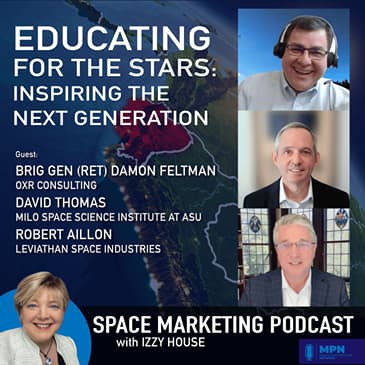
In this episode of the Space Marketing Podcast, host Izzy House dives into the power of education in space marketing. Featuring retired Brigadier General Damon Feltman (founder of OXR Consulting), Dave Thomas (Executive Director of Milo Space Science Institute at ASU), and Robert Aillon (founder of Leviathan Space Industries), the episode explores how they inspire the youth of Ecuador to dream big and reach for the stars! 🌟
Brig General (retired) Damon Feltman - Founder of OXR Consulting
David Thomas - Executive Director, Milo Space Science Institute at ASU Robert Aillon - Founder Leviathan Space Industries
Contact via LinkedIn
CHAPTERS:
01:32 Meet Damon, David, and Robert
05:11 Robert Aillon and the Ecuadorian education initiative
8:39 Brigadier General Damon Feltman goes to spread the word that space is for everyone
11:27 Media interviews
12:31 Dave Thomas - sharing the dream to space
16:43 Promoting the initiative and creating a space future
20:57 Milo Science Science Institute programs - Climate Action Academy where business applications using satellite imagery to monitor Earth and using Moon to Mars Architecture to inspire new ideas
23:31 “Why Ecuador should go to space” essay
25:11 Talking to the different departments about the space economy and it trajectory
26:00 Space Marketing Books clip
26:29 Next steps for the education programs
28:16 Milo Space Science Institute programs into other countries
29:12 Sharing space changes lives
30:45 Thunderbird painting - the story of mutual respect
33:41 Thunderbird School of Management - providing the tools to empower people and impact the space industry
41:55 Importance of education
48:24 A challenge
Links:
Thunderbird School of Management - https://thunderbird.asu.edu/
Milo Space Science Institute - https://miloinstitute.org/
Leviathan Space - https://www.linkedin.com/company/leviathan-space-industries-llc/
OXR Consulting
School mentioned:
Centro Ecuatoriano Norteamericano - CenEcuador.edu.ec
Unidad Educativa Bilingue Javier - uejavier.edu.ec
El Colegio Politécnico - copol.edu.ec
Academia Naval Almirante Illingworth - anai.edu.ec
Colegio Americano - colegioamericano.edu.ec
Universidad Hemisferios - uhemisferios.edu.ec
Inicio Universidad San Francisco de Quito - usfq.edu.ec
University of the Americas - udla.edu.ec
Escuela Superior Politecnica del Litoral - espol.edu.ec
Space Marketing Podcast - Artemis Accords signing - Ecuador Ambassador to the United States Ivonne Baki at https://spacemarketingpodcast.com/episode/space-marketing-podcast-ecuador-ambassador-to-the-united-states-ivonne-baki
ABOUT IZZY
Izzy's website - https://izzy.house
Author of Space Marketing: Competing in the new commercial space industry AND Space Marketing: Spaceports on Amazon and Audible - https://bit.ly/Space-Marketing
Podcast host for Space Marketing Podcast - https://spacemarketingpodcast.com
Organizer for Space for Kentucky Roundtable - https://spaceforkentucky.com
Hosted by Simplecast, an AdsWizz company. See pcm.adswizz.com for information about our collection and use of personal data for advertising.
[00:00:00] My dad works in B2B marketing, but I never really knew what that meant.
[00:00:04] Then one day my dad came by my school for career day and told everyone in my class he was a big ROAS man.
[00:00:11] Then he just kept saying things like,
[00:00:13] The bigger the ROAS the better. Over and over.
[00:00:16] My friends still laugh at me to this day.
[00:00:19] I think it means calculating a return on ad spend.
[00:00:23] One thing's for sure, I'll be known as the ROAS man's kid for the rest of my days.
[00:00:28] Why couldn't you just be a fireman or a lawyer?
[00:00:31] Why?
[00:00:32] You ruined my life dad.
[00:00:34] Not everyone gets B2B, but LinkedIn has the people who do.
[00:00:38] And with ads on LinkedIn, you'll be able to reach people based on job title, industry, likelihood to buy and more.
[00:00:44] Start converting your B2B audience into high quality leads today.
[00:00:48] We'll even give you $100 credit on your next ad campaign.
[00:00:51] Go to linkedin.com slash mpn to claim your credit.
[00:00:54] That's linkedin.com slash mpn.
[00:00:56] Terms and conditions apply.
[00:00:57] LinkedIn, the place to be, to be.
[00:01:00] Hi, I'm Jason Falls, the executive producer of the Marketing Podcast Network.
[00:01:04] As you probably know, Asheville and Western North Carolina were nearly destroyed by Hurricane Helene in late September.
[00:01:10] The Red Cross has deemed this a Category 7 disaster, which is the largest category they give.
[00:01:15] One of our member podcasters, Patrick Casale, is on the front lines there.
[00:01:19] He's an Asheville native who is living through and witnessing the trauma, destruction, and recovery his family, friends, and fellow community members are going through.
[00:01:27] Patrick started a GoFundMe campaign to raise money for relief efforts.
[00:01:30] All donations through Patrick's fundraiser go to local nonprofits who are helping with supply runs.
[00:01:59] Any amount goes a long way.
[00:02:01] Even just $5 can provide a few gallons of clean drinking water to a family in need.
[00:02:06] Please join us in helping the relief and recovery efforts in Asheville and Western North Carolina.
[00:02:10] Go to bit.ly slash WNCHELP today and contribute.
[00:02:15] That's bit.ly slash WNCHELP.
[00:02:18] The full URL, bit.ly slash WNCHELP.
[00:02:23] Donate what you can.
[00:02:25] Every dollar helps.
[00:02:26] Welcome to the Space Marketing Podcast, where we look at marketing principles, strategies, and tactics through the lens of space.
[00:02:35] Hi, I am your host, Izzy House.
[00:02:38] Education is my favorite form of marketing because it improves lives.
[00:02:44] Today, I get to talk to retired Brigadier General Damon Feltman, who is also the founder of OXR Consulting.
[00:02:53] Dave Thomas, executive director of Milo Space Science Institute at ASU.
[00:03:00] And Robert Ion, founder of Leviathan Space Industries, about how they use education to inspire the children of Ecuador to reach for the stars.
[00:03:13] So, lift off in 3, 2, 1.
[00:03:28] Welcome to the Space Marketing Podcast.
[00:03:31] Information relating to our discussion today and links to the video version can be found in the episode show notes on SpaceMarketingPodcast.com.
[00:03:42] Please like and subscribe to the podcast.
[00:03:44] It will help more people reach beyond the atmosphere.
[00:03:50] Information in this episode is for entertainment and information only.
[00:03:54] Please consult a professional for your specific situation.
[00:03:58] Education is my favorite marketing tool because it improves lives and makes people better.
[00:04:05] We promote careers with our efforts and make people excited about the future and promote initiatives that make our planet a better place to live.
[00:04:16] I have a pretty impressive panel with us today and they choose to do just that.
[00:04:23] So, I will begin with recently retired Brigadier General Damon Feltman, who served as the Mobility Assistant to the Deputy Chief of Space Operations, Strategy, Plans, and Programs, Requirements, and Analysis for the United States Space Force at the Pentagon.
[00:04:43] In his role, he led strategic planning, space system requirements, and international partnerships while coordinating with other military branches to support the Space Force's role in joint operations.
[00:04:58] He is a proud graduate of Mississippi State University and has held numerous leadership positions throughout his career, including commanding satellite operation crews and managing training policy for over a million reservists and guardsmen.
[00:05:17] After retiring, he served as the principal to the director for SDA for architectural requirements and tech on-ramp strategy for 330 satellite tactical data links and broadband network.
[00:05:33] He is now the founder of OXR Consulting.
[00:05:38] Next on the list, we have Dave Thomas.
[00:05:42] He is Executive Director to the Milo Space Science Institute at Arizona State University, where he organizes and conducts innovative space science and exploration missions.
[00:05:55] He works with strategic partners to provide space infrastructure as a service.
[00:06:01] He provides programs to build capacity to support the missions within the partner country, creating an end-to-end pipeline, making space accessible to all.
[00:06:16] And then Robert Ion.
[00:06:18] I have had the pleasure of interviewing him in a podcast.
[00:06:22] He is a person that impacts lives, including my own.
[00:06:27] He encouraged me to attend the GSA Space Fort Summit and asked me to write my second book, Space Marketing, Space Ports, and provided support during this journey and has opened so many doors.
[00:06:42] I am where I am today because of Robert, and I am deeply grateful.
[00:06:48] So he is founder of the Leviathan Space Industries and has partnered with schools in Ecuador and the International Space Station to send radish seeds from LATAM to space and then grow them in his school in Ecuador.
[00:07:05] He created an education space marketplace, showing schools how they can access space.
[00:07:11] He cares deeply for his country and Ecuador's future, creating programs and outreach initiatives to help Ecuadorians reach the stars.
[00:07:22] And today we will journey to Ecuador to find out how these three gentlemen created outreach initiatives to create a movement and grow the space industry.
[00:07:33] Hello, everyone.
[00:07:35] Welcome to the podcast.
[00:07:37] Isi, thank you for having me here again.
[00:07:39] It's wonderful to be able to join and share this forum with David and Damon.
[00:07:45] It's just exciting.
[00:07:47] And since last we talked, we were signing the Artemis Accords, and now they're signed.
[00:07:52] It's a year later.
[00:07:53] And now 2024 has been a great year where a lot of different activities have taken off in Ecuador.
[00:08:01] So why don't you set the stage for what we're going to talk about today with Dave and Damon coming to Ecuador and what they did there and why they did it?
[00:08:11] So we have been working, as you know, in getting the students ready, getting these educational institutions, you know, prepared.
[00:08:20] And that part, as many people know it, is workforce development.
[00:08:24] It's getting ready the next generation to be able to handle all these big changes that are happening with technology.
[00:08:31] And organizations like Milo Space Science Institute, Thunderbird School of Global Management, you know, the State Department and the U.S. Embassy in Ecuador have become involved in supporting those efforts.
[00:08:45] And that's great news because that has allowed, in this case, more active participation and gearing towards how do we get these different universities and schools involved.
[00:08:56] So now we have universities like San Francisco de Quito, who's doing the NASA Space App Challenge.
[00:09:03] We have now Centro Cuatro Norte Americano, which is the cultural center, part of the U.S. consulate, you know, doing STEAM space programs to get kids excited about that.
[00:09:14] And that's how we were able to get Damon to come visit us.
[00:09:18] You know, we were able to have him come as a guest to one of these lectures and be able to interact with the kids and meet a space person, really.
[00:09:26] So it was just a wonderful experience.
[00:09:28] And with David, we're launching some amazing programs with universities in Ecuador, Universidad Misferios and Espol and Udla, and also talking to other universities to be more involved.
[00:09:39] So it's just wonderful to see now that these institutions are committed to space and they want to take concrete actions.
[00:09:47] They want to do something very special for their students and have an impact in the local economy.
[00:09:53] Why don't you tell us a little bit about the school that they visited?
[00:09:56] Well, with Damon, we had a very full agenda.
[00:09:59] He spent a whole week here.
[00:10:01] So we were able to go to Guayaquil, which is the major city in the coast, and then to Quito, also the capital.
[00:10:10] So in Guayaquil, we were able to go to four different schools, Colegio Javier, Anai, Academia Naval Almeida, Eveningworth, Copol,
[00:10:21] and also to the Centro Cuatro Norte Americano to interact with the kids.
[00:10:26] So it was just a wonderful experience to be able to interact that way and see the kids' excitement as they were taking pictures and asking questions with Damon.
[00:10:35] And then afterwards, he was interviewed in Quito by different media and be part of the program launch of Universidad Misferios with their climate intelligence program with Milo.
[00:10:47] So that was really, really excited about how having this big figure coming to Ecuador, showing that space is accessible, is just very impactful.
[00:10:57] Damon, do you want to walk us through what it is that you did that day and why you chose to go to Ecuador?
[00:11:05] Izzy, thanks for having me here.
[00:11:06] And thank you for the kind introduction.
[00:11:08] I'll add that, yes, I am a proud graduate of Mississippi State University, but I'm also a proud graduate of Arizona State University,
[00:11:14] the Thunderbird School of Global Management out there, and that's what brought Robert and I together.
[00:11:20] So I wanted to make sure that I completed the picture of some of my academic background.
[00:11:25] So Robert invited me to come down and spend a few days in Ecuador as part of his STEM outreach program.
[00:11:32] And the idea that he presented to me resonated from the standpoint of, I grew up in Mississippi here in the United States,
[00:11:40] and this was in the 70s and 80s when I was growing up.
[00:11:44] And the economic setting back there, while it's not negative, it certainly is not a place that you think of where space leaders come from or space enthusiasts come from.
[00:11:56] But yet that's the background I came up in.
[00:11:58] That was a little bit of the eyeball in high school being the kid who wanted to do things related to space.
[00:12:03] And I was able to take that kind of passion and grow it a little bit.
[00:12:08] Eventually found myself going into the Air Force and spent 32 years working inside of the Department of Defense space arena.
[00:12:15] And so what I've found myself doing over the past couple of years is looking for opportunities to talk to kids
[00:12:22] and just let them know that the space economy is shifting pretty significantly.
[00:12:27] That while this economy still has a need for engineers and scientists and people with the big, hard technical backgrounds that we're used to,
[00:12:38] there's room for other people who might not want to go to that level of education and training.
[00:12:43] But there's plenty of opportunities for skilled labor.
[00:12:45] There's plenty of opportunities for business leaders in this economy.
[00:12:48] So I wanted to talk to these kids and let them know that they have a future in the space economy.
[00:12:53] And they don't have to start in the United States.
[00:12:55] They can start in Ecuador and let that passion take them anywhere in the world they want to go.
[00:12:59] Yeah, I'm a child of the Appalachia Mountains.
[00:13:02] And I grew up as Appalachia poor.
[00:13:05] So sometimes you just need somebody to tell you, you can do it.
[00:13:10] You know, when I got to high school, I loved space.
[00:13:13] But everybody looked at me like I had three eyeballs.
[00:13:16] And nobody else was into space.
[00:13:18] So I can it took me several decades to make my way back to space.
[00:13:24] And so that is a heart that I have as well.
[00:13:28] It's just telling these these children, these and even some young adults and some not so young adults that they can do it.
[00:13:36] And it doesn't have to be engineering.
[00:13:39] It can be marketing.
[00:13:41] It can be it can be all kinds of, you know, if you know how to turn a wrench when space needs you.
[00:13:47] If you know how to crunch numbers, space needs you.
[00:13:52] So so when you got down, you went to all these different cities and you did some interviews with the media.
[00:13:59] The interviews went from the high school journalism clubs all up to major media.
[00:14:04] So Forbes Ecuador, we got to spend about an hour with them talking just about what's going on there in Quito and Guayaquil.
[00:14:13] And so that was that was fun because you can see from the the journalist's point of view, they were very excited about this potential.
[00:14:21] I don't want to over characterize, but but I was left with the impression that that at least in the small community that I was talking with, space is seen as something that that nations like the United States participates in, that nations like the Europeans participate in.
[00:14:35] Maybe, you know, China or Japan, et cetera, you know, larger economically developed nations.
[00:14:40] And the fact that there is an effort in Ecuador to build an economy for Ecuador to participate in the space economy, there was a great fascination on the part of the journalists who were talking to us.
[00:14:51] So that was that was fun to be around.
[00:14:53] And it's good news.
[00:14:55] You know, so people love to share good news.
[00:14:58] Dave, do you want to tell us your part in the process here and how you ended up in Ecuador and what you're doing to initiate some outreach there?
[00:15:08] Well, easy.
[00:15:09] I have to say thank you very much for having me on and and tremendous respect for General Feltman and Robert's been an inspiration to myself and fascinating the commonality in our backgrounds.
[00:15:21] I'll begin with my own story, which is very similar to what the general shared, which is I came from perhaps humble means or a humble background without any expectation of participating in space or science.
[00:15:35] And I had a few people along the way who really encouraged me to pursue my dreams, to pursue the thing that I felt like I could do.
[00:15:44] That was it seemed out of reach at the time.
[00:15:48] And for me, it was applied physics.
[00:15:50] And when I was there, when I had that opportunity to experience what it was like to sort of realize the thing that you've worked so hard to to to get into was there was there was nothing like it.
[00:16:05] It was like it gave me a sense of purpose.
[00:16:08] It gave me a sense of motivation.
[00:16:10] It brought meaning to my actions, to my education, to my career.
[00:16:14] And and so from that point, I've also been in the defense sector for some time, but now feel a sense of responsibility.
[00:16:22] Like it's our job to tell as many young people as possible.
[00:16:26] Your dreams are not out of reach.
[00:16:28] They're not too difficult.
[00:16:30] They're not too far away.
[00:16:31] And we now have programming that can help you get there.
[00:16:34] And the the job of this panel, I believe in sincerity, is to open as many doors as possible for as many people on this planet as we possibly can.
[00:16:44] And so what we have done at Arizona State University is sort of realizing the the being pragmatic and realizing the nature of capacity building in any location in the world.
[00:16:58] We have to go out of our way to make it accessible.
[00:17:02] And so we do that with live virtual programming where anyone can join on a virtual platform like this one.
[00:17:09] And we bring experts like the general, like Robert, like yourself, and they tell their stories.
[00:17:14] They talk about what it's like to work with a Mars rover, what it's like to study the moon and to prepare for landing sites at the South Pole of the moon for Artemis, for example, or what it's like to think about preparing for a mission to go to an asteroid and study that asteroid.
[00:17:35] And that brings this reality of people who are working on these places every day to the students in Ecuador, to early career professionals around the world.
[00:17:47] And they get a chance to interact and ask questions.
[00:17:50] We give them projects and we guide them through a project as if they were on a space mission.
[00:17:56] And that gives them hands-on experience and then the transferable skills of working together in teams to solve challenges and leadership skills.
[00:18:06] And what we're doing is we are actually preparing these people around the world to participate in space exploration, in space commerce, in space diplomacy.
[00:18:19] And I just find it fascinating because space is this conversation that inspires us.
[00:18:26] No matter what our background or what our desired field is, we can come together across many disciplines for a common purpose that's bigger than any one of us.
[00:18:36] And in doing so, something very special happens.
[00:18:39] So it's really an honor just to be a part of this, to inspire as many people as we can in Ecuador and other countries.
[00:18:46] That's the unique thing about space is that it isn't about just one company or one person.
[00:18:54] It's you get involved because it's a community.
[00:18:59] It's a lot of people trying to do something very hard.
[00:19:03] And when we succeed, we all succeed.
[00:19:07] That's what I love about space.
[00:19:09] Robert, do you want to talk to us about how you were able to promote this particular initiative?
[00:19:16] That brought everybody down to Ecuador?
[00:19:19] You talked about the news media and, you know, getting with the school.
[00:19:24] So walk us through a little bit about your outreach in just getting this set up.
[00:19:28] For the last couple of years, we've been working on two different approaches.
[00:19:32] The first one that we have been working on, it's a program for the English Cultural Center, Centro Cuatro North Americano.
[00:19:38] And then with them, we've been working in developing a STEAM program for kids that live in a very economically challenged environment.
[00:19:49] And whose idea is to promote their interest in English.
[00:19:53] And that has led for them to be interested in science opportunities so they can aspire to go to university and eventually think about STEAM-related careers, you know.
[00:20:01] So this is our third edition of the program.
[00:20:03] And this is a program funded by the U.S. Embassy in Ecuador.
[00:20:06] And it's really great because we were able to get a first interaction with the students, which are usually 14 to 18 years old.
[00:20:15] They've never sometimes done any experiments in their lives.
[00:20:18] They never had access to Legos.
[00:20:20] So it's the first, you know, social interaction about dealing with specific science.
[00:20:27] And space is a great topic to get them excited and inspired.
[00:20:30] So for this session, we were able to bring Damon as a guest speaker to participate.
[00:20:37] And that allowed us to create a wider agenda to visit other schools.
[00:20:42] And one of the great things about, you know, this social interaction was the first school that we visited, you know, an elementary school called Colegio Americano, the American School in Guayaquil.
[00:20:51] You know, we went to the library, we did a tour of the facilities, and we found a small section about books related to science and space.
[00:21:01] And there was these books, you know, were pretty much the same books that Damon used when he was a young kid to learn about space and sciences, to be inspired.
[00:21:11] So it was just a great, you know, of things coming together, you know.
[00:21:15] We continue that interaction at, I don't know, at a cosmic level.
[00:21:20] So for me, that was very inspiring to see now, hopefully with Damon's presence, we can now have this new generation of kids start thinking about their role.
[00:21:29] And then we'll probably have our own space general sometime in the future because of Damon's visit.
[00:21:35] Just imagine that, how that comes across.
[00:21:37] The different outreach that you can do, like, for example, working with the Ecuadorian kids with different states.
[00:21:46] Exactly.
[00:21:47] And having some cross-pollination where our world is no longer small.
[00:21:52] You know, we're talking and, you know, we're all over the place.
[00:21:56] We're in Arizona, we're in Ecuador, we're in Kentucky.
[00:22:00] And Damon, I'm sorry, I'm not sure where you're from.
[00:22:03] So...
[00:22:04] In Alabama today.
[00:22:05] Alabama, yes.
[00:22:06] Okay.
[00:22:07] So we're all over and we're able to just come together in a meeting.
[00:22:10] So kids are able to do that now.
[00:22:12] And so let's capitalize on that and make the world even smaller.
[00:22:17] Yes.
[00:22:18] And the second part that I wanted to mention was for the last couple of years, we've been working with David Thomas with Milo Space Science Institute about having a program.
[00:22:28] You know, so university students will have the opportunity to participate and get ready and develop those skills so they can bring back to the local economy and the local businesses that are not space related, can benefit and start thinking about applying those technologies.
[00:22:42] And now this year we were able to start the rollout of the first program with Universidad Misferios.
[00:22:49] And then also with the access of a grant from the U.S. Embassy, you know, working with UDLA and SPOL rolling a program in 2025.
[00:23:00] So David's visit, it's very fortuitous because now we're able to launch those programs and Ecuador is going to be the pilot for Latin America, which I think it's a great story for us to start thinking about what do we want to do?
[00:23:13] Where do we want to go? And with the right friends and assistance, we can definitely achieve some important things.
[00:23:20] Dave, do you want to tell us a little bit about the program itself?
[00:23:23] So there's two programs that Robert mentioned.
[00:23:28] So the first with the University of Misferios is really about using satellite imagery to monitor resources on Earth.
[00:23:38] So there's certain things that we can do from space for Earth, like looking at canopy cover in the rainforest or looking at urban planning.
[00:23:48] We can actually identify a disease that gets into agricultural plantations and look at hydration and manage water.
[00:23:57] These are really practical applications for terrestrial markets where we can leverage information from space to help us do better on Earth.
[00:24:08] And so we call this our Academy, our Climate Action Academy.
[00:24:12] There are many people these days that really want to make a difference and sort of change the trajectory that we're on.
[00:24:19] And so we're empowering them, giving them tools to become valuable in the job market, maybe start their own companies.
[00:24:26] And again, to inspire this generation that they can become empowered to make a difference.
[00:24:31] The second one is kind of fascinating, the one that is actually going to be sponsored by the State Department, the U.S. Embassy in Ecuador.
[00:24:40] And again, we're using space as this place of inspiration.
[00:24:45] So NASA has something called the Moon to Mars Architecture.
[00:24:49] So they've published this call for assistance to bring innovators together and to say, we need some help in creating certain things in order for us to populate the Moon with humans on a regular basis and eventually go to Mars.
[00:25:07] Well, the things that they need are things like habitat, energy, water usage, again, food storage, communications, logistics.
[00:25:17] These are the very things that we need innovation on Earth to help us.
[00:25:23] And so what we do is we have an innovation challenge model and we use the Moon to Mars architecture to inspire ideas, but they have to also be applicable to our communities on Earth.
[00:25:37] So this is a great way to demonstrate how space can bring us together and to form teams, to think about challenging problems.
[00:25:44] But then we need to intentionally allow our innovation to provide opportunities for stability and economic growth on Earth.
[00:25:54] It's an exciting program.
[00:25:56] Absolutely.
[00:25:57] Damon, do you want to give us a little bit of what you hope to see?
[00:26:02] And are you going back to Ecuador anytime soon?
[00:26:06] So Robert wants me to come back to Ecuador as much as my personal calendar and my bank account will allow us.
[00:26:13] But Ecuador was a very fun visit and I hope to get back there soon.
[00:26:17] What inspired you most about the visit?
[00:26:19] I would see it in a couple of places.
[00:26:21] And these are two separate schools.
[00:26:23] And as the conversation was unfolding here, I wish I had pulled a couple of things and had it sitting on my desktop with me.
[00:26:29] One was from one of the high schools there in Guayaquil where a young girl, she was not a student at the school where I was speaking.
[00:26:37] And to get excused from her other school to come and see me, she had to write an essay that allowed her to be excused to come and listen to me.
[00:26:45] And so she gave me a copy of the essay.
[00:26:47] It was about why Ecuador should go to space.
[00:26:49] And that was very, for a young lady, maybe 12 years old, who's very well thought out.
[00:26:55] And about a page and a half, just a neat little perspective from a young woman who has a passion for space.
[00:27:01] So there's that aspect from having to write down your idea about what space means to you.
[00:27:06] And then at the North American Cultural Center that's run by the consulate there, I received a different token from another student.
[00:27:15] And it was that they had a competition to design like a mission patch.
[00:27:19] And the artistic capabilities of a lot of these kids just blew me away.
[00:27:22] And this young lady gave me her mission patch.
[00:27:27] And that I was able to bring back home with it.
[00:27:29] And it was just very touching and very well thought out and very artistic.
[00:27:32] So I very much appreciated that point of view from these kids.
[00:27:36] Then maybe the last piece I would leave is when we went to Quito and spoke to the University of Third Hemispherios,
[00:27:43] we spent the afternoon talking to several different departments at the same time.
[00:27:47] So there was the engineering department, those environmental sciences, business and law were all in the auditorium together.
[00:27:53] And we spent time talking about the trajectory of the space economy and how there are very practical applications today,
[00:27:59] like Dave was talking about with the environmental reserve that the school has and the work that Milo is supporting them with.
[00:28:06] But then this kind of long-term trajectory of where these different schools under this one university,
[00:28:10] there was a piece for every student in this economic trajectory.
[00:28:14] And so the kids could then, I say kids, they're young adults at this point,
[00:28:17] whether they were lawyers or business students or engineers or scientists,
[00:28:20] they can see a little piece of their curriculum in this future state of the economy.
[00:28:25] And so that was very rewarding.
[00:28:27] Hold on to your boosters.
[00:28:30] We will be right back after the briefest message from our sponsors.
[00:28:35] Please like and subscribe to the Space Marketing Podcast so you don't miss a thing.
[00:28:55] Robert, do you want to tell us what the next steps are for these particular programs?
[00:29:00] The main program with Centro Cuatro Norte Americanos is wrapping up.
[00:29:04] We're reaching its end now at the first week of October.
[00:29:06] So it's been an amazing experience for the 60 kids that have participated in.
[00:29:11] And we definitely hope to run it again next year and think about ways of expanding that,
[00:29:16] about how can we have a bigger impact and have a wider audience that can participate and be part of these efforts.
[00:29:22] I think that's something that we have to think very carefully about how we can definitely grow this.
[00:29:27] And the next part is going to be the recruitment aspects for the Milo programs,
[00:29:32] which is going to be a game changer, I think.
[00:29:35] Once those programs start and we start seeing those kids graduating,
[00:29:40] I think companies are going to be very interested in grabbing them and hiring them.
[00:29:44] So we've been talking and making agreements through Milo with the American Chamber of Commerce, AmCham,
[00:29:52] and also the Chamber of Industry.
[00:29:54] So they're aware of this new talent that is developing so they can start thinking about,
[00:30:00] okay, how can we integrate those kids into these companies that are the current business leaders in Ecuador?
[00:30:08] Because they're going to need to update their business models in the next decade.
[00:30:11] So they're going to need the right talent to be able to guide them through that.
[00:30:15] So I think it's going to be a very important 2025 as we see these kids graduate and start seeing their ideas,
[00:30:23] their goals, if they want to create companies and being entrepreneurs, astrepreneurs.
[00:30:29] So I'm excited.
[00:30:30] And this is going to be great.
[00:30:31] And hopefully this can be as a great stepping stone for the other countries in Latin America,
[00:30:36] also to start thinking about in terms of participating and joining and doing the same for their communities.
[00:30:42] And Dave, what other countries are you planning on rolling this out in anytime soon?
[00:30:47] So we have looking to roll out in Morocco.
[00:30:52] We have an ongoing program in Australia.
[00:30:56] We've just recently concluded a program in South Korea.
[00:31:00] And we have the Climate Action Academy also in Puerto Rico in the U.S.
[00:31:08] That one is taking off.
[00:31:10] There's a lot of interest around the world.
[00:31:12] So we have a number of different countries that are quite interested.
[00:31:16] We have an ambassador program of which Robert supports.
[00:31:19] And we have ambassadors in the Pacific and Africa.
[00:31:24] And I'll spend quite a bit of time in the Middle East.
[00:31:28] Space is fascinating because it is, by nature, it's international.
[00:31:33] And so everyone is interested.
[00:31:36] I like to say that, you know, we have all at one time or another stared up at the scars of the sky and have been inspired.
[00:31:44] We've asked some compelling questions.
[00:31:46] And this brings us together.
[00:31:48] This is something common to all of us.
[00:31:50] But if I could, I just want to really, really highlight the work that Robert and General Feltman have done in Ecuador.
[00:31:59] Because what General Feltman has described, you know, I had a chance to experience a little bit of as well in my journeys there.
[00:32:07] The difference that this is making in the minds and the hearts of the young people cannot be overstated.
[00:32:13] The fact that you have people like General Feltman traveling to Ecuador and saying, you know, I'm here for you.
[00:32:20] And the students are hearing the stories and they're saying, OK, if he can do it, I can do it too.
[00:32:25] And they're relaying this in their documents, in their art, their drawings, their creations.
[00:32:33] They're being inspired by these interactions.
[00:32:36] And this creates an alternative path for their future.
[00:32:42] I mean, dare I say it instills hope that there is an alternative path for them in the future that's positive, that's good, that allows them to express their talents, their dreams, their desires.
[00:32:54] And this is what makes this so special.
[00:32:58] This is what makes Robert so special as the ambassador for a country to say that we can change the trajectory of thousands and thousands of people.
[00:33:08] And this is not hyperbole.
[00:33:10] This is happening right now.
[00:33:11] One thing easy that I just wanted to say now that David mentioned that is we have more people getting excited about space from different types of careers, professions.
[00:33:22] And one of them is Marcos Rivadeneira, who is a very renowned pop artist here in Ecuador.
[00:33:29] So he makes all these beautiful designs and now he's very excited about space.
[00:33:32] And with the visit of David, he made a specific drawing, a painting just for him and Thunderbird.
[00:33:41] It's beautiful.
[00:33:43] Two people together from Arizona and Ecuador in a campfire where the Thunderbird comes from the flames, you know, goes into reaching into space and transforms into a rocket.
[00:33:54] Talking about the spirit of collaboration and that ancestral knowledge that we have and how we're coming together to create something new.
[00:34:02] So David was, I don't know, David, you have to say how you feel, how you felt about it, but you had a big smile that day.
[00:34:11] Goodness.
[00:34:12] It was, it was, I was quite, it was an emotional experience.
[00:34:16] I have to admit it.
[00:34:17] I mean, there's, you know, we, we spend time and, and we, you know, we, we trust that our efforts are making a difference.
[00:34:24] And then to have this response was, was just amazing.
[00:34:28] And if I may, I'd like to retell the story, Robert, from, from my understanding.
[00:34:34] And it's been, and is it a trust we can edit this appropriately.
[00:34:39] So the artists relayed this story of this painting, right?
[00:34:43] And this story is what really truly moved me.
[00:34:46] It was, and, and, and Robert will show you the image and I'm happy to share it as well.
[00:34:51] So, so you have this indigenous Ecuadorian person, right?
[00:34:56] Sitting by this campfire and there's an indigenous or a person from Arizona and their interpretation, indigenous.
[00:35:04] And, and, and what's interesting is he begins the story with this, this commonality, this bond.
[00:35:11] He says there's this mutual respect and that's where everything starts.
[00:35:16] Everything begins with this coming together in a place of mutual respect for each other, sharing ideas, sharing thoughts, sharing passions.
[00:35:25] And from that mutual respect, which is the foundation of this, that the Thunderbird arises, right?
[00:35:31] And so then the Thunderbird represents, okay, there's something significant emerging from our dialogue, from our diplomatic discourse, from our understanding of each other.
[00:35:42] And that Thunderbird eventually transforms into a space program for Ecuador represented by a rocket that sort of emerges from, from the smoke.
[00:35:53] And, and, and I just found that to be really fascinating that we come together on this human level of mutual understanding and appreciation.
[00:36:00] And then who knows what can come from that?
[00:36:03] It was really, really amazing to hear this story.
[00:36:06] I'd like to transition a little bit is that it's so important to touch this new future generation, but it's also very important to give the tools to the current generation so that they can do powerful things like this.
[00:36:24] And so I want to kind of transition a little bit to the Thunderbird School of Global Management, where you all met.
[00:36:32] Dave, do you want to tell us a little bit about what that is?
[00:36:36] Thunderbird is a very special place.
[00:36:38] There's a, there's a mystique.
[00:36:40] There's something about the community of Thunderbird alumni that's very special.
[00:36:44] It's, it's very unique on, on the earth because of its global reach over a hundred thousand, I'm sorry, 200,000 alumni of executive education programs, 50,000 from, from their executive masters.
[00:36:56] And, and so we have an executive masters in space leadership, business, and diplomacy.
[00:37:04] And that is a one-year program designed for executives who may be in a terrestrial market and they want to transition into space or folks who are mid-career, maybe they're in space, they want to expand their portfolio.
[00:37:18] And then with that, we have a one-week certificate program that we deploy both domestically and internationally.
[00:37:26] And that sort of condenses into a very intense week.
[00:37:31] We have a lot of information around civil space, space diplomacy, what's happening around the world and how we need to work together and space commerce and entrepreneurship and startups.
[00:37:43] We train folks who are astronauts from other countries.
[00:37:47] And, and this is really an empowering experience.
[00:37:52] I don't know of any other program in the world today that can really empower an individual in their trajectory to, to go into space or to advance their, their existing careers in space.
[00:38:04] And we have this, again, this incredible network of people we bring from NASA, from State Department, from ASU, School of Earth and Space Exploration, from law and policy to architecture and design to negotiations.
[00:38:19] It's a very broad and comprehensive program and, and it's, it's quite weighty.
[00:38:25] And I trust that, that our alum here on the panel will attest to the, to the value as well.
[00:38:30] So, Damon, why did you choose to go to this school and what have you gotten out of it?
[00:38:36] I was getting prepared for the time when I would no longer be in the service.
[00:38:41] So, I've been serving for, for over 30 years at this point and knew that, that my time in the service would be, would be ending at some point.
[00:38:48] And I was just doing a self-assessment that I felt like I knew the Department of Defense space enterprise and how to work in that, in that circle pretty well.
[00:38:55] But the, the trajectory of, of the space economy required me to understand more about not only just how companies interact, work internally, the mechanics of a company that's in the space business, but how this, this global ecosystem kind of all fits together.
[00:39:12] And so I happened to listen to Dr. Greg Autry.
[00:39:16] He was one of the first professors of the program.
[00:39:19] I listened to one of his pitches and talked it over with my, with my wife.
[00:39:23] And, and, you know, at age, I remember what was 52, 53 years old, I decided to go back to school to get another degree.
[00:39:30] And it was fantastic.
[00:39:32] Surprisingly, there was, it was myself and one other person with only space people in the space cohort.
[00:39:36] So there's 25 students.
[00:39:38] I had a lot of space background.
[00:39:40] The others were from industry, doctors, pharmaceuticals, food supply, venture capital, manufacturing, and on and on and on.
[00:39:49] And so it was really a neat place for me to be able to get exactly what I was looking for, which was interaction with people outside of my local comfort zone.
[00:39:57] And it was a place where we had a couple of international students.
[00:40:00] So Robert was one of them, another gentleman from, from India who was here in the United States while his spouse went to her own graduate school.
[00:40:07] It was a fantastic opportunity to get introduced to this global ecosystem.
[00:40:11] And since then, cohort two and cohort three, it just started up.
[00:40:14] I've been able to make, been able to make new friends and get new associations and new networks around the world.
[00:40:20] Robert, tell us about your journey in the Thunderbird program.
[00:40:24] Thunderbird has always had this amazing mystique in my family.
[00:40:28] So many years ago, my uncle, he wanted to go.
[00:40:31] He was accepted.
[00:40:32] But due to tough economic situations in Ecuador in the 80s, he was unable to travel and make it over there.
[00:40:40] So it was always like this top business school, you know, with this mystique.
[00:40:44] And once they created the program with Greg Autry, in this case, I had reached out to Greg before.
[00:40:52] And then he mentioned that he was creating the program.
[00:40:54] And I said, I have to apply.
[00:40:56] I just have to try it out.
[00:40:57] But at least I can say that I applied for the program, never expecting that I was going to be admitted.
[00:41:02] You know, so it was just like this wild shot.
[00:41:04] And everybody in my family was, you know, just joking, you know, not paying attention, not taking it seriously.
[00:41:10] But afterwards, I was admitted.
[00:41:13] And then I had this problem.
[00:41:15] Now I have to go to the program.
[00:41:16] And I have to tell my family I have to take a year off, basically, traveling to go because he was running in L.A. every month.
[00:41:22] So it was an amazing experience.
[00:41:25] You know, the cohort, the group of people that were there, they're the next generation of leaders in the United States that are going to create such an amazing future.
[00:41:34] And I'm just so fortunate to call them my friends and be able to go through that learning process together.
[00:41:43] So I'm just fortunate and grateful that Thunderbird thought of me as a person to be part of their program.
[00:41:49] This isn't about the particular program, but it's about Thunderbird just in general.
[00:41:53] So when I was getting ready to leave Ecuador, I'm at the airport there in Quito.
[00:41:57] And I'm wearing a little pullover that has the Thunderbird logo on the sleeve.
[00:42:01] And I'm just standing there minding my business.
[00:42:04] And a gentleman comes up to me and says, hey, is that Thunderbird in Arizona?
[00:42:08] Yes, it is.
[00:42:09] He says, well, I'm a graduate.
[00:42:11] And so this was an American doing business down there in Ecuador.
[00:42:15] And he was on his way back home.
[00:42:17] But it's mystique, if that's the right word, or at least the influence and camaraderie of the Thunderbird program is that around the world, they see the logo or see the tag on your backpack or something like that.
[00:42:29] You're almost compelled to stop and just have a brief conversation and greet a fellow Thunderbird.
[00:42:34] From somebody on the outside looking in, there seems to be a very powerful community there.
[00:42:40] And you empower that community to have even more power to go out and do good things.
[00:42:48] Dave, do you want to finish up this Thunderbird thing and talk a little bit about how this, I don't even know what you want to call it, this kismet is crafted.
[00:42:59] It's created.
[00:43:01] It's very special.
[00:43:02] And the general alluded to it.
[00:43:04] He was in Robert Ring cohort one, but it's an additive thing.
[00:43:08] Every subsequent cohort is introduced to the previous ones.
[00:43:11] And the network continues to grow.
[00:43:14] And it is truly this wonderful community where we support each other.
[00:43:19] Anybody within the network can reach out to me and say, will you help me with this?
[00:43:23] And I will say, yes, it is.
[00:43:26] You know, we are we we take fundamental responsibility for the health and well-being of this community.
[00:43:32] We serve each other in this in this community.
[00:43:35] And so it is an incredible thing.
[00:43:38] And if you you think about where we are in history and both in space, but in some of the, you know, some of the social political dynamics that are going on today.
[00:43:49] We need community more than ever, more than ever.
[00:43:53] And we need each other and we need to know that we can trust each other and we have somebody that we can rely on.
[00:43:59] Somebody that has our back, somebody that's going to challenge us, somebody that's going to assist us.
[00:44:03] Maybe there's somebody that we can partner with for an entrepreneurship endeavor.
[00:44:08] And this is what we the Thunderbird creates is this amazing community that's accessible and it is loyal and unified.
[00:44:17] And and together we can accomplish some pretty amazing things.
[00:44:20] If you will, each one of you and we'll start off with Damon, tell us what your thoughts about how important education is and outreach is and what some thoughts are you want to leave our audience with today?
[00:44:35] I suspect Robert and Dave will have similar similar thoughts and they'll probably be a little bit more articulate than I am on the subject.
[00:44:43] But I've been the benefactor of a great educational opportunities because I had this interest in space and was able to go through STEM based programs at the university level.
[00:44:56] And then through my military career, just got that reinforced time and time again, that there's clearly a value in in the educational system as we've got parts of it designed in the United States today.
[00:45:07] The weakness that I see and the place that I would encourage the viewers of this video to look at is you can you can read in current literature about the growth of the space industry here in the United States and the tension that's putting on the workforce and on the supply chains.
[00:45:23] Because there's more demand than there is supply of workers, particularly skilled workers at all levels inside and inside of developing a space capability.
[00:45:32] And so back at the end of World War Two, for example, the United States decided that it wanted to be a major airfaring nation and built this entire ecosystem of education across the U.S.
[00:45:43] that today reaches down into community colleges and trade schools where a kid can go.
[00:45:48] They have a fascination for aviation, but they might not want to be a pilot.
[00:45:52] And they can go to a trade school and learn how to work on airplanes, or they can go to a community college and get an associate's degree in aviation technology.
[00:46:01] Or they can go off and be a pilot or be an aerospace engineer.
[00:46:04] In the U.S., I feel like we start at the university level education and go forward from there.
[00:46:09] We need to back it up a little bit and try to catch some of these kids coming out of high school that love space, want to be part of space, but don't want to be a university graduate.
[00:46:18] They want to be a craftsperson. They want to have an associate's degree or something like that.
[00:46:23] So that's where I hope education is going to take us as the economy continues to grow.
[00:46:28] And it's a message that I try to reinforce when I speak in public audiences like this.
[00:46:35] Education is an important foundation for any type of efforts that we want to do.
[00:46:39] And in Ecuador, it's the building blocks about getting out of poverty and start thinking in terms of how do we become a developed nation?
[00:46:47] How do we get our people ready to be able to use the new technologies to adapt, to seize the opportunities?
[00:46:53] Because without education, we're going to miss out because we're not going to be aware of what's new, what's changing.
[00:46:58] How do we see an angle or an opportunity for us to do business or create value?
[00:47:04] So it's very, very important. And that's why most of the efforts that we're spending here in Ecuador is building that foundation, try to establish.
[00:47:13] And now we see that flourishing. We have a lot of actors participating and trying to get involved and trying to understand the role that they play.
[00:47:22] Universidad San Francisco has been their first university, developed their first space institute.
[00:47:27] And I think that's great, you know, that now we can say that there's a university in Ecuador that has a space institute looking to do space science.
[00:47:35] So that's amazing. Now, today we had an article in Forbes where the vice director for academic development at Universidad de las Americas, UTLA, wrote an article about space sustainability.
[00:47:50] And I think that speaks wonders about how they start thinking now and voicing that opinion so other people in the community can start thinking about what's important, how is it relevant to them?
[00:48:01] And now the next step is how do they get involved?
[00:48:04] And I think that's one of the most important messages is that school opens doors and schools will open up opportunities for people.
[00:48:12] But we have to be ready and understanding of that and be supportive of those efforts for those kids so they're successful.
[00:48:17] Dave, your whole being revolves around education and the importance of it.
[00:48:23] Do you want to give us some some words about that?
[00:48:26] Sure. I just I continue to be inspired by this panel.
[00:48:29] I just want to reiterate something that Damon said and this idea of, you know, it's it's one thing to get an intellectual education.
[00:48:36] It's another thing to have the hands on experience and in a training that's very practical.
[00:48:42] So I really applaud what he's saying. Education to me is is very personal because I remember coming out of my childhood, which is arguably a bit dysfunctional and without any direction, without any sort of idea of what I wanted to do or be.
[00:49:00] And education was two things for me.
[00:49:02] One, it was an opportunity to learn about what I cared about, to find the thing that excited me, that inspired me.
[00:49:10] And it was it opened up doors for me to observe and to experience and then to find that thing that I loved.
[00:49:19] And then second, it was it was it empowered me to become good at it.
[00:49:26] And so both finding the thing that you love, the thing that you're passionate about, the thing that's uniquely you, you are genetically coded to do certain things really well that come easy to you.
[00:49:37] And then to become empowered such that you're able to succeed and make a difference with that thing that you are passionate about and good at that.
[00:49:48] That is, you know, effectively a powerful statement for a good life to make a difference with what I have.
[00:49:56] But I can bring to the world and education is the thing that helps me find it.
[00:50:01] And it's the thing that empowers me to make a difference.
[00:50:05] And then as we collectively grow this, then all of a sudden we're starting to talk about changes at a national level, about economic difference, about alternatives to pathways that are that have been perhaps holding us back for many years.
[00:50:22] It's it's it's an amazing game changer.
[00:50:24] And I will say, lastly, that in all of this and all of this journey and all the travels, it is enormously humbling because the more you learn, the more you understand sort of the more you realize, you know, your place in this.
[00:50:40] And it's a it's a very humbling experience.
[00:50:42] So thank you very much, Izzy.
[00:50:44] You've done a wonderful job.
[00:50:45] And I want to, again, just say thanks to the panelists and inspiring group.
[00:50:50] What one thing can our audience do today and what challenge do you want to give them?
[00:50:57] Go ahead, Damon.
[00:50:58] Oh, my gosh.
[00:50:59] One challenge for today, I would say maybe read a space article or about technology.
[00:51:06] It's been kind of an adjacent market just a little bit just to kind of see where things are going.
[00:51:10] Yeah.
[00:51:10] So I was I was a big Apollo nerd.
[00:51:12] You know, I grew up in that era.
[00:51:14] And so I was fascinated by big rockets and walking on the moon.
[00:51:18] But there's so much more to space than just that.
[00:51:23] And every day I try to spend about about 15 to 30 minutes a day reviewing just short articles to pick up on something.
[00:51:30] I'll bookmark it, hang on to it.
[00:51:32] And then that will prompt me to go back and read deep around the subject.
[00:51:35] So I think that's maybe what I would say is read a little bit more about something besides your core space interest, some kind of adjoining interest.
[00:51:41] Robert, what challenge do you have for the audience today?
[00:51:44] I would say go visit a school, talk to kids, try to be a mentor.
[00:51:48] Since you guys in the space industry always go to these conferences, there's always stickers, posters and all kinds of space memorabilia.
[00:51:56] Grab some of that and take it to school and give it to them, you know, empower the kids, give them a book, you know, get somebody inspired and excited.
[00:52:04] I think that's so wonderful and powerful.
[00:52:07] So you should do it.
[00:52:08] I would like to piggyback on that and to also visit your libraries.
[00:52:12] Libraries are a good place that youth and children that have nowhere to go after school, that's where they go.
[00:52:20] And that's where a lot of hands-on activities are now.
[00:52:23] So visit your library as well.
[00:52:26] Dave, what challenge would you like to have the audience do today?
[00:52:30] I would challenge everybody to open a door for one person a week.
[00:52:34] We all have stories of people that opened doors for us and gave us opportunity.
[00:52:40] Spend some time, spend an hour mentoring someone, as Robert said.
[00:52:44] Hang out at a library.
[00:52:46] Connect somebody to someone else in your network.
[00:52:49] But one time a week, try and open a door for someone.
[00:52:51] So I went off camera about halfway through for about 10 seconds.
[00:52:56] And it was right after I made my comments about one of the more inspiring events.
[00:53:00] And I did that because I remembered where the material was that I had referenced.
[00:53:03] So this is, if I can get it up here.
[00:53:07] Hang on.
[00:53:08] Let me de-blur my screen here for a second.
[00:53:10] Maybe I'll show it that way.
[00:53:14] There we go.
[00:53:14] So this is, that's the artwork that one of the young ladies did for me here.
[00:53:21] Wow.
[00:53:22] Yeah.
[00:53:23] So young lady, she's, like I said, in her late teens, probably 16 years old, did this.
[00:53:27] And then her name was Maria.
[00:53:30] And then this is the paper.
[00:53:33] I've covered her name.
[00:53:34] But Isabella wrote the paper about why Ecuador should go into space.
[00:53:40] So, yeah.
[00:53:42] And so I want to bring those home with me.
[00:53:43] So that was big fun.
[00:53:45] Well, and kudos to those teachers that had her do that.
[00:53:51] Yeah, it looks like Dave had something, too, that he came home with.
[00:53:55] And Dave, you have something you're holding up.
[00:53:58] No, I'm just amplifying.
[00:54:00] It's just amazing.
[00:54:02] The students, when I visited, they knew I was interested in this mission to this asteroid called Apophis.
[00:54:10] And so they kindly drew drawings of their interpretation of an asteroid.
[00:54:16] It was amazing.
[00:54:17] Awesome.
[00:54:18] And your turn, Robert.
[00:54:20] I see you holding up something, too.
[00:54:22] I was just grabbing a picture of the moment.
[00:54:26] Okay.
[00:54:27] Okay.
[00:54:28] So how can everybody contact you?
[00:54:31] I'm going to have links to the Milo Science.
[00:54:33] And I'm going to have links to the Thunderbird ghoul as well in the show notes.
[00:54:39] I'm on LinkedIn.
[00:54:41] It's a great tool.
[00:54:42] Yeah.
[00:54:43] Damon Feltman at LinkedIn.
[00:54:44] I look like this.
[00:54:45] My picture is there.
[00:54:48] Yeah.
[00:54:48] Same.
[00:54:49] LinkedIn's great.
[00:54:49] LinkedIn is that's the social platform that space goes to and more than just for jobs.
[00:54:57] So wonderful.
[00:54:58] All righty.
[00:55:00] Thank you all so much.
[00:55:02] Don't forget, you have to come visit us in Ecuador now.
[00:55:05] You're the only one missing to the party.
[00:55:06] I am trying, actually, very hard to get there because I think it would be very interesting to do.
[00:55:13] If you do a podcast down there, that'd be great.
[00:55:16] Yes.
[00:55:17] Yes.
[00:55:18] A special thanks to Brigadier General Damon Feltman, founder of OXR Consulting, Dave Thomas,
[00:55:27] executive director of Milo Space Science Institute at ASU, and Robert Ion, founder of Leviathan
[00:55:35] Space Industries, for sharing their journey to space and their service to our world.
[00:55:41] Be sure to check out their links listed in today's show notes at
[00:55:47] SpaceMarketingPodcast.com.
[00:55:49] Please like and subscribe to the Space Marketing Podcast to help us get the word out about this
[00:55:55] incredible industry of space.
[00:55:58] I hope that you have found this podcast useful for your journey as you reach for the stars.
[00:56:30] You may know you're listening to this show along the Marketing Podcast Network, but did
[00:56:33] you know there are other great shows on MPN to help your business?
[00:56:36] Hennika Watka-Sporter hosts the Entrepreneurial You, empowering entrepreneurs with insights on
[00:56:42] leadership, business, and success.
[00:56:43] Hennika, tell listeners what to expect from your show.
[00:56:45] So we provide innovative business strategies and practical solutions to the world.
[00:56:49] common entrepreneurial challenges.
[00:56:52] And where can people subscribe?
[00:56:53] Find us at HennikaWatkaSporter.com, as well as the Marketing Podcast Network at
[00:57:00] MarketingPodcast.net, or search for it wherever you get your podcasts.
[00:57:05] You heard her.
[00:57:05] Go subscribe.
[00:57:06] This podcast is heard along the Marketing Podcast Network.
[00:57:09] For more great marketing podcasts, visit MarketingPodcasts.net.