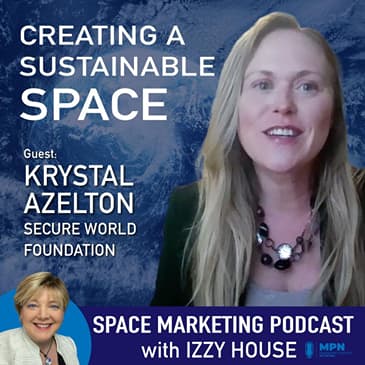
Izzy chats with Krystal Azelton, Senior Director of Program Planning at Secure World Foundation. She is a passionate voice about getting the space message out into the public. Krystal works tirelessly as she is driven to ensure that space is secure, sustainable, and peaceful for future generations and our planet. She travels all around the world to spread the message of how important space is in our daily lives.
Krystal Azelton
Secure World Foundation
https://swfound.org/
Chapters:
01:15 Introducing Krystal Azelton, Senior Director of Program Planning at Secure World Foundation
02:30 Krystal’s journey to space
07:38 Becoming the megaphone for a cause
10:48 The message of value about space and the connection to the environment
14:46 Importance of communication and our audience
15:47 Importance of messaging for the future of space and its space sustainability
16:49 Messaging impacts innovation, budgets, policy, regulations, and the future workforce
20:02 Workforce - appealing to this generation who want to make an impact in the world
22:19 Inspiring our children - space relates to many industries
24:58 Space need everyone from accountants to marketing to scientists
27:03 Marketing is multifaceted
27:43 Space sustainability
33:15 Taking action
35:36 Outside of the bubble
37:59 Creating a healthy space industry
42:23 Final thoughts and a challenge
ABOUT IZZY
Izzy's website - https://izzy.house
Author of Space Marketing: Competing in the new commercial space industry AND Space Marketing: Spaceports on Amazon and Audible - https://bit.ly/Space-Marketing
Podcast host for Space Marketing Podcast - https://spacemarketingpodcast.com
Organizer for Space for Kentucky Roundtable - https://spaceforkentucky.com
Hosted by Simplecast, an AdsWizz company. See pcm.adswizz.com for information about our collection and use of personal data for advertising.
[00:00:00] Welcome to the Space Marketing Podcast. We look at marketing principles, strategies and tactics through the lens of space.
[00:00:09] Hi, I am your host Izzy House. Today we chat with Krystal Azelton, Senior Director of Program Planning at Secure World Foundation
[00:00:18] about sharing the message to ensure that space is secure, sustainable, and peaceful for the future generations as well as our planet.
[00:00:30] So, lift off in 3, 2, 1!
[00:00:44] Welcome to the Space Marketing Podcast.
[00:00:48] Information relating to our discussion today and links to the video version can be found in the episode
[00:00:53] show notes on spacemarketingpodcast.com. Please like and subscribe to the podcast.
[00:01:01] It will help more people reach beyond the atmosphere.
[00:01:06] Information in this episode is for entertainment and information only. Please consult a professional for your specific situation.
[00:01:15] A few weeks ago, I was at the Small Sat Conference in Logan, Utah, and it was really a great conference.
[00:01:23] It was my first time there, and it was so much fun. I was invited to speak on a panel by our next guest.
[00:01:31] She is a passionate voice about getting the space message out into the public. She works tirelessly as she is driven to ensure that space is secure.
[00:01:43] It is sustainable, and it is peaceful for our future generations and our planet.
[00:01:49] Crystal, Asulton, Senior Director of Program Planning at Secure World Foundation, travels all around the world to spread this message about how important space is in our daily lives.
[00:02:03] So welcome Crystal! How are you doing today?
[00:02:07] Great, Izzy. I'm so excited to be with you here on this podcast. Thanks for having me.
[00:02:13] Oh, it is a delight to have you. And thank you for doing what you do. It is so needed. It's why I am here with my podcast, is because this message needs to be told.
[00:02:26] And space needs to be told. But before we get into the nitty gritty, let's talk about how you personally became interested in space.
[00:02:37] What's your journey and how did you discover the space industry?
[00:02:41] Yeah, thank you for that. So yeah, like many people I didn't necessarily follow a traditional career path into this space industry.
[00:02:49] I was a bit of a space geek as a kid. You know, I went to space camp and I collected collectibles and I was really excited about it.
[00:02:56] But when I was 17 years old, I was just smart enough to realize I probably wasn't going to get to be an astronaut and I didn't really want to be a scientist or an engineer.
[00:03:04] Like I really liked spaces and idea. I loved the idea of colonies on Mars. I found the whole thing very exciting, but I couldn't see a place for myself in the industry where my strengths were more in English and social studies and all these other areas.
[00:03:18] I liked reading about science that I didn't necessarily want to be the scientist. And so I followed another passion of mine which is politics and international affairs.
[00:03:27] And I went to Georgetown and study those things. And I did development work around the world for a number of years and really loved it, but eventually kind of came to the conclusion that I didn't necessarily want to make that my long-term career. And by then,
[00:03:39] I knew enough people in Washington and I've realized like there's whole parts of the space industry. There's whole professions that, you know, aren't necessarily technical but that can contribute to this really great industry.
[00:03:50] And so I did a big career switch and I was in my mid-20s and talked my way into a job working on a contract at NASA headquarters where I got to do.
[00:03:58] Well, I think of as like interagency communications between all the different branches. So really helping the scientists report out in vice versa and over time that's you know turned into the career I have now.
[00:04:08] But so for me it was really about kind of combining all the things I was passionate about. It is only kind of gotten better too because a lot of the work that I originally did in development, you know, trying to help communities around the world.
[00:04:19] As more time as past those communities and those projects work with space even more. So now part of what we're going to talk about today is like the benefit that space has and how we communicate that and how we encourage the adoption of space.
[00:04:31] And that's what I started with, you know, I talk a lot about being a young professional on the ground who kind of vaguely knew that space might be helpful in space data but not really sure how to use it to someone who now works on that.
[00:04:44] And so it's been kind of in a different journey. But one that I think is really applicable in this space industry. Again, we talk a lot about stem. We talk a lot about the hard sciences which are super important and we always want to encourage people to go into those.
[00:04:57] But for the space industry to thrive and to grow we need marketing people and comms people and politicians and lobbyists and you know people that you know do all kinds of different jobs and so it's kind of neat to be able to speak to that a little bit too from a personal angle.
[00:05:13] Well, your title is program planning. So what is it that you do with program planning it's cure world?
[00:05:21] Yeah, absolutely so I couldn't be happy where I landed in the end. I felt quite privileged. I am with this cure world foundation which we can talk a little bit about which is a non-profit based in Washington DC and Colorado.
[00:05:32] And our mission is entirely space sustainability which these days is a fairly hot topic. So all assume the readers are the listeners have a decent understanding of that but 1015 years ago that wasn't really the case.
[00:05:42] And we really work to promote space sustainability solutions all around the world. So as you can imagine, we have a number of key areas, you know things like debris and space situational awareness are really important to us.
[00:05:53] But so I think it's like commercial best practice and space law and even security in the role that it plays in geopolitics regarding space sustainability.
[00:06:02] So we work on all of these things. And actually my previous role to cure world which I still do quite a lot of and is a bit more relevant to this conversation is I was the director of human environmental security and space applications.
[00:06:14] And so really trying to understand the policies and best practices around how we actually use space in space data and communicating that to the world.
[00:06:22] My current role is a little different one of my colleagues left a few months ago and I've taken on some of his duties, some of you know him brand-new even.
[00:06:29] And what I do now is really help the organization think strategically as well. So I kind of do my projects and one side.
[00:06:34] I run things like we call this summit for space sustainability.
[00:06:37] But then it also really helps us with our strategic thinking, our budgeting, our program planning. We are in on-profit with an endowment.
[00:06:43] So every year we go through a budget planning process to decide what projects are we going to respond to, what are we going to do this year.
[00:06:50] And it changes, you know, space environment changes every year, what becomes really important, you know, it's not a month to month kind of thing.
[00:06:55] But we really try to be adaptive to where the trends are and what all the other actors in the system are because we're there to be a supporter, a convener someone who's doing research and holding events to talk about these important issues and help other people come to the solutions.
[00:07:10] So we're kind of unique in that way. We're not a classic think tank, we don't just do research. We really are out there trying to push for solutions and help others to get to know each other so that all of the different parts of the space community can recognize which I think is pretty common these days.
[00:07:26] But also make progress towards space sustainability solutions because if we don't do that obviously then the benefits from space at some point in the future could decrease and that is really what our organization is trying to avoid.
[00:07:37] Well, and I'd like to really point our own to that even though you're not, you're not a marketing professional marketing is a huge part of what you do.
[00:07:49] I mean, you are the megaphone that is something that you're getting the word out there, you're on social media, you're on panels, you are spreading the message.
[00:08:00] But you're not in marketing and my point to everybody is, is that we're all in marketing number one. Number one, we are all in it.
[00:08:13] So if you want to talk about how did you become the megaphone? I mean this is not something that you just wake up one day saying, oh, I want to be, you know, the poster child for this particular cause. So how did you get there?
[00:08:26] Yeah, so I'll talk about two things one a little bit with the organization and why we feel these issues are so important. And then a little bit myself and how I actually got really interested in marketing you know you and I connected over this event that I put together it's small side which one of my favorite conferences highly recommended to everyone.
[00:08:40] But also like other events around the world that I actually feel really strongly that what you just said is true that we're all marketing marketers in space and I think when some ways we need to do a better job of it. And so secure world as an organization is very much as you said kind of a mouthpiece for this issue, you know, we're not necessarily saying well this is the only solution to space to see inability because we're just want to play here.
[00:09:01] But because of our early mission early on we realized that the understanding of this topic and how people were going to approach it was going to vary right you have global approaches, you have national approaches, you have how commercial industry is really grown.
[00:09:21] And so a big part of what our message is that everybody has to care about this, everybody has to work on these topics, everybody needs to be thinking about this that we can't just go about our business of running businesses and you know doing government projects etc.
[00:09:33] So our organization works really hard to do that and you know that just because you said involves getting out there and involves doing studies and doing research and making sure people understand the importance of these issues and where they're going to go and but what that might look like in the future.
[00:09:51] And so as long as we really spend a lot of time on that but we also have we're learning to do our own comps you know I something I say to space companies is you know how how is your marketing how is your BD, you know we often focus on the science and the technology.
[00:10:04] And where we are and we forget about kind of the softer pieces of making a saw work in my organization was no different we hired our first contractor recently actually within the last two years.
[00:10:15] And so you know we as organization to want need to think more about this and then I've gotten really passionate about space marketing.
[00:10:23] A couple years ago I was really observing kind of two parallel trends and I kind of started incorporating them into my work at secure world foundation so the first was that there is obviously a huge focus on commercial launch.
[00:10:34] And particularly on sort of the non scientific part of launch so you know whether you call it space tourism or whatever you want to call it there's a lot of public consciousness around that and a lot of the news coverage that I was seeing was not terribly good.
[00:10:47] And a lot of it was driven by us they're not all of it some of it is something that just the story lines that the commercial regular media is going to pick up.
[00:10:54] But I also saw kind of a lack of focus on why we wanted to do this like why is it important to look at exploration why do satellites matter and so I kind of had that observation and at the same time you know I also have a teenage step kids and so I mean I'm online a lot looking at social media and a lot of coverage that I saw in this space community there was also fairly dismissive.
[00:11:14] And so one of my big concerns for to be is that I think in the space community we're all really passionate about what we do it's so cool it's so fun you know a lot of us like me did this from the market.
[00:11:25] And I don't know that the public consciousness is quite there with us and I suppose I'm mostly talking about the West but not entirely.
[00:11:33] And I think that you know it's there's always been critics of space is this we're spending money on why are we investing in this why does this matter that's not new.
[00:11:40] But the voices are getting a little louder you know one year and one super bowl there were multiple commercials that touched on space is frivolous why are we wasting money on space and that just surprised me it's like this is super bowl why is this a message.
[00:11:54] And a patagonia came out with this huge add all around the world there was all about you know we're about the earth not Mars and like that is just not how I want this space community to be viewed by others.
[00:12:06] And the only people that can really fix that is us.
[00:12:09] I would like to touch on that a little bit is that okay if patagonia wants to go in that direction about carry more about the planet they don't have to go very far before they trip over space.
[00:12:21] You know if we want to better our planet and we want to fix our climate where do we go we go to space to do that and so that particular campaign.
[00:12:34] I personally don't get because.
[00:12:39] You need space to do what it is that they were talking about doing so you know that I just wanted to throw that in there that I realize myself which is why I'm here is because I saw space not doing a very good job of getting that message out.
[00:12:55] I mean we carry space in our pocket with our phones.
[00:13:00] Everything about this thing is space and yet most people have a disconnect so.
[00:13:06] And yes please please continue.
[00:13:08] Well that's exactly how I felt so I started looking at this and you know from my side of it someone who works on the space policy it's like you're not going to get better space policy if we don't start from a fundamentally basic place of why space is important.
[00:13:21] And so I started doing some events and looking at this back in 2022 you know trying to get space community to think about some of these things and for me to get a better understanding and then slowly I'm not to know folks like you who are really kind of the pretty butter people.
[00:13:34] Working on this issue and I think.
[00:13:38] I think that message of really trying to focus on the communities and how we are.
[00:13:44] Show casing value and look it's not that every single person everywhere needs to understand exactly how space is a part of their daily lives.
[00:13:51] But at the same time I feel like we sometimes talk in an echo chamber and if we don't do a better job of getting that value out there we're going to see a decrease in investments we're going to see push back from the public because they do assume this is a boom dog or it's just a bunch of rich people are all these things not really true.
[00:14:06] But it's easy to see that or you know I say let a misinformation online you know rockets are terrible for the environment okay we're looking into that but also some rockets don't even you know some rockets burn hydrogen.
[00:14:17] Yeah there's one rocket that uses plastic bottles it's actually a green rocket so we're looking at using cow dung and methane and things that are considered to be.
[00:14:30] You know where we're using green technologies and once we figure that out with rockets then guess what it comes back down here it comes back into our energy supply.
[00:14:41] And we use it for other things so all that comes back down even with rockets.
[00:14:48] Well exactly and so I've just gotten really passionate about trying to incorporate into our messaging and to our work where I can.
[00:14:54] This idea of the space community itself whether you're a business whether you're an academic whether you're in government etc that we really can't dismiss the need for communication so for me it's not always just marketing.
[00:15:06] I think sometimes it can be that broader communications kind of grade but the same message applies is that if you are thinking about your audience fear thinking about what they need to understand you will some more you will be able to get more resources you'll be able to do all the things that we want to do but a core part of that.
[00:15:21] As being able to communicate about why it matters and what we do it because is you said that the reality is there you know this is you don't have to go very far to find that benefit.
[00:15:32] But you do have to focus on communicating it and helping people understand in terms of this approachable to them as opposed to very scientific or very technical or assuming that we're only talking directly to our sellers.
[00:15:44] I think that's a mistake that we often make in the space industry is that you know if you go you look at websites.
[00:15:51] You know how are they structured who are they communicating to that sort of thing and so yeah the come really passionate about trying to incorporate some of these messages into my work around space sustainability which I do think is a strong message but you know also admitted all tear your motive you know in my case.
[00:16:06] I want people to understand the value space because I also want to make sure that we continue getting that value.
[00:16:11] Which means thinking about space sustainability and space environmentalism and making sure that we're taking the correct steps to have access for the long term and then as we expand.
[00:16:21] You know beyond the nearer than environment are we thinking about all the sustainability issues in those environments as well and so those are big topics but it's exciting for me.
[00:16:30] And they're all kind of part and parcel you can't break them out if we're going to have conversations about the future.
[00:16:37] We have to be thinking about how people understand our industry now I mean the truth of the matter is it's very easy to overlook space but we shouldn't be.
[00:16:45] And so yeah that's become a big part of what we do at secure world.
[00:16:49] Well one of the the concerns that I have is that it does matter on politics it does matter in how things happen like for example NASA budget is being cut severely and this has really large ramifications because.
[00:17:08] Okay say the Artemis program gets pushed to the point where China puts the first person on the moon before us that has geopolitical ramifications and.
[00:17:22] If the public doesn't think space is important then they're not going to make it to where is part of the larger budget.
[00:17:30] They're not going to make sure it's in schools a lot of schools have taken science out of pretty critical ages and you know that that's something that we is really important with this message it's it's how we inspire the future workforce.
[00:17:47] Do we want them to just flip burgers or do we want them to reach for stars you know so it's a choice that we're making with our dollars and with our message.
[00:17:59] Yeah I couldn't agree more on the budget area and resource question and on the worst workforce question so you know it comes to the US budget I'll be honest with you I think we're almost maybe a little over reliant on that classic China is the threat situation.
[00:18:13] I think that's driving a lot of space force budgets I think we're trying to use that to drive NASA budgets and I personally think it's a bit of a mistake of course I have National Security concerns there but I also think.
[00:18:23] That we need to focus on the real reasons like the really core reasons of what you just said as to why we need to fund these things we need to fund this for future innovation we need to fund this for STEM reasons we need to fund space and space activities whether they're exploration whether they're satellites.
[00:18:37] You know whether they're exploratory programs trying to figure out really interesting things because that is the future of our world we're already dependent on these technologies we need to remain.
[00:18:48] In competitive globally but you know also from an internal perspective and so I absolutely worry that budgets are being cut they're being reallocated what we prioritizes becoming more political space was often kind of viewed as a very bipartisan issue and I think there's still a lot of truth in that comparatively to other topics.
[00:19:06] But it's not 100% and I do think we've slowed down.
[00:19:12] Our funding for space you know again I work on the regulatory and policy sites when addition to NASA budgets I also worry about like the office space commerce and the FAA and all these other agencies that do really critical space infrastructure stuff you know they work on the regulations they do the licensing they help commercial industry grow etc.
[00:19:29] And those places are also stymied by you know often on a lack of budget or a lack of clarity we've been debating a lot of policy and regulation in the United States for years now and it's all great.
[00:19:40] And we've slowly made progress among multiple you know across multiple administrations but we need to keep working on that and you know we are global leader on these things if only by the size and number of the satellites that we have and so I really want my nation to lean in and be a leader on this scientific front on the policy front etc.
[00:19:57] And really showcase what it is to be a space nation and what that means and the value that comes from that.
[00:20:03] And on the workforce I could not agree with you more.
[00:20:06] I'm very concerned on this front and I think part of the answer is better marketing and what I mean by that is you know the young generation coming in is very aware of the problems in the world, you know they are very concerned they're very socially active.
[00:20:23] They want to have careers that are fit their lifestyle but also that have a purpose.
[00:20:30] And so if we focus only on the technical and we focus only on that kind of thing I think we lose a decent portion of young people who is used that are we even training them and teaching them from an early age but then beyond that are we showcasing them that you can go be in this industry and you can work on climate change.
[00:20:47] If you're passionate about disasters if you're passionate about any of these things spaces a part of that solution a really big part of that solution.
[00:20:56] And I think we're missing that link sometimes and that to me is a huge loss selling point to young people, you know who are growing up in this world who are very concerned about all these things.
[00:21:07] And so why would we not make that case? Why would we not present hey look at our amazingly cool industry. Oh and by the way you get to help the world.
[00:21:16] And I think that is something that we should be doing a lot more. I think right now we focus a lot on oh look astronauts aren't astronauts cool and look I like an astronaut as much as the next person.
[00:21:25] But I don't think that that's the selling point to the next iteration at least not here that it used to be. I think we have to focus on purpose and value and the benefit of space way more than we used to people don't just assume its meat we have to show them that.
[00:21:41] Hold on to your boosters we will be right back with guests crystal asalton senior director of program planning for secure world foundation after the brief and smashage from our sponsors.
[00:21:53] Please like and subscribe to the space marketing podcast so you don't miss a thing.
[00:22:19] Well and there's also another problem that's happening with our youth today is that they they don't have something to work for as a group as you know something that's bigger than themselves and something that you know makes them feel like they belong to something greater and better
[00:22:39] and it is so important that we inspire them and make them feel like a part because suicide is a drug use is a you know there's all these things that compete for our children's lives.
[00:22:55] And space is one of those things that can give them inspiration it can change how they go to school and this is why I am here is because I have seen it work I have seen those that 14 year old that was transformed.
[00:23:12] And is successful because of something like space I mean space for me is a vehicle for inspiration for our generation and so that's why it's important.
[00:23:27] Well it's interactive learning it's the opportunity and I mean that's something the beauty you know we've made space it has become more approachable right.
[00:23:35] There are more opportunities for young people to get involved to get hands on to understand whatever their passion is I mean one of the other things that we touch on briefly but that I always like to point out is that the opportunity for space to affect pretty much any industry you want any topic you want in the world is very real whether it already is.
[00:23:53] Or there is the potential like the potential fairly endless you're passionate about animals there's ways that you know effects that if you're passionate about elections and politics there's ways it spaces used in those circumstances to make produce better results and that's that tangible hands on learning.
[00:24:10] That is so applicable and then when you show someone that hey this science is part of you whatever you're interested in you know you can be interested in urban housing development and spaces of tool that is used in that field.
[00:24:21] And if it isn't it can be so I think that that's a lost opportunity to showcase you know how key sciences is to all parts of life it's a much more hands on application of space is applicable now you can talk about other biology is of course it is but it's so much easier to show someone hey look at this link and look at what we use the data for and look where the data comes from and look what you can do with it you yourself have access to some of that's that kind of thing.
[00:24:48] And that can be not just inspiring but it's also something where it becomes yours like you you can already do things with it right away and that's really exciting to me.
[00:25:00] And if you have somebody in your family that's suffering from something like osteoporosis or Parkinson's or you know there's things that are going on right now in space that are making those things better.
[00:25:14] Diabetics the strips that we that test our blood sugar came from testing astronauts up on the ISS you know there's so many things like that.
[00:25:25] One of the companies that I have locally in Kentucky that is a space tango they are building artificial retinas to be able to give people with macular degeneration eyesight how is that going to impact this world when.
[00:25:43] You can give somebody eyesight so there's so many things you know from marketing to.
[00:25:50] Planning to you know what if you just like the finance part or any any kind of career that you want to do there's probably a space career that's pretty comparable.
[00:26:02] Yeah well and we need those people that goes both ways like I want to inspire that generation but when I want workforce issues I also want those people to come looking for jobs in our industry.
[00:26:11] You know our industry can't exist and do well without accountants and all of these other.
[00:26:18] careers and sure somebody might just stumble into one of these jobs and that's fine but actually to showcase like the complexity of the world to say that you can go do this one thing and then you have your pick of what industry you support.
[00:26:30] And if you want to support an industry that's really relevant and really important this might be the one for you.
[00:26:36] You know if you don't want to go do science you don't have to but you can work in an organization and do their counting and know that the work that you're supporting is you know as you said changing lies around the world.
[00:26:46] And I think that's a really powerful message plus a benefit to us too because people need to know that you know we're open for business and that we need all of these people.
[00:26:54] You know workforce doesn't just mean stem it means all the workforce that you need to support your your industry and your community.
[00:27:02] And one of the things that I talk about is like marketing itself is like a big diamond and there's different facets you know when people think of marketing they think of the sales part which is important it's the human touch to marketing is the sales part but marketing is also education.
[00:27:20] You know when you're talking to that 14 year old and you're talking about different careers you're marketing to that 14 year old and they're choosing an identity based off of what the message is that you're giving out.
[00:27:33] So education is my favorite because it makes people better and you're very focused on education so.
[00:27:41] You want to talk about how you personally got to be the megaphone and and what does success look like for that particular endeavor for you.
[00:27:55] It's such an interesting question and so.
[00:27:58] Because I work in a space sustainability field one of the big things for me is we've kind of shifted our goals in the last few years so when my organization started and even when I came on which has been quite a while now.
[00:28:12] One of our biggest focus was awareness raising you know get people to care about this topic get people in this basic community to talk about space sustainability talk about the different challenges and that's still something that we do right.
[00:28:22] I think a lot of people here's based in bling the only think of debris and that is not.
[00:28:29] That's only a part of the question you know we talk about spectrum that we talk about space weather and we talk about all these other things that contribute to space sustainability.
[00:28:37] And they're just as important and there's more important.
[00:28:40] But at the same time I would say that that has generally been fairly successful so between us and many other organizations working on this topic.
[00:28:47] You know you can't go to a space conference these days and not hear about space sustainability which is great.
[00:28:52] But talking about it isn't the same thing as doing something about it.
[00:28:57] And so that's a big part of what we try to use our megaphone for is what can we do? How can we do about how can we encourage others in this space community to take their part and and making and finding these solutions and to recognize there is an urgency here.
[00:29:13] Space is a place where you can get the technology can get out in front of the issue just like any other field.
[00:29:19] Why do we have some of the problems we have on earth because technology and human action and all these things got in front and got out in front of what was necessarily the best way forward.
[00:29:28] And it's a balancing act right.
[00:29:31] You know my organization absolutely support commercial development of space.
[00:29:34] I'm going to say that I'm going to be able to do my organization absolutely once governments to continue all of the different types of missions that contribute to lay funer.
[00:29:40] If we want to see all kinds of space activity in the forward but we want to see that done in a responsible and obviously sustainable manner.
[00:29:49] And that is actually defining what that is and how to do it is harder.
[00:29:53] And so, you know, my personal journey is to try to figure out what can I do and what can my organization do to really push buttons and move things forward.
[00:30:03] And where can we be creative? And so a good example of that is back in practically the 2019 now.
[00:30:09] You know, I proposed internally of my organization that we hold in the vet not that the world needs more space events but I was starting to get this feeling that space can be quite siloed.
[00:30:19] I'm sure you guys find this true in the marketing world too. Like, you know, the people that do this talk over here and the military people talk over here like the different people talk in their little silos.
[00:30:29] But when it actually comes to solving certain problems, I think we have to break through those silos. You know, the academics need to talk to the politicians politicians need to talk to the industry people and they need to talk to all of the industry people and not just the people who are knocking on their door asking for something.
[00:30:42] And so we put together this event, which is now just had it six one the last one was in Tokyo until I moved around every year and the idea is that it's it evolves. Like we don't make money off this event. It's not designed to produce revenue from my organization's design because we sit at the nexus of a lot of these issues and can bring together all of those different people. And it was actually at that event back in 2022 in London where I did my first session on marketing where we did a big big panel where I got like,
[00:31:12] marketing people and journalists and others to basically tell the whole room full of space people. Hey, you're not doing a very good job.
[00:31:18] It was great. And but it was a way of exploring these topics and we really believe that if you can breakthrough some of those silos that you're going to make more progress than you will separately because it's really easy to identify a problem.
[00:31:30] It's a lot harder to actually find a solution and then make that happen. And so that's really kind of how we judge ourselves is can we contribute to those things, you know, what can we do? Can we identify points to that.
[00:31:41] And that's been a really exciting place and I'm really privileged to work at a place where I can be creative and come up with new ideas and think about what can be most useful for the world.
[00:31:50] And so my favorite thing about working at a nonprofit is that you know, I have that room for creativity to support things and come up with new new products and new ideas. You know, one of my colleagues a few years back they will also in 2019.
[00:32:03] You know, came up with this idea around counter space capabilities. So this is another topic that if you don't work on space sustainability, you might not think about it is really key but the ability, you know, there's all kinds of counter space capabilities.
[00:32:14] You know, basically, you know, anti-satellite weapons. But the kinetic ones, the ones where we actually shoot down and break up satellites are the most concerning from I sustainability perspective.
[00:32:24] And my colleagues put together this amazing resource of your interest that it's all is out there.
[00:32:29] Where we went around and we said, well, people don't want to talk about this because it's tied to militaries and that's a lot of it's classified.
[00:32:34] But they said, but actually we all know what the problem is. Like the stuff that we need to talk about isn't classified. It's just there's this like overlap. So we have a paid document that's nine interfaces long with over a thousand citations of everything we can verify from public sources. So yeah, there's things that aren't in there.
[00:32:50] But we really tried hard to put together a resource that could serve as a basis for conversation. And so those are the kinds of things that as an organization like mine, we're really excited to put out there in the world.
[00:33:02] To basically help governments and companies how conversations about what a safe environment looks like. So is there just some examples of some of the things that I do my colleagues do that.
[00:33:12] We think contribute to this larger conversation.
[00:33:16] Well, one of the things I like about what you do is not only do you think about what needs to happen as a base and what the message would be for that.
[00:33:26] But you measure the success of it by action. You know, it's one thing to have a good message is one thing to for people to listen to another thing for people to take action based off your words.
[00:33:39] And that's where you really are, you're doing the right thing. You're ringing that bell.
[00:33:46] Yeah, we absolutely try to do that. I mean, that's the real passion and the joy.
[00:33:50] But it's also as we design events and we come out to this topic of marketing.
[00:33:54] You know, it's something where I really try to showcase positive action and to showcase to the community that there are people working in all facets of these topics.
[00:34:06] And so it's been really interesting to get to know other parts of the space community as well.
[00:34:12] And, you know, professionals like yourself who are working on this various specific piece of this and so exciting to see to see change.
[00:34:19] And to be able to be a voice that, you know, isn't Hamburg I guess is one of the things I really like. So for instance, I did a session on space marketing.
[00:34:29] A climate change space climate change conference in Oslo, a few years ago.
[00:34:33] And we really got some speakers up there, who are able to say look, you guys as websites are terrible. Your press releases are not focused on the people they need to be focused on.
[00:34:40] And it was really gratifying to actually have companies come up to me afterwards and they're like, I have a meeting next week with my marketing person because you know, you're right. Like all we do is have pictures of satellites on our websites.
[00:34:51] And I'm like, that's great, but that's just the place to start. You know, as you said earlier, you know, this isn't just about sales.
[00:34:58] But if you even want to build up to sales, you have to first start with understanding.
[00:35:02] And a lot of times the people you're selling to, especially if you're trying to expand your market, they don't know that much about this or their busy. And they need to understand it in things that are much more digestible to them.
[00:35:13] And I think we overlook how important is if we're going to grow the value that we have so that we can grow our businesses but also just have more benefit.
[00:35:21] We actually have to look at who we're trying to talk to and recognize that they don't know as much about this as we do that it is going to be a slow learning curve.
[00:35:29] And what materials and what products and all these things can be put out there, you know, all of us that help that.
[00:35:37] Well I call it talking inside the bubble, you know, a lot of the companies talk inside the bubble to each other.
[00:35:44] And yes, they know what's going on, they know the industry, but there are so many people outside the bubble that have no idea.
[00:35:52] And with commercial space going outside of the bubble, you've got companies like John Deer and Adidas and as they lotter that are getting into the space arena.
[00:36:06] But they aren't necessarily inside the bubble. So number one there's opportunities outside the bubble number one.
[00:36:14] Number two, a lot of the companies inside the bubble have don't even have marketing. A lot of them don't even have marketing people at all.
[00:36:23] So you know, let's get the marketing person in place and think of that as a valuable position because a lot of companies just, you know,
[00:36:32] the only person they had to woo was NASA for many years. They are maybe an investor, but even those are getting more and more competitive and you need marketing.
[00:36:44] You need somebody that knows how to craft that message resonate and make the listeners take action.
[00:36:53] And when part of my message is that and when you're doing this a lot of the marketing that companies do have, they're only trying to get customers with it.
[00:37:05] Take a little slice, you know, take and maybe just twist one of your messages a little bit to be out in the public because NASA's footprint is getting smaller and smaller.
[00:37:19] They're their budgets are getting cut, but even if they're budgets weren't cut, let's just say in a magical world, their budget wasn't cut.
[00:37:25] Their presence in the world is being minimized due to the explosion of space programs all over the world.
[00:37:35] You know, we went from two countries, us and Russia, to 80 countries with the last figure I heard that had space programs.
[00:37:43] So the just the sheer mass of the industry is making that voice even smaller.
[00:37:51] So if we don't think of it as an important thing to do, we won't have a healthy space industry.
[00:38:00] Yeah, I mean, it's that healthy part that worries me because yeah exactly the marketing and these kind of support services are some of the last thing that space companies want to spend money on.
[00:38:10] And it worries me.
[00:38:12] There's always going to be a retirement in this space industry, but I get worried that we build out really amazing technologies and then we do a poor job of selling them.
[00:38:21] And then these companies might go away and then we lose these technologies and then we're in this huge cycle where oh well that technology wasn't really viable. Well was it or did we just do a poor job of selling it?
[00:38:30] You know, there's there's I have a lot of questions about how we judge market business plans and market buyability in this space industry.
[00:38:39] And that I think we over emphasize this technology and under emphasize everything else that makes the business successful.
[00:38:45] You can have a really great product and a really great idea and you can still fail.
[00:38:50] And that is absolutely a lot of things.
[00:38:51] Yeah, and a lot of tech people don't want to feel like well if your products good, you're going to do fine.
[00:38:56] I'm like no, that's not true. That's not true. Did you have good market timing? Did you talk to people?
[00:39:02] You know, I would even say there's this middle ground between the public and NASA but there's like all these communities out there who kind of know that space data is maybe a part of their world or maybe they even use a little bit.
[00:39:13] But who aren't well as you.
[00:39:14] I mean, there's all these companies out there who really need to speak to their growing market. You know, who actually can use space data.
[00:39:23] Maybe they are a you look at you said maybe they're John deer and they already use a little bit of their integrating certain things into their technologies.
[00:39:30] But really trying to speak to that community of people who are looking to expand their businesses but also understand that those people are busy.
[00:39:37] Those people are not out there looking to buy things and you need to like present them with packages that make sense and that they can ingest and sell internally.
[00:39:48] And then you can then you can focus on selling them things, but if you don't give them the tools to make a case outside of the space industry, then you're cutting yourself off. And yes, it's a long tail those are not always going to be easy sales but that's where we're going to grow.
[00:40:01] And so I think we have to come up with ways to do that effectively and efficiently. And this applies to small startups and it applies to large space companies as well. They're not always better at this.
[00:40:11] I've had conversations with some of the large EO providers who will tell me, yeah, we don't have time to focus on the long tail like we've got to focus on our primary clients and I'm like okay.
[00:40:21] But you how are you going to get more clients? Like I guess I just don't understand that logic or if you go into the websites, the somebody's company is like clearly they think the only people who go on their website are people who already know all about them.
[00:40:34] And so it's data and statistics and pictures of satellites and there's very little storytelling, there's very little contextualizing on why this matters.
[00:40:41] Or even if you want to get more specific, very little in the middle where you talk about well if you work in this industry, this is how our company's products apply to you and here's who you call to utilize this data.
[00:40:55] It's just not there. It actually surprised me because it's not just small startups with no budgets that have this problem.
[00:41:01] I mean it's all of these companies, there's a lot of them and we really have to get better at it or we're going to start to see more and more companies fail and like I personally don't want to see that.
[00:41:11] There's a lot of great products that never make it when I started my career I was an environmental technology incubator and I saw life saving technology for the planet die because people thought that if you have a cure for cancer
[00:41:30] they're obviously going to find you. No, they're not. They are totally not going to find you unless you tell them you exist and when tell them why they should care that you exist.
[00:41:46] So we've talked a lot about what companies can do, you know, care about your message a little bit, care about the space industry more and care about the public a little bit more.
[00:41:59] And you can see massive changes if we all do just a little bit. It doesn't have to be just all NASA doesn't have to be all one entity, you know it could be just a little bit of all of us.
[00:42:12] You know, be creative with your marketing person's time and see where you can just expand the story a just a little bit.
[00:42:22] So are there any last words or final thought you want to leave our audience with today as we start to go through our day and maybe a challenge on what they should do?
[00:42:35] Yeah, absolutely. So I'm going to assume that a lot of people listen to your podcasts are the marketing professionals in the space industry but even if they're not as surprised which is one of things I used to do at NASA was help the scientists talk to other people right like they would write these very scientific things and then I would look at it be like well what you really mean here or can we define what that is or how do we tell this to an own be auditor.
[00:43:00] So I mean, I had a lot of work early in my career with like translating science speak to words that other people understand and I would encourage everyone who listens this to like really take ownership of that because I agree with you.
[00:43:12] If we all did a little we'd see a lot of result but first it comes from framing and not assuming everybody finds what we do cool.
[00:43:19] So start from a place of like the people I'm talking to are not enthralled as I am with satellites and astronauts and all these things.
[00:43:27] And then figure out what that means for your company or your organization and if you're the communications person, if you're the marketing person do not be afraid to tell the scientists the CEOs and all these other people you're not doing this right.
[00:43:39] They're really smart people they know what they do and they do it really well but one of those things is typically not communicate.
[00:43:47] Again, I've met a lot of aerospace engineers in my life and a lot of them if you make a joke about a rocket scientist don't even know why that's funny.
[00:43:54] So let's not start from a place that everybody is a good communicator and that's okay we all have different skill sets.
[00:44:00] And so my challenge would be if you are someone who knows I communicate or if you're someone who's in a position to make this change to really challenge yourself to think about who are all of my communities.
[00:44:10] If I came to my own website or if I came to my own presentation and then should be all of your communications, there should be any time anybody speaks it should be what you put out on social media it should be all these places.
[00:44:21] Really look at it with a challenging eye and try to ask yourself can we do better and who are we trying to talk to here and is this an effective way to do that.
[00:44:31] And don't be afraid to work with others who those aren't their skill sets to help them get better or at least help them improve because that's I think we're going to make you know if we bring in these other skill sets more and more to the space industry we're all going to get better.
[00:44:43] And that's a responsibility that we all have and so my challenge to everybody would be don't don't take this lying down and understand that it is something that you can improve piecemeal but you can also improve wholesale it's a whole conversation.
[00:44:56] But at first you have to really understand that marketing yeah is not just about sales but it will improve your sales.
[00:45:04] But it is about the viability of our whole industry and so really coming on it with that critical eye with an understanding that if you if what you put out there can only be understood by 10 people in your company that's a place to start.
[00:45:18] And to really seek to improve that there's nothing wrong with aesthetics there's nothing wrong with figuring these things out I think sometimes in the science community can be quite just painful sometimes at these kinds of skills and things that we shouldn't be everybody has different things to bring to making.
[00:45:35] Making this all successful and if we're going to do that that means is all being wow let me look at this and figure out like if you know if my you know my child looks at this what are they going to come away from this if my grandma looks at this what are they going to come away with.
[00:45:49] And you can't win you can't speak to every audience all the time but if you put yourself in that audience mindset.
[00:45:59] It's much easier to figure out where you can make changes and tweaks and still present what you need to present you know like we provide you know high resolution blah blah blah all really important but it's not important if you never get their intention.
[00:46:10] If you aren't actually got people paying attention it doesn't matter how good what you're doing is or how interesting it is.
[00:46:16] So you have to start from a place of whom I talking to and how I told it in a way they can engage with me.
[00:46:23] So that would be my challenge to everyone is don't be afraid to speak up this is really an issue it's great to see people like you is working on it full time I wish I could I do think it's really fun.
[00:46:32] We try to do our little piece of secure but you know we all should consider ourselves empowered to improve this because if we don't we will see cut budgets we will see loss of resources we won't see an expansion of our industries and so to me it's relevant to everybody.
[00:46:47] And like we started off this conversation we are all in the marketing business.
[00:46:54] So whether or not you you focus on that or not we are in marketing so and we need to market space.
[00:47:03] Absolutely.
[00:47:05] A special thanks to Crystal Asulton Senior Director of Program Planning at the secure world foundation for sharing her journey to space.
[00:47:15] Information about today's episode can be found in the show notes on space marketingpycast.com.
[00:47:23] Please like and subscribe to the space marketing podcast to help us get the word out about this incredible industry of space.
[00:47:32] I hope that you have found this podcast useful for your journey as you reach for those stars.
[00:48:06] This podcast is heard along the marketing podcast network for more great marketing podcasts visit marketingpodcasts.net