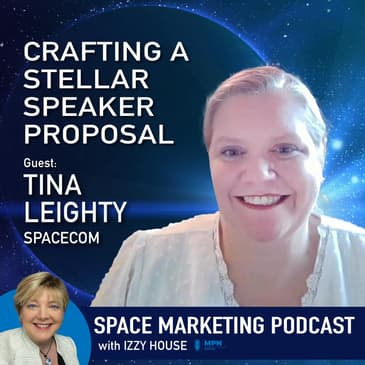
Getting your brand on stage at an event is a powerful marketing strategy. But how do you get selected to speak? Join Izzy to find out with guest Tina Leighty, Content Manager and Program Chair for SpaceCom.
They will talk about what an organizer looks at when selecting speakers and how to make your presentation proposal rise to the top of the submissions. Tina and Izzy will discuss crucial DOs and DON’Ts for aspiring panelists and keynote speakers, offering insights that can transform your approach to event speaking opportunities.
Commercial Space Week - January 27-31, 2025 in Orlando, FL
SpaceCom | 51st Space Congress - https://www.spacecomexpo.com
Space Mobility Conference - https://spacemobility.org
GSA Spaceport Summit - https://www.globalspaceportalliance.com/gsa-spaceport-summit-2/
Call for speaker presentations - DEADLINE: JULY 10, 2025
Izzy’s TINA Talk - https://youtu.be/VO0g8dt1uSw?si=lBNKFZ7BuzigNWjD
CHAPTERS:
01:12 Introduction
02:16 Meet Tina Leighty from SpaceCom Content Manager and Space Congress Program Chair
03:52 Tracks at SpaceCom and Space Mobility Conference
05:23 Speaking at SpaceCom
07:38 Getting interesting speakers and keynotes
09:12 Selecting panelists and TINATalks
09:54 Benefits of Speaking
11:56 Speaking is about the audience, not about selling your company
13:48 Filling out the speaker presentation proposal
19:21 Things to avoid in your proposal
20:24 The rating system for approval (how your paper can move to the top)
22:37 The criteria
26:46 Advice for would-be presenters
29:54 Toastmasters
ABOUT IZZY
Izzy's website - https://izzy.house
Author of Space Marketing: Competing in the new commercial space industry AND Space Marketing: Spaceports on Amazon and Audible - https://bit.ly/Space-Marketing
Podcast host for Space Marketing Podcast - https://spacemarketingpodcast.com
Organizer for Space for Kentucky Roundtable - https://spaceforkentucky.com
Learn more about your ad choices. Visit megaphone.fm/adchoices
[00:00:00] Welcome to the Space Marketing Podcast where we look at marketing principles, strategies, and tactics through the lens of space. Hi, I am your host Izzy House. Getting your brand on stage at an event is a powerful marketing strategy. But how do you get selected to speak?
[00:00:20] We will find out with Tina Leedy, Content Manager and Program Chair at Spacecom. So, lift off in 3, 2, 1. Welcome to the Space Marketing Podcast. Information relating to our discussion today and links to the video version can be found in the episode show notes on spacemarketingpodcast.com.
[00:00:55] Please like and subscribe to the podcast. It will help more people reach beyond the atmosphere. Information in this episode is for entertainment and information only. Please consult a professional for your specific situation.
[00:01:13] In past episodes, we have discussed how important being a speaker at an event can be for your brand awareness, your credibility, and your promotional strategy. It is one of the best ways to tell your company's story, be an influencer, or create a movement.
[00:01:31] You get it and you are on board with the idea. So, what's next? Well, now you have to get the opportunity to speak. There is a selection process that goes into choosing a speaker. How do you or your company get selected to speak?
[00:01:51] Well, today we will unpack what goes on behind the scenes and how speakers are selected with Tina Leedy, content manager and program chair for Spacecom. Hi Tina, how are you today? I'm great Izzy, how are you doing? Thank you so much for joining me.
[00:02:10] This has been a topic that has been being discussed among my peers for a little bit. Yeah, I'm just really glad that you can help the people that are listening to you today. It's really my pleasure.
[00:02:23] I got to tell you that I have been an avid fan of Spacecom for about six years and you are one of the ones behind the scenes that have made that possible. And I've even been a speaker at Spacecom and you may not know this.
[00:02:40] But it was on my bucket list and it was hanging on my mirror to be a speaker at Spacecom and you might my dream come true. And now I get to work with you. So that is awesome.
[00:02:55] Before we get too far along, let's talk about what it is you do at Spacecom. Absolutely. So I work as the content manager for Spacecom.
[00:03:08] And we are a an event that is works in collaboration with Space Congress, for which I'm the program chair, but essentially putting together the program is what I do for the event. And that means a lot of different things.
[00:03:27] But primarily, I do review every single submission and then we push forward the ones that we think are just the top tier. It goes for review through a group or program committee.
[00:03:42] And then we have to make some decisions because there's only so many slots that we have available for each conference. And you got to make it interesting too.
[00:03:53] I mean, it's not just enough just to have speakers and they've got to be something people want to learn and want to hear about. That's right.
[00:04:02] And so right now, Spacecom and Space Congress along with Space Mobility Conference, which happens in January 27 through 31 next year, they recently opened up their call for presentation proposals.
[00:04:16] And there were a couple of different categories that you're looking for. Do you want to talk about your categories this year? Absolutely. So our categories, there's basically these the Spacecom Space Congress conference has four different tracks that happen consecutively over a two day event.
[00:04:36] And those tracks this year are space exploration, space domain awareness, emerging technologies and the commercial space infrastructure. Now, because of some changes that have happened in the Space Mobility event, I'm also on the program committee for that event this year too.
[00:04:57] So they are really seeking out just the different things that are important criteria to the Space Force and Space Systems Command at this time, including launch services, range, sustainment and operations, space access, mobility and logistics, rapid delivery and orbital resiliency and collaboration with industry and partners.
[00:05:24] I want to tell you this is a huge undertaking. I mean, how many speakers do you have in one event like a Spacecom last year?
[00:05:32] I think we had just about 120 different speakers at the event last year between, again, the four different tracks for the Spacecom and Space Congress event, as well as Space Mobility.
[00:05:49] And if you think about different panels that were happening for each of those, those areas, as well as we offer up something called a Tina Talk. I know I'm Tina but it's I'm not the Tina because Tina stands for technology innovation and advancement.
[00:06:08] So think of it like a TED Talk, but we are not a nonprofit event so we are not sanctioned to have TED Talks.
[00:06:17] But we have Tina Talks and so those events were or those speakers were also happening on the main stage throughout the day and throughout the program. So it was a lot of juggling happening.
[00:06:30] Absolutely, because not only do you come up with what the tracks are, figure out who the speakers are, contact them, get their bios, their headshots and all that stuff just to get them to the day of the show.
[00:06:46] I mean, there's a reason why you start this early on creating the different tracks.
[00:06:54] Yes, we have to because if you think about what happens in industry and any industry really, you know, throughout the year, we don't really know exactly where we're going to be in January of next year.
[00:07:10] But we have a good idea based on where we are right now. And a lot of the things that we know that industry is looking for.
[00:07:18] So, you know, we do the best we can to make everything as relevant and interesting as possible. And sometimes we have to do some forward thinking to make sure that who we are very excited about having that that's going to be important, you know, six or seven months from now as well.
[00:07:40] And you get some very phenomenal keynote speakers as well, like Jose Hernandez, which I was totally fanning out last year when he was there. I got to meet him and got a picture and he's my favorite astronaut.
[00:07:55] I love his story. And so you get to reach out to those particular speakers as well and figure out who it is that's going to draw the most people.
[00:08:05] Yes. And that is a tough, tough decision to make. Because the submissions that we get a lot of those people also are interested in doing keynote presentations.
[00:08:20] But as again, you know, for opening ceremonies and opening sessions, as well as closing sessions, we really can only accommodate, you know, maybe four or five different keynote presentations each year.
[00:08:37] So, aside from all the people that we already are inviting, you know, the head of SpaceX and of course everyone wants to hear from Elon Musk. But that's probably not going to happen.
[00:08:50] But, you know, all of those caliber of people that we invite and we have to wait because they're checking their calendars. And maybe we have to go through a different agency to get them and do agreements with them.
[00:09:06] So sometimes we don't know until the very last minute who is it going to be up on that main stage.
[00:09:12] So, but the rest of the slots, the panels, you know, you have all kinds of different panel conversations and, and of course the Tina talks, which I got to do. And I was, I want to tell you, I was terrified for like three months.
[00:09:24] So, but it was an honor to do it. You did great. And I just want you to know, I don't know if you know this Izzy, but you were the first one. Oh, I was the first one.
[00:09:38] So, there's Tina talk that you can see on YouTube on the space calm YouTube channel. That's right. And I think all the other ones and it was, but it was, it was, it was terrifyingly exciting.
[00:09:56] So let's let's talk about what are some of the benefits of speaking and why are there so many people jockeying for these positions. I think, you know, some of the benefits that are important are that it is a way to promote your company.
[00:10:14] I know that's, you know, basically what some of the target of your podcast have been your sessions.
[00:10:21] And so it is a great way to promote your company or yourself maybe you have your own personal brand and you might be representing a company but you also are concerned about self branding.
[00:10:34] So those are definitely the benefits because our audience is pretty robust. We had about 3,500 attendees at our last event and that's pretty amazing. So, and we are targeting based on the growth projections that we've seen that we're going to be breaking that 5,000 mark in January.
[00:10:59] So that's a lot of people to get that message out to all, you know, right around the same time. So hundreds of people will see it thousands of people potentially will see it or hear about it.
[00:11:12] And also interact with all of those people that are attending. You'll get to interact with the other speakers which we've already talked about the caliber of some of the speakers that we've had.
[00:11:23] So you get to interact as a speaker with them as well and really influence potentially, you know, the future of the industry. So that's a really exciting thing for most people I think.
[00:11:36] Definitely. And it was why it was on my my mirror for so many years as a bucket list is because, you know, that and to me, Space Calm was it, you know, when I decided to go into space.
[00:11:49] Space Calm was the first one I signed up for and and now I pinch myself that I'm actually there. So let's get into the nitty gritty because promoting your company isn't what speaking is about. It is about the audience.
[00:12:10] And if you go up there expecting to do a commercial, you probably won't be asked back if you do that. So you want to talk a little bit about that.
[00:12:19] That's accurate. And I will tell you that I can tell that oftentimes based on what the submission says and how certain things are worded that they're really only focused on their product or, you know, selling their company services, as opposed to the bigger idea in
[00:12:41] the middle of the things that we're trying to promote in regards to those tracks and the different ideas that that we want to promote to our audience.
[00:12:51] You're giving the audience a service and you're you're educating them, you're entertaining them. And it's not even though it's about you, you're up on stage.
[00:13:02] It's about you. It's about them and it's about giving them what they came there to learn. You got to give the audience what they need and then they will will like you. That's right.
[00:13:15] Hold on to your boosters. We will be right back with guest Tina Leedy content manager and program chair for Space Calm after the briefest message from our sponsors. Please like and subscribe to the Space Marketing podcast so you don't miss a thing.
[00:13:46] You may know you're listening to this show along the marketing podcast network, but did you know there are other great shows on MPN to help your business? Kristi Heiler hosts a fantastic podcast called Own It. Kristi, tell us more about the show.
[00:13:59] Own It is all about celebrating women and non-binary advertising agency owners. We talk about buying out of the voice club of advertising because less than 1% of ad agencies are owned by women. And where can people subscribe?
[00:14:10] You can find the podcast at untilyouownit.com. We're also on the marketing podcast network at marketingpodcast.net. And of course you can subscribe wherever you get your podcasts. You heard her. Go subscribe.
[00:14:24] And so let's look at the physical application, you know, when you actually do a proposal. So tell us the details, you know, like the proposal length and the things like basic information that you look for and what tends to overwhelm you when you get it.
[00:14:41] Absolutely. So I think you have to remember to be very direct and succinct. And in the title of just what you're proposing, it goes a long way. That's the first impression for the entire program committee as the reader.
[00:14:59] That's our first impression of whatever your topic and presentation is, is that title. And if it's something that is juicy, you know, really enticing, then it gets me excited to read the rest of your proposal.
[00:15:17] So don't be, don't, don't not allow yourself time to make sure that your title really represents what your presentation and what you want to put forth. So I want to say that just to start.
[00:15:30] The second thing that I want to say is in our form submittal, as well as I think in most others for other conferences.
[00:15:40] The things that we put in there that are the specific requests, don't ignore what we've written in there that are instructions for you. We do that to help you and there's some reasoning for it. And I'll be happy to tell you a perfect example.
[00:15:56] So the description of the presentation that is generally what you're submitting to us for review right now to determine even next steps. We have provided a word count.
[00:16:10] So we're looking for 100 to 300 words just to describe the concept of what you want to put forward. Now, the reason we do that is because we use your description in the future as promotion for that panel or that talk.
[00:16:29] So we don't want to have to rewrite it and we don't want you to have to rewrite it again. And, you know, you might feel like all of this information is really critical. Well, think about the audience, you know, nowadays with just people's attention is you really only have it for a couple of minutes.
[00:16:50] So that's really what you need to keep in mind for that.
[00:16:53] I didn't know that about that, by the way. I did not know that you use that description in that thing. So when you're doing your submittal, you have to think like you're reading, you're going to the conference and you're looking at the description.
[00:17:07] And that's what you need to write for not necessarily a short synopsis of what the actual body of it is. So that's very interesting. I didn't know that.
[00:17:18] Yeah, yes. We do use it and we do review it and we might update it will change some verbiage and certainly once we have accepted your proposal, you are absolutely given every opportunity to rewrite it in whatever way you'd like.
[00:17:31] But just note that that whatever is in that description is what we generally push forward to the website as the description of that panel. Or we try to combine them if multiple people have submitted similar topics and you guys might get combined on a panel together.
[00:17:49] Then we have to take all of those synopsis and merge them together and come up with a beautiful product that's going to describe what that panel is about to the entire audience and potentially the world with the internet because it's going to be posted to the website for the event.
[00:18:06] Very good. I did and just think of it like a newspaper in a headline and that very first paragraph is critical whether or not they want to read more because how many proposals do you get in a single year? I mean, that's a lot of reading.
[00:18:22] Yes, it really is and I'm glad you asked because I want people to know that we received 225 submissions last year. So I expect that to increase this year as the reach of our conference has expanded over time.
[00:18:45] So I'm very nervous about the period, the review period, I'm going to be honest because it's very difficult. If you think about last year there were 225 submissions and there were 24 maybe 30, 32 different slots available.
[00:19:10] I didn't do the math ahead of time, but that's not a high percentage of acceptance. I'll put it that way.
[00:19:18] So I do want people to remember that please do your best effort to put forth what you want to for the submission, but please don't think if we didn't accept it that we don't like you or that we didn't like the topic that you put forth.
[00:19:34] It's just, it's difficult to select from all of the abundant wonderful topics that get put forth.
[00:19:42] So we have to make some decisions that are really based on what are the tracks and what are the, what do we, the people that are putting on the conference believe is in the best interest of the audience for that track.
[00:19:58] So I guess you get some some really good ones and you get some ones that aren't so good and are a little bit painful to read. So what would be some things to avoid in your proposal, you know, first, like I said there's that word count and everything like that.
[00:20:16] So please don't copy and paste your entire technical paper into the little box that says 100 to 300 word description. People do do that.
[00:20:31] And aside from the fact that usually the punctuation from whatever you were using doesn't translate into the form that we have. So everything just gets jumbled together to one big blob of words.
[00:20:46] Oh, that again, we're not I'm not looking for that like I can't read your however long technical paper. So, you know, again, make sure you're paying attention to the instructions.
[00:21:02] Please note that you can put forth the description. And if you have suggested other panelists, we're not using that as part of your word count.
[00:21:12] So, you know, you can put that at the end to sort of make it more desirable like oh you have contacts at this agency or this company. We'd love to know that because it definitely makes an impact on Oh we've been trying to get that person and you know this topic is interesting.
[00:21:30] And so right away, like you get moved up a notch. I'd say in the ratings. So we do rate each proposal on at least three or four different criteria and the scales of one to five.
[00:21:45] And then each member of the program committee is doing that same review we average out those scores within our system. And then we really just sort of move everything that's below a certain point, just out of the field completely.
[00:22:01] And then we just target those ones that are like in the top percentage. And then we have to be sort of go back through and do that review and certainly as a committee, I have favorites. Someone else has favorites and someone else has favorites.
[00:22:17] So we all have a discussion where we go, come on. Don't you think this would be a great presentation. Can you just see it. So we are defending them but some of the great things that we want from you are, you know, don't be afraid to put in there's a biography option, you know area that you're putting in.
[00:22:38] Don't be afraid to tell us if you presented at other conferences. Don't be afraid to tell us some of the other jobs that you might have had. Again, that biography is at it fully editable by you up through the day of the conference itself.
[00:22:53] So don't don't be afraid to make sure that you're telling us about yourself too and why we want you to talk about this topic. You know, why should we trust you with all of our thousands of audience members. Those are things that we want to know.
[00:23:13] So what are the criteria that you look for. So I will be honest because these are the days of social media that one of the criteria is, you know, what's your following on LinkedIn. What's your social media following.
[00:23:29] We certainly look at it as a criteria because if you do have a very popular following on any of the channels we do look at all of them.
[00:23:40] And so we do look at them. And based on that, we trust that you representing yourself at our conference also further propels our conference to, you know, a bigger audience that we might not have had otherwise as well. So we do take that into consideration.
[00:24:02] So your sort of caliber of who you are in the world makes a difference. Yeah, it really does. Social credibility. Yes. Yeah. Okay.
[00:24:15] We also do take a look at the same thing for your company if that's applicable, not everyone's an independent contractor so you might be representing Jacobs or Boeing or you know things like that well certainly we don't want to turn them away if they've got a good presentation to present
[00:24:36] and then we want to make sure that they get pushed to the upper echelon but honestly those two things are the lower purse like it all rolls up into a percentage so those are weighted less than literally just the interest in your description
[00:24:54] So how applicable is it to any of the tracks that we have that are going on for the conference including space mobility and obviously space calm. Can it fit best into one of those tracks and did you peak my interest, is it something I haven't really heard before.
[00:25:12] I think that's something that's been at higher than something that's been out there, you know, in the news that we've already been talking about for a year or a couple years, unless you have a new take on that topic.
[00:25:26] So if you do then make sure that that's what you're presenting not regurgitating some data that's really already publicly available. We really want to be on the new side and we want to be entertaining too so that is an important thing also put your description in a word document or whatever you use for, you know, for that.
[00:25:52] And just read it, read it using your internal voice or even read it out loud. How does it read because that's how I'm reading it. And I think sometimes people can get they overlook it they they they're trying to just get the idea out so quickly that they don't take the opportunity to just reread that and how is that being received by the by the reader.
[00:26:21] It really does make a difference. Definitely look at the descriptions of the tracks and craft your message based on that. So instead of just taking a paper or taking your, your resume or anything that you've you've done, you know, your companies bio and just slapping it in there, craft it.
[00:26:42] And this is where marketing people earn their weight, because you if you have a marketing person on staff they're able to help craft that message. Absolutely. I love marketing.
[00:26:58] I do. And honestly, we do have a lot of marketing people that I know are are submitting on behalf of their clients. It happens all the time. There's actually a place within the application where they would put like I'm the POC, but I'm not the presenter.
[00:27:15] You know, I know that they're doing the best representation they can for their people. So I think that's great. I encourage it.
[00:27:23] What advice would you give would be presenters when they're doing these particular type of presentations at events if they're when they're giving the presentation or just in general, you know, and I will add that when you're getting ready to speak that getting some training to speak is critical.
[00:27:45] And, you know, most of us are not born with it. So we have to learn it over time. Absolutely. So I really would encourage people to, you know, fear is not a bad thing. Fear helps you be ready.
[00:28:04] Fear will help you take the idea that you've submitted the topic that you submitted and it's going to make darn sure that you do your homework in anticipation of being a part of that panel, because you want to seem knowledgeable, and you have no idea maybe the exact caliber of every other person on that
[00:28:22] panel and what their knowledge base is. So you want to have an intelligent discussion as part of that panel. So you want to be prepared if the more prepared you are, even if you don't use all of your preparation, the more confidence you'll have in what you're saying.
[00:28:40] And I think that that's just a critical thing that people miss. Another thing I really would advise is you were just mentioning that your talk was on the YouTube channel. Don't be afraid to go to YouTube and look at some examples of other speakers.
[00:29:00] What tips or tricks do you notice that they are putting into their presentation that make it interesting? How are they putting their ideas forth and engaging with the audience?
[00:29:13] Don't be afraid to, in response to something, ask the audience a question. But make sure it's something where it's just a raising of the hand or something of that nature in response, because you're not really going to be able to get live feedback every single time from the audience.
[00:29:32] But don't be afraid to think of engagement. Engagement is really critical because that's going to keep their attention on your message and your topic. And that really goes far, and you will stay memorable to them.
[00:29:48] And make sure you have your facts because you don't want somebody in the audience to say they're going, oh, that's my BS meter going off. Well, that's the preparation part. Don't be afraid of the preparation. And if you don't know the answer to something, just say so.
[00:30:09] I'm not knowledgeable in that area, but let me tell you about this. There's plenty that you are the subject matter expert on. So don't hesitate to rely on your own strengths. Or just give it to another panelist if you don't know the answer.
[00:30:26] I don't know that one, but George might. That's right. And one of the things that has helped me in my career is Toastmasters. I did Toastmasters for many years because I was very shy and I didn't, you know, speaking is not something that we instantly are born with.
[00:30:46] Most of us, some of us are, but most of us were not. It's something that we have to learn. And Toastmasters, they help me and they're all over the world. And I highly recommend that you prepare with them.
[00:31:00] And when I was doing that, that Tina talk, I actually met with my Toastmaster group several times and did the speech with them and they were able to critique and help me make it even better. So I highly recommend that. Agreed. Practicing certainly won't hurt.
[00:31:22] Yes, practice, practice and practice, but don't be too practice because if you sound like a robot up there, that's not good either. So we already have robots. We don't need you to be one.
[00:31:33] And they're getting better. The robots are actually sounding much less robotic now. So yes, right. Who's the robot?
[00:31:43] So, and so again, we are going to talk about the speaker proposal for space calm and space mobility conference. The deadline is July 10th, which is as we're recording this. It's next week. Please get your submissions in any last words that you want to tell the audience today.
[00:32:03] Thank you for your submittal. Thank you for taking the time and good luck. And please join us for the commercial space week with space calm, space Congress, space mobility conference and GSA space port summit on January 27th through the 31st in 2025. See you there.
[00:32:25] A special thanks to Tina Leedy, content manager and program chair for space calm for sharing her advice about taking the stage. The link for speaker submissions for space calm and the space mobility conference are in the show notes.
[00:32:40] Please like and subscribe to the space marketing podcast to help get the word out about space. I hope that you have found this podcast useful for your journey as you reach for the stars.