
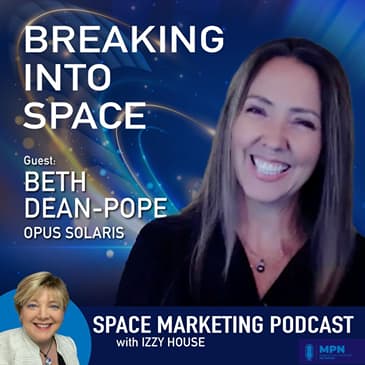
Join Izzy as she chats with Beth A. Dean-Pope, CEO of Opus Solaris and a pioneer for expanding the boundaries of what's possible in space and space marketing.
In this episode, we dive into the rise of non-traditional industries entering the space sector—from technology and fashion to automotive and telecommunications. We'll explore how these industries are not only driving innovation but also creating new opportunities for new marketing tools as non-space businesses of all sizes to participate jump into the space industry.
CHAPTERS:
01:13 Meet Beth Dean-Pope
06:30 Opus Solaris
08:18 Point of transition in space
08:47 Building benefits for the sciences with commercialization of space
10:34 You can’t change the world if no one knows you exist
11:27 Storytellers of Apollo
12:16 Edison Moment
13:58 Bringing non-space companies into space
17:11 Subscribe to the Space Marketing Podcast
17:48 The high net worth
18:48 Inspiration 4 and Polaris Dawn
21:31 What are the barriers for the non-traditional companies as they go into the space industry?
23:48 Non-space brands doing science in space
24:34 Companies big and small can do space projects and workforce development
25:39 Changing life on Earth and Agritech
26:53 Target and cotton
27:21 Comes back to storytelling
28:16 Providing marketing
31:23 Marketing to the public
33:32 Ultimate product placement and corporate involvement
36:25 The future of space
36:39 Orbital data centers
38:43 Multiple space stations for science and space tourism
39:39 Space debris
41:29 Spaceship Earth
44:59 Final thoughts
Links:
Contact Beth on LinkedIn
Space for Kentucky - https://spaceforkentucky.com/
Loretta Whiteside - The New Right Stuff
ABOUT IZZY
Izzy's website - https://izzy.house
Author of Space Marketing: Competing in the new commercial space industry AND Space Marketing: Spaceports on Amazon and Audible - https://bit.ly/Space-Marketing
Podcast host for Space Marketing Podcast - https://spacemarketingpodcast.com
Organizer for Space for Kentucky Roundtable - https://spaceforkentucky.com
Hosted by Simplecast, an AdsWizz company. See pcm.adswizz.com for information about our collection and use of personal data for advertising.
[00:00:00] My dad works in B2B marketing, but I never really knew what that meant.
[00:00:04] Then one day my dad came by my school for career day and told everyone in my class he was a big ROAS man.
[00:00:11] Then he just kept saying things like, the bigger the ROAS the better, over and over.
[00:00:16] My friends still laugh at me to this day. I think it means calculating a return on ad spend.
[00:00:23] One thing's for sure, I'll be known as the ROAS man's kid for the rest of my days.
[00:00:28] Why couldn't you just be a fireman or a lawyer? Why? You ruined my life dad.
[00:00:34] Not everyone gets B2B, but LinkedIn has the people who do.
[00:00:38] And with ads on LinkedIn, you'll be able to reach people based on job title, industry, likelihood to buy and more.
[00:00:44] Start converting your B2B audience into high quality leads today.
[00:00:48] We'll even give you $100 credit on your next ad campaign.
[00:00:51] Go to linkedin.com slash mpn to claim your credit.
[00:00:54] That's linkedin.com slash mpn. Terms and conditions apply.
[00:00:57] LinkedIn, the place to be, to be.
[00:01:00] Hi, I'm Jason Falls, the executive producer of the Marketing Podcast Network.
[00:01:03] As you probably know, Asheville and Western North Carolina were nearly destroyed by Hurricane Helene in late September.
[00:01:10] The Red Cross has deemed this a Category 7 disaster, which is the largest category they give.
[00:01:15] One of our member podcasters, Patrick Casale, is on the front lines there.
[00:01:19] He's an Asheville native who is living through and witnessing the trauma, destruction, and recovery his family, friends, and fellow community members are going through.
[00:01:26] Patrick started a GoFundMe campaign to raise money for relief efforts.
[00:01:30] All donations through Patrick's fundraiser go to local nonprofits who are helping with supply runs.
[00:01:36] Donations there directly impact people in need.
[00:01:38] I've given to the fund personally.
[00:01:40] Patrick has given as well, despite the fact he's having to recover too.
[00:01:43] The Marketing Podcast Network wants to help, and we know you do too.
[00:01:46] Visit Patrick's campaign at bit.ly slash WNCHelp.
[00:01:51] The abbreviation is for Western North Carolina WNC.
[00:01:55] bit.ly, B-I-T dot L-Y slash W-N-C help.
[00:01:59] Any amount goes a long way.
[00:02:01] Even just $5 can provide a few gallons of clean drinking water to a family in need.
[00:02:06] Please join us in helping the relief and recovery efforts in Asheville and Western North Carolina.
[00:02:10] Go to bit.ly slash W-N-C help today and contribute.
[00:02:15] That's bit.ly slash W-N-C help.
[00:02:18] The full URL, B-I-T dot L-Y slash W-N-C help.
[00:02:23] Donate what you can.
[00:02:25] Every dollar helps.
[00:02:27] Welcome to the Space Marketing Podcast,
[00:02:30] where we look at marketing principles, strategies, and tactics through the lens of space.
[00:02:35] Hi, I am your host, Izzy House.
[00:02:39] Today we explore new opportunities and new marketing tools as non-space businesses of all shapes and sizes
[00:02:48] jump into the space industry game with Beth Dean Pope, CEO of Opus Solaris.
[00:02:55] So lift off in three, two, one.
[00:03:09] Welcome to the Space Marketing Podcast.
[00:03:12] Information relating to our discussion today and links to the video version can be found in the episode show notes on SpaceMarketingPodcast.com.
[00:03:23] Please like and subscribe to the podcast.
[00:03:26] It will help more people reach beyond the atmosphere.
[00:03:31] Information in this episode is for entertainment and information only.
[00:03:36] Please consult a professional for your specific situation.
[00:03:40] I met our next guest early in my journey in space with the space tourism side of things.
[00:03:47] Beth Dean Pope, CEO of Opus Solaris, has worked on several large brands such as Zero-G and Axiom.
[00:03:56] She is breaking boundaries and creating new solutions to get brands into space.
[00:04:05] That's perfect.
[00:04:09] So welcome to the podcast.
[00:04:11] It has been forever since I've seen you.
[00:04:14] Izzy, it's so nice to reconnect.
[00:04:16] We both keep passing and crossing paths throughout this whole space journey that we're on.
[00:04:23] It's just really exciting to be a part of what you're doing as well.
[00:04:27] So thank you for inviting me.
[00:04:28] You are on a new journey.
[00:04:30] So let's talk about how you got to space in the beginning.
[00:04:36] I like to let people get a chance to meet you.
[00:04:39] So how did you get sucked into space?
[00:04:44] Sucked into space sounds very scary.
[00:04:48] It's a long journey, actually, although it seems like it was really short.
[00:04:53] Even as a child, and I know we all say this, all of us that are in the space industry started our passion for the space industry when we were young.
[00:05:02] We knew then that it was something that was going to excite us.
[00:05:05] It was a dream.
[00:05:06] It was something that we would aspire to get to.
[00:05:09] And so when I actually first went off to university, I wanted to I wanted to become an engineer or something that I could do mathematician to be to go into the space industry.
[00:05:19] And I figured out very, very quickly.
[00:05:22] My professors figured out very, very quickly that that was an absolute no go for me.
[00:05:28] I was horrible.
[00:05:29] I'm no mathematician.
[00:05:31] I have no engineer.
[00:05:33] I had no, you know, skills in that area.
[00:05:36] And so it was very quick for me to figure out that my skills are going to lie in marketing and networking and business development.
[00:05:43] And it's where I soared.
[00:05:44] And I loved it.
[00:05:45] I still I still absolutely love that.
[00:05:48] But I never lost my passion for space.
[00:05:51] So I kind of stayed involved, you know, on the fringes, joining different groups and getting involved in different volunteering type situation,
[00:06:00] joining different boards just so that I could kind of stay in around the industry and what was happening and constantly kind of keeping my finger on the pulse of the industry itself.
[00:06:11] Never think that there would ever be a place for my particular skill set.
[00:06:15] So as I went through my career, I started working with brands all over the world and lived in London for about 15 years.
[00:06:23] My husband and my children are British.
[00:06:25] And so we lived there for a long time as they went through education.
[00:06:28] And I worked with a number of different industries kind of working with the high net worth or the very high end luxury products, putting these people and these parties together across many different industries.
[00:06:39] And it's absolutely a passion of mine.
[00:06:42] And over those years, I was able to build up a really large book of clients and ultra high net worth individuals and companies where I was constantly able to go back to them with different opportunities,
[00:06:56] depending on what industry had asked me to come in and help them, you know, come across the line.
[00:07:02] And those industries were, again, luxury fashion and real estate and even expedition cruising with Herb de Gruten, where they would ask me to come in and actually see how I could start building up their business development side of things in a new and exciting way.
[00:07:20] And then about two and a half years ago, three years ago, I started seeing this shift in space, started seeing, you know, obviously with what was going on with Elon and with SpaceX and Blue, Blue Origin.
[00:07:34] And you started seeing that there was there was a real interesting movement that was happening.
[00:07:41] And so I was really watching that very closely when Zero G reached out to me and they were looking for someone that would come in and start putting those networking opportunities together.
[00:07:51] And that was closely followed by, to my amazement from Axiom Space.
[00:07:57] I mean, one of the companies that for me, I've looked up to and watched so closely over the eight years that they've been in existence and for them to actually now start seeing this opportunity for the commercialization of space in a very new and different way.
[00:08:13] I was in, I had this opportunity to come to the space industry.
[00:08:17] And that's kind of where I was really able to start really deep diving and learning the inside workings of the space industry, not just from the fringes, but from the inside of seeing it from the space industry's point of view.
[00:08:32] And you got to do a little bit of science, too.
[00:08:35] I did.
[00:08:35] You know, that's that's one of the things that you and I are kind of cut from the same cloth.
[00:08:40] You know, we love marketing and the power that marketing can do to open up worlds.
[00:08:46] But then, you know, there's a science geek side of us that, you know, we don't usually get to play with in our marketing.
[00:08:54] And and you do.
[00:08:56] So tell us a little bit about your new adventure.
[00:09:00] Well, it's to be honest, it's the same old job with a new name.
[00:09:06] Really, I will be doing the same thing as I was working with Axiom.
[00:09:09] And it was just such an amazing opportunity and such a great learning ground.
[00:09:14] I started realizing that all of the other players out there that are also building space stations right now were kind of in the same boat as Axiom was.
[00:09:24] And so you could kind of see it with the other providers that were that were getting ready for these space stations.
[00:09:29] And we're also reaching out and asking, you know, questions about how how to bring these new nontraditional industries to the market.
[00:09:37] And I thought this is the time.
[00:09:40] This is the time for us to actually start sharing that knowledge and really exponentially growing the ability to fund crude missions, science projects,
[00:09:52] private astronauts to space in a way that has not been out there before.
[00:09:56] You typically most of these companies have gone the government funding route.
[00:10:02] I mean, that's that was really all that there was.
[00:10:04] But as the science is growing, we have to find more funding because we have to have the funding to be able to actually accomplish the cure to cancer or diabetes or, you know, what close to my heart is dementia with my parents.
[00:10:19] My mother suffers from dementia.
[00:10:21] And so how are we actually going to be able to afford to get enough time and space for these things to happen?
[00:10:29] It had to come from another opportunity of funding.
[00:10:32] And where do we go for that?
[00:10:34] We needed to go to nontraditional companies and allow them to see an ROI within our industry, within our space sector of how they could get involved.
[00:10:43] You know, that's the one thing, too, with space is I think we're at that pinnacle, that that point where it's getting so big that government can't fund it anymore by themselves.
[00:10:56] And and then we have a lot of budget cutting and things like that.
[00:11:01] So it needs to really break off and and be truly commercial.
[00:11:07] And this is this is how we do it.
[00:11:10] We find creative and new ways of of doing marketing, of building benefits for companies that are not necessarily space focused.
[00:11:21] Yeah.
[00:11:22] And I love what you do there.
[00:11:24] Yeah.
[00:11:25] And building benefits for the science as well.
[00:11:27] I'll tell you a funny story.
[00:11:29] I was in a meeting with all scientists.
[00:11:32] I was the only non-scientist in this meeting.
[00:11:34] And I was talking to them about like, what is this commercialization of space you speak of, Beth?
[00:11:40] You know, what is this?
[00:11:40] What are you doing?
[00:11:41] And so it's kind of walking them through, you know, here's what it is and what I've just explained to you.
[00:11:47] And there was this sharp intake of breath.
[00:11:49] And they were like, you're going to ruin space.
[00:11:52] You know, space is about science and space is about research.
[00:11:55] And I said, yes, that's exactly the point.
[00:11:58] That is exactly the point.
[00:11:59] And when we talk about government funds, by the time that any of those funds get down to the really important work of the science, it's so watered down.
[00:12:10] It's so spread.
[00:12:11] Because you're right, the budgets are being cut.
[00:12:13] The requirements and who needs it is being multiplied exponentially.
[00:12:17] And so much of this science and research will never see the light of space or the darkness of space, if you will, in what they need is another opportunity, a well to pull from.
[00:12:30] And when I started explaining it to them that way, I said, there's a necessity for the commercialization.
[00:12:36] Because with the commercialization comes the funding, comes the awareness, comes the global attention to all the things that you're doing and what that needs is those three elements.
[00:12:50] And then they were like, oh, okay.
[00:12:52] So there is a need to have a Coke machine in space.
[00:12:55] And I'm like, yes, there is a need to have a Coke machine in space.
[00:13:00] When I first started my career, I was in what was called an environmental technology incubator.
[00:13:07] Wow.
[00:13:08] And I was surrounded by scientists that were doing some amazing things for the environment, for our world, our planet.
[00:13:16] And I watched a lot of those scientists and their projects die because they figured that if they created this wonderful thing, the world would come to them and they didn't need marketing.
[00:13:32] They would just flop to them.
[00:13:33] And that's not how it works.
[00:13:36] So even the science, if you do not have good marketing, nobody knows you exist.
[00:13:45] And if nobody knows you exist, you can't do the good work that you're trying to do.
[00:13:52] There is a field of dreams mentality out there.
[00:13:56] And the problem is, is that over the past few decades, what we've lost is the storytellers.
[00:14:03] And because we've lost the storytellers, the field of dreams can't work because you must have the storytellers.
[00:14:10] So part of what you and I are doing and a number of other players that are in the space sector right now is we're building those storytellers again.
[00:14:18] We're building the stories and we're figuring out how to get those stories out to the masses in a way that they did back in the 60s, in the late 50s.
[00:14:27] They understood the storytelling space and they did an amazing job with it.
[00:14:32] But we've lost that ability or we lost the storytellers.
[00:14:35] And now we're building up this new breed of storytellers.
[00:14:39] I was listening to a podcast over the weekend and they were talking about that Edison moment.
[00:14:45] And I've actually done a post today about it on LinkedIn.
[00:14:48] But we were talking about when the light bulb first came out and how Edison shared that knowledge with everyone because the need for it to become global was more important than the need for him to hold on to the knowledge.
[00:15:03] And that's where we're going to.
[00:15:04] We're going to that point of storytelling and sharing and getting it out there again where there's because there's so much interest if they only knew all the stories that are up.
[00:15:15] And I love your Edison type of your example there because Edison was a wonderful marketer and there was a lot of kickback from the communities just like we have nowadays about the electric light bulb.
[00:15:31] People were afraid of it.
[00:15:33] They had oil lamps.
[00:15:35] Why would they rebuild all this infrastructure for something like this?
[00:15:40] And so he had to get the communities, the elected officials, and everyone else on board in order to make the light bulb work.
[00:15:50] If it wasn't for the fact that he knew how to market and knew how to not only tell the story but bring the people into it.
[00:16:02] That's the important part.
[00:16:04] You can tell stories all day long if nobody hears them and it doesn't or they don't feel like it relates to them.
[00:16:11] You're going to fall on deaf ears.
[00:16:12] So but he brought the people in.
[00:16:16] And that's what I love about what you're getting ready to do or you're working on or have worked on.
[00:16:22] And please give us a little example about how you're bringing the non-space business into space to try to make everybody win.
[00:16:35] Yeah, I can give you some great ones.
[00:16:38] And we won't be able to mention any names, but I'll give you some great ones.
[00:16:41] And some of the companies are already doing this on a very small scale.
[00:16:45] And the revenue that it's generating is very small, but it is a tip of an iceberg and it is showing demand.
[00:16:52] It's just not showing it enough yet.
[00:16:55] So typically when I'm talking to a potential non-traditional corporate, so let's say one of the FTSE 100 or the top 100 companies in the world,
[00:17:03] the first thing is, is as we're going from space into that non-traditional industry, we have to know which budgets we're going into within those.
[00:17:14] It's a very different animal.
[00:17:16] Space companies don't think what are the budgets of the corporates.
[00:17:19] That's our job.
[00:17:20] That's our job to figure that out.
[00:17:22] And so there are two budgets that could lend themselves to space, one being a corporate philanthropic budget.
[00:17:29] But those budgets are very small and there's a lot of demand for where they put that philanthropic budget.
[00:17:35] The second budget, much harder, is their marketing budget.
[00:17:39] Their marketing budgets are huge, but the ROI has to be even bigger.
[00:17:46] So what we had to do was go in and say in this particular mission, let's use a crude mission, for example,
[00:17:52] how would it benefit a particular bank, corporate bank, global bank to partner for this mission?
[00:17:59] Where can we build in an ROI that would benefit this partner?
[00:18:04] And that's the first step.
[00:18:06] And it was literally breaking it down to say what would benefit XYZ Bank for this mission?
[00:18:13] And that's what we did.
[00:18:14] So we started actually building marketing campaigns around a mission that might start months before the mission leaves the ground.
[00:18:22] So instead of it just being a two-week window, let's say, again, for ISS, an ISS mission where it's only 14 days in space,
[00:18:30] what if we start this campaign when the astronauts go into training six or seven months before the launch?
[00:18:37] And then we start giving these corporates seven, nine months worth of marketing opportunity,
[00:18:44] literally their whole campaign for that year, and actually show how they would get an ROI
[00:18:49] by utilizing the limited amount of ROI information we have now as far as media impressions and those things.
[00:18:56] But that's starting to grow.
[00:18:58] And grabbing those corporates that already have an idea, they're already leading in their industry.
[00:19:04] They're already on the edge of their industry.
[00:19:06] They're the first ones to do something.
[00:19:09] They're the Red Bulls of the world.
[00:19:12] They're the McLarens of the world.
[00:19:15] They're the ones that are pushing the envelope all the time.
[00:19:17] And that's the first place you go because they understand the mentality of where do we lead our competition?
[00:19:24] And so those have been some great examples of how we do it.
[00:19:27] We literally go and make sure that the ROI is evident and goes into their marketing.
[00:19:33] So it shows an immediate return.
[00:19:34] Hold on to your boosters.
[00:19:41] We will be right back with guest Beth Dean Pope, CEO of Opus Solaris, after the briefest message from our sponsors.
[00:19:50] Please like and subscribe to the Space Marketing Podcast so you don't miss a thing.
[00:19:56] One of the things that I'd like to also kind of touch on is that a lot of people would say, well, those are the rich people.
[00:20:21] Okay.
[00:20:21] Well, during the time where the pioneers went across the oceans to discover new lands, it was backed by some of the richest, most powerful people on the planet.
[00:20:37] The kings and the queens and the nobility.
[00:20:40] They paved the way.
[00:20:41] When airplanes started going into the commercial arena, it was the jet set.
[00:20:50] There was even a term for it that paved the way.
[00:20:54] And nowadays, we can go anywhere in the world for relatively inexpensive.
[00:20:59] It's not like it used to be.
[00:21:02] And I am so happy that these entities that do have funds have an interest.
[00:21:10] Absolutely.
[00:21:11] And doing it.
[00:21:11] Yeah.
[00:21:12] I mean, Claire is done.
[00:21:13] Great example.
[00:21:14] Great example.
[00:21:15] And Inspiration4 is one that is a great example of what you're talking about.
[00:21:21] That the story was that there were some people from the children's clinic, the St. Jude's Children's Clinic, that were a partner there.
[00:21:34] And they raised over $200 million for St. Jude during that time.
[00:21:40] And you got to watch six months in advance, you know, on Netflix, them go through their journey.
[00:21:47] And it was just, you were part of the story.
[00:21:50] So that by the time that they launched, you didn't watch them go.
[00:21:56] You went with them in your heart.
[00:21:58] That's a good way of saying it.
[00:21:59] And you're right.
[00:22:01] And even with the story, I think, I know I was and I know you were.
[00:22:05] I know everyone on my team were watching Polaris Dawn with bated breath and crossed fingers and hope in our hearts that it would be the success that it actually turned out to be.
[00:22:16] And it really has opened an awareness that wouldn't have happened in any other way besides through those missions, through Inspiration4 and through Polaris Dawn and through the upcoming Frong 2, I think will also be kind of one of those pivotal watershed moments.
[00:22:34] And even with those, and they were pretty creative about some of the brands that they were able to relate to and bring into this mission.
[00:22:43] Even then, there was what we would say revenue left on the table for those space companies where there is an opportunity to continue to raise that bar and raise that funding.
[00:22:54] You know, we have two private, part of what we do as well as bringing these corporates and space companies together is we're also putting together a crewed mission as well.
[00:23:04] And we want to work with private astronauts.
[00:23:07] And like you said, to date, private astronauts have for the most part been run by, you know, the ultra high network individual.
[00:23:15] But the two private astronauts that we're working with right now, we're actually going to fund them exactly like we would do with a space company.
[00:23:24] We're actually going to build the story around each one of these astronauts and utilizing an algorithm that we've developed for Opus Solaris is to actually fit them and match them with the companies, with the nontraditional companies that would get a huge benefit from these two individuals going to space.
[00:23:44] So it is changing.
[00:23:46] So it is changing.
[00:23:46] Yes, the high networks needed to do it first to show that it can't be done.
[00:23:50] But it's moving very quickly to where it is accessible to all.
[00:23:56] So what are some of the biggest barriers to these nontraditional industries that they face when they come into the space industry?
[00:24:04] It's a good question.
[00:24:05] And it really is being able to prove the ROI because these corporates, and certainly when you're talking about your CMOs, they know what they're looking for.
[00:24:15] And because all the industries that typically they'd be spending their money in can very much show a recent within the last 12 months what an ROI, what the media impression is, what the reach is.
[00:24:29] They can show it at its extent because they're working all within industries and opportunities and media opportunities that they know and that they've used in the past.
[00:24:37] So there's a huge amount of information out there to back them doing it again.
[00:24:42] Let's say doing an F1 sponsorship again.
[00:24:45] They see all of the response that they had last year.
[00:24:48] Of course, they'll do it again.
[00:24:49] We lack that.
[00:24:51] We lack that element.
[00:24:52] And so there has to be a level of a bit of creativity of saying, because it was like this in this industry, we can adopt some of that.
[00:25:01] And because we have shown ROI for the things that have gone up to space that have been partnerships, we can adopt some of that.
[00:25:08] So it's a little bit less material as far as being able to say, this is exactly what your ROI is going to be.
[00:25:16] They have to be creative with us.
[00:25:18] They have to go on the journey with us.
[00:25:20] And they have to take the chance a bit with us as well.
[00:25:23] That typically goes back to why we start with those corporates that already did those things.
[00:25:30] They did it because they decided not to do the football, you know, the soccer sponsorship.
[00:25:37] And they decided to do Wimbledon instead.
[00:25:40] You know, what was the change?
[00:25:41] They didn't know.
[00:25:42] This is a banking partner in particular.
[00:25:45] They didn't know if that change was going to be catastrophic to them because they had been doing football, European football, for a very long time.
[00:25:54] But they felt like they almost lost their identity in doing that.
[00:25:58] It becomes so common that they literally it wasn't the return that they wanted.
[00:26:03] They were going to switch over to a different industry, a different opportunity.
[00:26:07] It takes that you still have to step out in, you know, in faith that that's going to work for your brand and that opportunity.
[00:26:14] One of the things that you use is you use the science geek part.
[00:26:18] I love that.
[00:26:20] There are some major brands that you wouldn't think of as space brands that are already on the International Space Station.
[00:26:27] You have Tide, which is doing research on how to create laundry detergent without using much water.
[00:26:35] Yeah.
[00:26:36] You know, and you have Estee Lauder and they are looking at alternative plastics.
[00:26:41] And you have Adidas and they're looking also at different materials.
[00:26:46] So they're doing science in space as well.
[00:26:50] So why don't you talk about how maybe there's opportunities for the big brands and maybe the smaller ones in space exploration and the science.
[00:27:02] Yeah.
[00:27:03] I mean, I think understanding each corporate as you're approaching them and what their philanthropic outreach is.
[00:27:11] For example, one of the companies I was talking to most recently, they are having a brain drain.
[00:27:17] Essentially, they don't have enough people coming out of education that find their industry interesting enough to be going into it.
[00:27:26] And they need a highly skilled workforce.
[00:27:29] But they just were having a really hard time recruiting.
[00:27:31] And so for them, it was like, how do we make ourselves relevant, important, attractive enough for these higher, you know, higher education students coming out to want to come back into their industry?
[00:27:43] And so they see space, not just of the science that's going to happen in outer space, but they see space coming back to Earth as a way for them to elevate themselves and be able to attract that education.
[00:27:57] I think that's what's really important to Opus as well, is that all the science and all the missions and all the collaborations we're putting together are all focused back on Earth.
[00:28:38] Oh, yes.
[00:29:01] And so I think that's what's really important.
[00:29:07] The agritech side, not just for what we can grow in space, but what can we learn in space that we can utilize on the planet.
[00:29:16] I think that's one of the most exciting that we're working on right now.
[00:29:19] Target is a very good example of that particular thing.
[00:29:23] They are working on growing cotton, you know, like what you make clothes out of in space.
[00:29:29] And cotton is a very thirsty plant.
[00:29:33] So there is a challenge with growing it here down on Earth.
[00:29:37] So they're looking at ways to make it not as thirsty.
[00:29:40] Yeah.
[00:29:41] And that's Target.
[00:29:43] Yeah.
[00:29:44] Yes, that's a major company.
[00:29:45] And there you go.
[00:29:46] I mean, that's storytelling.
[00:29:48] That's the storytelling that we need to be doing.
[00:29:51] While everything else is important and governments going to ISS and the new space stations are massively important.
[00:29:58] The storytelling is the missing link.
[00:30:00] I was telling someone the other day when they said, you know, is there enough demand?
[00:30:05] Is there enough going on in space?
[00:30:07] That's usually when I realized that we failed in our storytelling because there's so much going on in space.
[00:30:12] But imagine in five or six years from now when there's not just the ISS up there, but there are three different space stations with constant flows of crewed missions and space payloads back and forth.
[00:30:25] You know, how do we actually stay on top of that now, build the demand now so that we have a pipeline that's ready for that research to happen and ready for the backers that are interested in, you know, in the non-thirsty cotton, if you will.
[00:30:40] You know, that demand is coming.
[00:30:41] Yeah.
[00:30:42] Well, that's one of the reasons why I'm doing what I'm doing is because there's a lot of space companies that do not realize how important marketing is.
[00:30:52] Just like that environmental technology incubator that I was a first part of, they didn't understand or respect what marketing is.
[00:31:01] They think it's just some, you know, used car salesman out there, but it's making your company exist.
[00:31:08] It's telling your story.
[00:31:09] And how do you think that the space exploration can influence consumer behavior and brands perception, which is what this is missing?
[00:31:22] Because there's nobody to tell a story in industries like fashion and technology and telecommunications.
[00:31:29] Yeah.
[00:31:30] Yeah.
[00:31:30] Well, I mean, how did they get children of all ages?
[00:31:35] And I remember this.
[00:31:36] I'm aging myself.
[00:31:37] But how did they get children of all ages, including me, to drink Tain, you know, when we were kids?
[00:31:44] I'm sorry.
[00:31:45] Horrible stuff.
[00:31:46] Horrible stuff.
[00:31:47] Drink it because I thought I was going to be an astronaut.
[00:31:49] So did all of my friends, all of my neighborhood friends.
[00:31:52] All we've all drank in Tain because we, you know, that's what the astronauts drink.
[00:31:56] And so there's going to all of those industries and showing that and storytelling ahead of it and storytelling during it.
[00:32:05] By showing that example, we show the space companies that they have a requirement for it.
[00:32:11] Now, here's a funny, interesting thing about these space companies.
[00:32:15] Right now, they're all pretty much working for the same funding, for the same, you know, grants.
[00:32:23] And when it comes down to what do they do with that money, they have to decide, do they market themselves or do they manufacture what they're required to put in space?
[00:32:35] And it's a solid, real, correct question.
[00:32:39] Do they start building overhead to market themselves or do they not take that funding and utilize it towards building the space station or building the space suit or putting the satellite up there?
[00:32:52] Or doing orbital data centers?
[00:32:55] And the answer is they should do that.
[00:32:57] Because building up the team that they would need to correctly market themselves is a huge overhead.
[00:33:04] It's massive.
[00:33:05] So there are enough companies out there like mine and those quite a few other ones that are out there that we're actually collaborating on is to come to us and let us be that for you as you need it, as and when you need it.
[00:33:19] And as and when your story needs to be told, let us go out and tell that story for you and use your mass, the bulk of your funding to create, to create the story that we're telling.
[00:33:30] And so for me, I think it's I wouldn't worry too much about the fact that they're not marketing themselves.
[00:33:35] It's important for us to go and remind them of why they do need to be marketed and how we can do that for them.
[00:33:42] They're there.
[00:33:42] I just plugged my company.
[00:33:44] Do you see that?
[00:33:45] I did.
[00:33:45] I did.
[00:33:46] In a story.
[00:33:47] In a story.
[00:33:48] Yes.
[00:33:49] One of the challenges that I see also is that the ones that do have marketing, they do not have any allocation towards marketing to the public.
[00:34:02] It's just to get the customers.
[00:34:04] That is true.
[00:34:04] And marketing the public is very important as well.
[00:34:08] And that's what a lot of these non-traditional businesses, that's what they want to do.
[00:34:15] They want to market to the people that are their audience, which are not space people.
[00:34:20] And I love that fact about what you're doing is that it's inherent in what you're doing, that you reach the people that have not been reached in a very long time since about the Apollo program.
[00:34:35] You bring up such a good point because of the space companies that I'm talking to and have talked to, their media team, they're only focused on other space media opportunities within their industry.
[00:34:51] And so they've become very well known within their industry.
[00:34:55] But if you ask someone walking down the street or walking into the Prada shop, who is this company?
[00:35:01] They have no idea.
[00:35:03] And so they have missed a lick on that.
[00:35:06] But it shouldn't be where they're focused.
[00:35:08] They should be focused on the space industry.
[00:35:10] What they need is that catalyst that says, let me take you into the common knowledge of the public.
[00:35:18] Let me help you build what you're doing and continue to do really well.
[00:35:23] And let's add that element of awareness across the global awareness as well so that they're not trying to water down what's really important to them, which is getting that message out of what they're doing.
[00:35:34] They need that extra on.
[00:35:35] That's really what they need.
[00:35:37] When you can actually collaborate.
[00:35:40] And not only am I the space company that's getting that particular unique thing, but you're bringing together other companies to make one big party of companies in their marketing and their story in your storytelling.
[00:36:00] So it's not just you're looking for different opportunities.
[00:36:05] Like, OK, does it have to be a blank whatever that the astronaut is wearing?
[00:36:12] Can it be something with an engraving on it?
[00:36:16] Or, you know, tell us a little bit about all the different fun little things that you can bring in several different companies on like a crude mission and how everybody will benefit from it.
[00:36:29] There's coming a day.
[00:36:31] Oh, this is going to give you trouble, I'm sure, with some people.
[00:36:34] But there's coming a day when you see a crude mission and you're watching a launch just like you watch an F1, a Formula One race, that it will have that amount of attraction, that amount of interest and that amount of corporate involvement.
[00:36:52] And if you've ever been to an F1 race, if you looked at the race cars or even the drivers or even the pit crew, they're covered in that branding.
[00:37:00] That didn't start that way.
[00:37:01] But now that F1 is actually that involved in so many of these, what would have been very nontraditional, have nothing to do with racing whatsoever.
[00:37:11] Because of their involvement now, you see advancements in science and technology in F1 racing that affect us almost immediately as consumers.
[00:37:22] Almost immediately.
[00:37:23] The only way that they actually started to get to a point where they could afford to do that kind of science and technology, you know, that McLaren does.
[00:37:31] And all of these companies do that are that are brand sponsors is because of where F1 got to from the corporate side, from that involvement and that awareness and excitement from the public.
[00:37:44] So I do see a day where you watch a launch with the same excitement and the same experience and the same visuals that you do for an F1 race now.
[00:37:55] I do see that happening.
[00:37:56] And I see it happening little by little.
[00:37:58] And the more that we go commercial and the more that we democratize space and the more that we actually make it more common to the everyday person, the more that we'll see that shift happen.
[00:38:10] And the faster we'll see real change and real progress in science and in space.
[00:38:16] That didn't cheapen what racing is.
[00:38:19] No, it's fantastic.
[00:38:20] It just it brought people into the industry and made them a part of the story and it gave them the funds they needed to be the story.
[00:38:31] If we don't have funds, there will be no story.
[00:38:36] So that's it's a good way to get funds.
[00:38:40] And yeah, you might promote some people along the way.
[00:38:45] Yeah, it's it's it's think of it as a party.
[00:38:48] It's a party.
[00:38:49] It's a party.
[00:38:50] It's OK.
[00:38:51] Speaking of the future, where do you see the space industry and say the next 10 to 20 years?
[00:38:58] And what do you think we should look out for in this particular barrier breaking stuff?
[00:39:05] Yeah.
[00:39:05] Yeah.
[00:39:07] Orbital data centers is something that just constantly stays on my mind.
[00:39:11] And there's a huge benefit to our planet for us to have data centers in orbit.
[00:39:17] I see that becoming something very prolific.
[00:39:21] I see it being a huge revenue opportunity as well for those companies that that are that are looking at orbital data centers and what that future is.
[00:39:30] And then the impact that it has for us on this planet by freeing up the amount of electricity that it uses, the amount of land that is used for these data centers and the demand for data is going up.
[00:39:42] So if we stay planetary with it, so will the demand for the electricity and so will the demand for land.
[00:39:48] Bringing it off planet is going to be a huge factor in the next 10 years.
[00:39:52] And the people that invest in that now, I'm one of them.
[00:39:56] And I don't I don't have any other saying in it except that I love orbital data centers.
[00:40:01] They'll that'll be a big thing for us in the future.
[00:40:04] I also people don't don't think about data as being one of those things that creates pollution and is causing some really damage, some damage to our environment.
[00:40:15] You know, they think of cows, they think of cars, they think of factories, they don't think of the data that's streaming through their phone hot.
[00:40:25] Yeah, it's it's it's warm.
[00:40:28] So you have to cool it down.
[00:40:29] And then you have to I mean, the amount of energy that it takes to run this data is just incredible.
[00:40:38] So you're generating pollution if you are using coal or gas or some other type of polluting type of energy.
[00:40:47] And now we're moving it to space where it's constant supply of solar energy, constant supply of cold.
[00:40:54] You know, this that to me, you know, I would say to anyone listening, watch watch this space.
[00:40:59] You know, if you if you do any training, go find an orbital data center that, you know, company that you love and and check them out because orbital data centers, I think, is going to be a huge shift.
[00:41:09] And I think the other pivotal moment for us as a planet will be when we have two, three orbital space stations out there instead of just the ISS.
[00:41:20] And I think for a number of reasons, it's going to multiply the amount of science is going to be done on a daily basis.
[00:41:27] And secondly, and this is how you and I met tourism will become a bigger thing.
[00:41:33] Space tourism will will then have a true place to be and true place to go.
[00:41:39] And I think that in itself will naturally capture more of the imagination of humankind as well.
[00:41:46] So I think in the next 10 years, as we see exponential growth in space stations, we see orbital data centers in space and space tourism grow as well.
[00:41:57] Then we're going to see that's we will all be looking up instead of just looking at each other.
[00:42:02] We will all be looking up for answers. And that to me is exciting.
[00:42:06] Debris, I think, is on the downside is something we mustn't lose sight of, you know, in our race to get to that 10 years from now.
[00:42:16] We mustn't lose sight of the damage that we can do.
[00:42:19] And so very interested in companies that are moving forward with, you know, how do we handle space debris?
[00:42:26] How do we monitor it? Not just monitor it, but control it now going forward.
[00:42:31] It's important that we start putting those measures in place as well.
[00:42:35] Some of the things that they're they're proposing to deal with it are are not only are they dealing with it up in orbit,
[00:42:44] but technology will come back down here.
[00:42:46] Like, for instance, grabbing a old satellite and shredding it and making it into materials that can 3D print.
[00:42:56] We'll be able to use that same technology that we learn down here to reuse what we have in our garbage filled world as it is to.
[00:43:06] So right.
[00:43:08] Space does not have room for garbage.
[00:43:10] It really doesn't for as big as it is, we have to be really resourceful in how we reuse our stuff,
[00:43:19] especially as we start to go further out.
[00:43:22] We're not going to be able to throw the piece of plastic away.
[00:43:27] I just did a a space for Kentucky that was on food.
[00:43:31] And one of the things that we were having a conversation about the food, it was like, OK, well, what did we do with the plastic?
[00:43:37] What do we do with this and what do we do with that?
[00:43:41] And you just you can't afford to have that take up space and we can't afford to have it take up our atmosphere either.
[00:43:49] So I completely agree that those are wonderful things to look at going forward.
[00:43:55] There was a quote by a friend of yours and mine, Loretta Whitesides.
[00:44:00] And she talks about it really was quite a pivotal moment for me when I read her book and she wrote about spaceship Earth.
[00:44:09] And I've always thought about space and I thought about the Earth and, you know, but I've always thought about spaces being out there.
[00:44:16] And I think a lot of people do think of spaces out there and space is only out there when it's dark, too.
[00:44:21] Like people don't typically look up during the day and go, space is out there.
[00:44:25] You know, typically it's at night.
[00:44:26] You see the stars and you think space is out there.
[00:44:28] But Loretta said it so poignantly when she said this is our spaceship.
[00:44:33] And if you were on a spaceship, how concerned would you be about pollution, litter, what you were recycling, what you were doing with things?
[00:44:41] This is our spaceship.
[00:44:42] We are hurtling through space on this beautiful spaceship that we have.
[00:44:47] And so everything we do, again, why the focus for myself and for Opus is back to this planet is how do we continue to make this spaceship the best spaceship it can possibly be?
[00:44:59] Running optimally, running cohesively and at peace with one another.
[00:45:04] How do we do that?
[00:45:05] And so I think we're on the right track now, Izzy.
[00:45:09] I do.
[00:45:09] I do, too.
[00:45:11] We're close.
[00:45:11] We're closer.
[00:45:13] And for those of you listening that may not like the idea of space tourism, let me tell you, there's a lot of people that go up that are just regular people like you and me.
[00:45:23] This last flight that was Polaris Dawn.
[00:45:27] There were two people on there that this is the story that I love is that they worked very hard at getting the crew up last time.
[00:45:36] They're just regular people that are working to help people have an experience with like the inspiration for.
[00:45:44] And they were rewarded for their hard work.
[00:45:46] And they got to go to space because they're just they're regular hardworking people.
[00:45:53] Right.
[00:45:54] And when you go up to space.
[00:45:57] What are you looking at?
[00:45:59] You're not looking up.
[00:46:01] You're looking down.
[00:46:03] Right.
[00:46:03] You're looking at our beautiful world.
[00:46:05] And you're seeing that it truly is a magnificent creation that we need to take care of.
[00:46:13] And the more people that can go and see it that way, the better our planet will be.
[00:46:19] You know, you remind me of a quote I was reading today from one of the astronauts that was on the recent Blue Origin mission that went a couple of weeks ago.
[00:46:29] And he said he was being asked by the interviewer, you know, what was the most amazing thing?
[00:46:34] What was really inspirational to you?
[00:46:36] And he said microgravity was was fantastic.
[00:46:39] It was it was great.
[00:46:40] He said that you you're so your sole desire is to look out the window at our planet, almost to the point where you forget that you're in microgravity while you're doing it because you've got your hands to the window.
[00:46:54] You're trying to see our planet.
[00:46:56] And so I think that that overview effect or that vision back to our planet is inherent.
[00:47:02] We it's inherent to us as we move away from it to look.
[00:47:06] You're right. Look back to our planet and and actually marvel at how fragile it is.
[00:47:13] It is extremely fragile and how but how strong it is at the same time.
[00:47:17] It's you know, it's fascinating.
[00:47:20] It is. It is. And yeah, I totally agree.
[00:47:25] What thoughts do you want to leave our audience with today?
[00:47:28] What do you want to take with you and mull around as they go through their day going?
[00:47:33] I never thought of it that way.
[00:47:35] Here's what I want you to do.
[00:47:37] Everything you see, every if you're watching the news tonight or tomorrow and or you're just walking down the street in your city.
[00:47:44] And every time you see an advertisement or commercial, I want you to think about that product and ask yourself, what would we do with that in space?
[00:47:54] What would what would be the benefit of that going to space?
[00:47:57] Because you will be shocked at the ideas that start forming in your mind.
[00:48:02] My husband and I did it this weekend for product and we reached out to them today.
[00:48:07] As a matter of fact, you're replacing them with a crude mission that's coming up.
[00:48:11] And it was completely out of the blue.
[00:48:13] It was me watching one of their advertisements on LinkedIn that had nothing to do with space.
[00:48:18] They were opening a new pop up shop in New York City.
[00:48:22] And as I was looking at it, I'm like, oh, it's they've done a beautiful job designing it.
[00:48:26] And, you know, people were walking into the store and I looked at it and I thought immediately I was like, oh, that would be so cool if it went to space like X, Y, Z.
[00:48:37] And so you if you start thinking that if you're listening to this podcast, you have you have a little bit of marketing and you have a little bit of space in you.
[00:48:46] I would challenge you to start looking at products and think of imaginative ways for them to go to space.
[00:48:53] A special thanks to Beth Dean Pope, CEO of Opus Solaris, for sharing her journey to space.
[00:49:00] Be sure to check out her links listed in today's show notes at spacemarketingpodcast.com.
[00:49:09] Please like and subscribe to the Space Marketing Podcast to help us get the word out about this incredible industry of space.
[00:49:18] I hope that you have found this podcast useful for your journey as you reach for the stars.
[00:49:46] You may know you're listening to this show along the Marketing Podcast Network, but did you know there are other great shows on MPN to help your business?
[00:49:53] Hennika Watkas Porter hosts the Entrepreneurial You, empowering entrepreneurs with insights on leadership, business and success.
[00:50:00] Hennika, tell listeners what to expect from your show.
[00:50:02] So we provide innovative business strategies and practical solutions to common entrepreneurial challenges.
[00:50:08] And where can people subscribe?
[00:50:09] Find us at HennikaWatkas Porter.com, as well as the Marketing Podcast Network at marketingpodcasts.net or search for it wherever you get your podcasts.
[00:50:21] You heard her, go subscribe.
[00:50:23] This podcast is heard along the Marketing Podcast Network.
[00:50:25] For more great marketing podcasts, visit marketingpodcasts.net.